01-Rust 教程 - 所有权

01-Rust 教程 - 所有权

LarryLan
发布于 2026-03-30 18:07:06
发布于 2026-03-30 18:07:06
Rust 教程 - 所有权
学 Rust 第一周:我是谁?我在哪?为什么我的代码又编译不过?
🎬 引入
说实话,刚开始学 Rust 的时候,我被所有权系统折磨得够呛。
记得那天晚上,我写了这样一段代码:
fn main() {
    let s = String::from("hello");
    let t = s;
    println!("{}", s);
}
我觉得很合理啊——把 s 赋值给 t,然后打印 s,有啥问题?
结果编译器给我泼了一盆冷水:
error[E0382]: borrow of moved value: `s`
 --> src/main.rs:4:20
  |
2 |     let s = String::from("hello");
3 |     let t = s;
  |         - value moved here
4 |     println!("{}", s);
  |                    ^ value borrowed here after move
我当时就想:这编译器是不是跟我过不去?
后来才明白,不是编译器有问题,是我没搞懂 Rust 的"规矩"。今天咱们就来搞懂这个让无数新手抓狂的所有权系统。
📌 核心概念
所有权就三句话
Rust 的所有权系统,说白了就三条规则:
- 每个值都有一个主人(所有者)
- 同一时间只能有一个主人
- 主人离开作用域,值就被扔掉
听起来挺简单吧?但实际写代码的时候,坑可不少。
🏠 生活类比:房子与钥匙
所有权就像你家的房子:
🏠 房子只能有一个房主(同一时间只能有一个所有者) 🔑 但钥匙可以借给别人(可以借用,但不能据为己有) 🗑️ 房主搬走了,房子就被清空(所有者离开作用域,值被 drop)
这样一想,是不是好理解多了?
移动语义(Move)
在 Rust 里,赋值操作会转移所有权:
let s1 = String::from("hello");
let s2 = s1;  // s1 的所有权转移给 s2
这时候 s1 还能用吗?不能!
println!("{}", s1); // ❌ 编译错误!
编译器在说什么人话?
编译器:兄弟,
s1已经给别人了,你咋还用呢?
🎯 为什么这样设计?
其他语言(比如 Python、Java)怎么处理的?
# Python
s1 = "hello"
s2 = s1  # 两个变量都指向同一个字符串
Python 用的是引用计数,Rust 用的是所有权系统。
Rust 的优势:
- ✅ 编译期就保证内存安全
- ✅ 不需要垃圾回收器
- ✅ 性能更高
代价:
- ❌ 编译器管得宽(但这是为你好!)
💻 代码示例
示例 1:所有权转移
fn main() {
    let s1 = String::from("hello");
    let s2 = s1;  // s1 的所有权转移给 s2

    // println!("{}", s1);  // ❌ 错误!s1 已经无效了
    println!("{}", s2);  // ✅ 正确!s2 是新的所有者
}
运行结果:
hello
示例 2:克隆(Clone)
如果你想要一份副本,而不是转移所有权,怎么办?
用 .clone():
fn main() {
    let s1 = String::from("hello");
    let s2 = s1.clone();  // 深拷贝,s1 和 s2 都有独立的数据

    println!("{}", s1);  // ✅ s1 还能用
    println!("{}", s2);  // ✅ s2 也能用
}
运行结果:
hello
hello
示例 3:复制(Copy)
有些类型实现了 Copy trait,赋值时自动复制:
fn main() {
    let x = ;  // i32 实现了 Copy
    let y = x;  // 自动复制,x 还能用

    println!("{}", x);  // ✅ 正确
    println!("{}", y);  // ✅ 正确
}
哪些类型实现了 Copy?
- 整数类型(
i32,u64等) - 浮点类型(
f32,f64) - 布尔类型(
bool) - 字符类型(
char) - 元组(如果所有字段都实现了 Copy)
String 为什么没有 Copy?
因为 String 管理着堆上的数据,不能简单地按位复制!
🐛 常见坑点
坑点 1:函数传参转移所有权
fn takes_ownership(s: String) {
    println!("{}", s);
}  // s 在这里被 drop

fn main() {
    let s = String::from("hello");
    takes_ownership(s);  // s 的所有权转移给函数

    // println!("{}", s);  // ❌ 错误!s 已经无效了
}
编译器吐槽:
编译器:你把
s传给函数后,它就不属于你了!
解决方案:
// 方案 1:传递引用(借用)
fn takes_reference(s: &String) {
    println!("{}", s);
}

// 方案 2:返回所有权
fn returns_ownership(s: String) -> String {
    s
}
坑点 2:函数返回值转移所有权
fn gives_ownership() -> String {
    String::from("hello")
}

fn main() {
    let s = gives_ownership();  // s 获得所有权
    println!("{}", s);  // ✅ 正确
}
这个没问题,但如果这样写:
fn wrong_way() -> String {
    let s = String::from("hello");
    s  // 返回 s,所有权转移给调用者
}

fn main() {
    let s = wrong_way();
    println!("{}", s);  // ✅ 正确
}
坑点 3:忘记 clone
fn main() {
    let s1 = String::from("hello");
    let s2 = s1;  // 转移所有权

    println!("{}", s1);  // ❌ 错误!
}
错误信息:
error[E0382]: borrow of moved value: `s1`
修复方法:
let s2 = s1.clone(); // 克隆一份
🎯 实战案例
案例:处理用户输入
假设你要写一个函数,处理用户输入的字符串:
fn process_input(input: String) -> String {
    let processed = input.to_uppercase();
    processed  // 返回处理后的结果
}

fn main() {
    let user_input = String::from("hello");
    let result = process_input(user_input);

    // println!("{}", user_input);  // ❌ user_input 已经无效了
    println!("{}", result);  // ✅ 正确
}
如果你想保留原始输入怎么办?
fn process_input(input: &String) -> String {
    input.to_uppercase()  // 借用,不转移所有权
}

fn main() {
    let user_input = String::from("hello");
    let result = process_input(&user_input);  // 传递引用

    println!("{}", user_input);  // ✅ 还能用
    println!("{}", result);      // ✅ 正确
}
案例:多个变量共享数据
fn main() {
    let s1 = String::from("hello");
    let s2 = &s1;  // s2 借用 s1
    let s3 = &s1;  // s3 也借用 s1

    println!("{}", s1);  // ✅ 所有者还能用
    println!("{}", s2);  // ✅ 借用者也能用
    println!("{}", s3);  // ✅ 多个借用者
}
这就是借用的威力! 多个引用可以同时存在,只要它们都是不可变借用。
🧠 思维导图
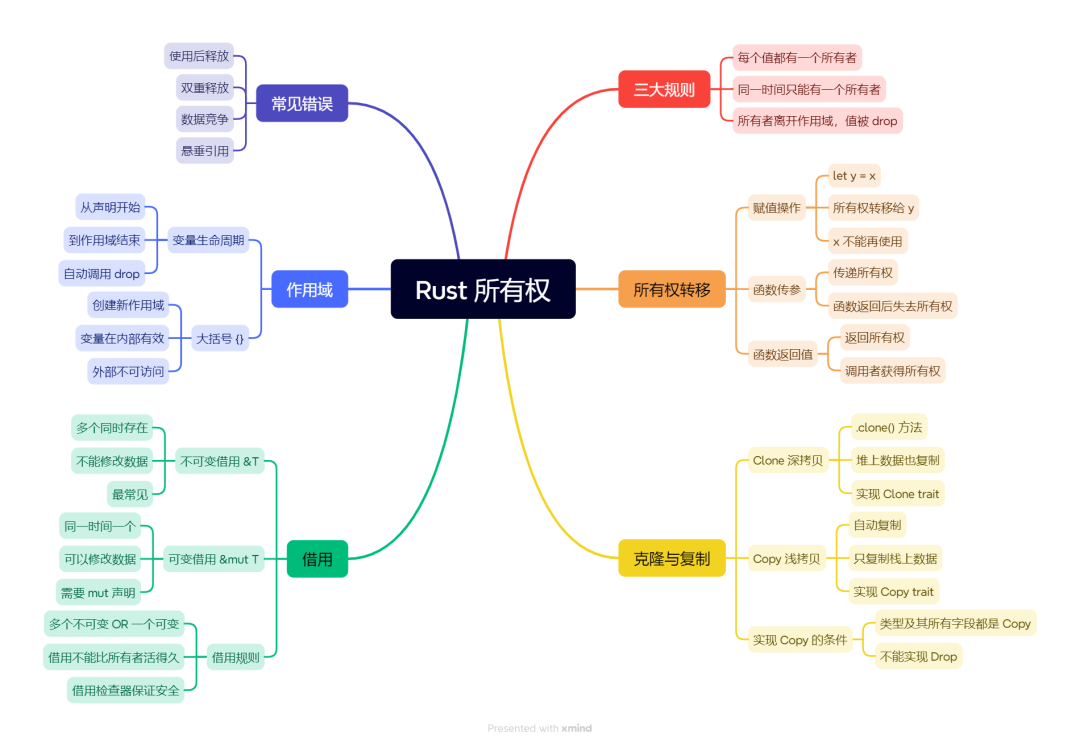
01-Rust 所有权
📝 小结
核心要点:
- 每个值都有一个所有者——这是 Rust 的"规矩"
- 赋值会转移所有权——除非类型实现了 Copy
- 需要副本用 clone()——深拷贝,但性能有开销
- 借用可以共享数据——
&T不转移所有权 - 编译器管得宽是为你好——编译期保证内存安全
金句:
Rust 的所有权系统就像个操心的老妈:"这个变量你拿好了吗?别人用了你还想用?不行!用完记得扔啊,别堆着!"
🔗 下篇预告
下一篇咱们讲讲变量与基本类型:
- 为什么 Rust 的变量默认不能改?
let、const、static有啥区别?- Rust 有哪些基本类型?
- 类型推断是怎么工作的?
敬请期待!
📚 参考资料
- The Rust Book - Chapter 4: Ownership
- Rust By Example
- Rust 官方文档
💬 互动问题:
你学 Rust 时被所有权折磨过吗?在评论区分享你的踩坑经历吧!😄
本文参与 腾讯云自媒体同步曝光计划,分享自微信公众号。
原始发表:2026-03-20,如有侵权请联系 cloudcommunity@tencent.com 删除
评论
登录后参与评论
推荐阅读
目录
腾讯云开发者

Copyright © 2013 - 2026 Tencent Cloud. All Rights Reserved. 腾讯云 版权所有
深圳市腾讯计算机系统有限公司 ICP备案/许可证号:粤B2-20090059  粤公网安备44030502008569号
腾讯云计算(北京)有限责任公司 京ICP证150476号 | 京ICP备11018762号