从回调地狱到异步王者:CompletableFuture 如何重构你的 Java 异步代码

从回调地狱到异步王者:CompletableFuture 如何重构你的 Java 异步代码

果酱带你啃java
发布于 2026-04-14 13:23:08
发布于 2026-04-14 13:23:08
引言:被低估的异步编程利器
在 Java 开发领域,CompletableFuture 就像一位深藏不露的高手。自 Java 8 引入以来,它彻底改变了异步编程的游戏规则,却仍有许多开发者停留在 Future 的时代,或在回调地狱中挣扎。
想象这样一个场景:用户下单后,你需要调用库存服务扣减库存、调用支付服务处理付款、调用物流服务创建物流单,最后发送通知给用户。如果用传统的同步方式,总耗时是四个服务耗时的总和;如果用 CompletableFuture 实现并行处理,总耗时将接近耗时最长的那个服务。这就是异步编程的魔力,也是 CompletableFuture 的价值所在。
本文将带你全面掌握 CompletableFuture,从基础 API 到高级实战,从底层原理到性能优化,让你真正理解并能灵活运用这一强大工具,写出高效、优雅的异步代码。
一、CompletableFuture 基础:超越 Future 的异步体验
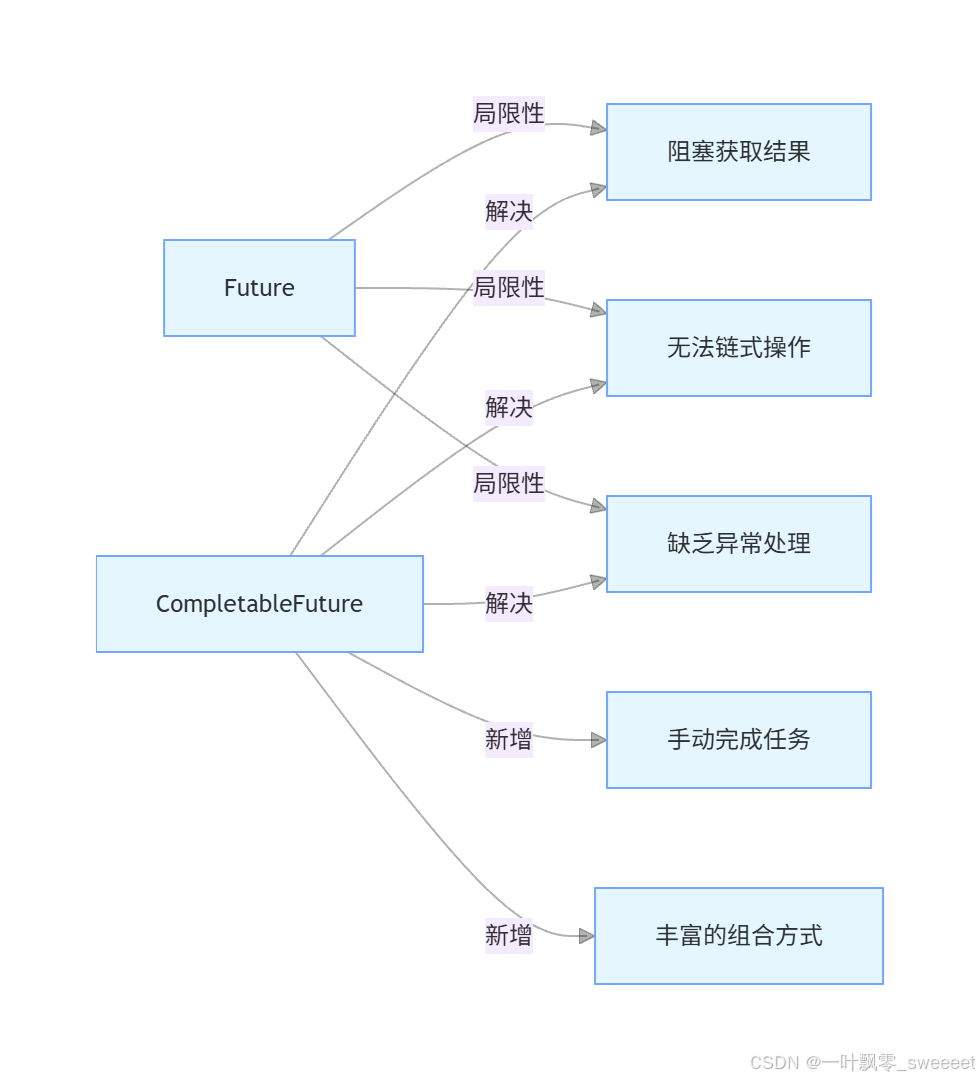
1.1 为什么 Future 不够用了?
Java 5 引入的 Future 接口为异步编程打开了一扇门,但它的能力非常有限:
- 无法手动完成任务
- 不能链式处理多个异步操作
- 缺乏异常处理机制
- 获取结果只能通过阻塞或轮询
import lombok.extern.slf4j.Slf4j;
import java.util.concurrent.ExecutionException;
import java.util.concurrent.ExecutorService;
import java.util.concurrent.Executors;
import java.util.concurrent.Future;

@Slf4j
public class FutureLimitExample {
    public static void main(String[] args) throws ExecutionException, InterruptedException {
        ExecutorService executor = Executors.newFixedThreadPool(2);

        // 提交任务
        Future<String> future = executor.submit(() -> {
            log.info("执行耗时任务");
            Thread.sleep(2000);
            return "任务结果";
        });

        // 必须阻塞等待结果,无法优雅处理
        log.info("等待结果...");
        String result = future.get(); // 阻塞在这里
        log.info("获取结果: {}", result);

        executor.shutdown();
    }
}
这种方式在处理复杂异步场景时显得力不从心,于是 CompletableFuture 应运而生。
1.2 CompletableFuture 的诞生与核心优势
CompletableFuture 实现了 Future 和 CompletionStage 两个接口,前者保证了与原有 Future 体系的兼容性,后者则提供了丰富的异步处理能力。其核心优势包括:
- 支持链式调用,轻松组合多个异步操作
- 提供丰富的异常处理机制
- 可以手动完成任务
- 支持非阻塞地处理异步结果
- 提供多种并行执行和组合的方式
1.3 创建 CompletableFuture 的四种方式
CompletableFuture 提供了多种创建方式,适用于不同场景:
import lombok.extern.slf4j.Slf4j;
import java.util.concurrent.CompletableFuture;
import java.util.concurrent.ExecutorService;
import java.util.concurrent.Executors;

@Slf4j
public class CompletableFutureCreation {
    // 自定义线程池,推荐使用而非默认线程池
    private static final ExecutorService CUSTOM_EXECUTOR = Executors.newFixedThreadPool(3);

    public static void main(String[] args) throws Exception {
        // 1. 无返回值,使用默认线程池
        CompletableFuture.runAsync(() -> {
            log.info("执行无返回值的异步任务");
        });

        // 2. 无返回值,使用自定义线程池
        CompletableFuture.runAsync(() -> {
            log.info("使用自定义线程池执行无返回值任务");
        }, CUSTOM_EXECUTOR);

        // 3. 有返回值,使用默认线程池
        CompletableFuture<String> supplyDefault = CompletableFuture.supplyAsync(() -> {
            log.info("执行有返回值的异步任务");
            return "任务结果";
        });

        // 4. 有返回值,使用自定义线程池
        CompletableFuture<String> supplyCustom = CompletableFuture.supplyAsync(() -> {
            log.info("使用自定义线程池执行有返回值任务");
            return "自定义线程池任务结果";
        }, CUSTOM_EXECUTOR);

        // 等待所有任务完成
        CompletableFuture.allOf(supplyDefault, supplyCustom).join();
        log.info("supplyDefault结果: {}", supplyDefault.get());
        log.info("supplyCustom结果: {}", supplyCustom.get());

        CUSTOM_EXECUTOR.shutdown();
    }
}
注意:生产环境中应始终使用自定义线程池,避免使用默认的 ForkJoinPool.commonPool (),后者是 JVM 共享的,可能受到其他组件影响。
二、核心方法详解:链式调用与结果处理
CompletableFuture 的强大之处在于其丰富的实例方法,这些方法可以分为几大类:结果处理、任务组合、异常处理等。掌握这些方法是灵活运用 CompletableFuture 的关键。
2.1 结果处理的三种方式
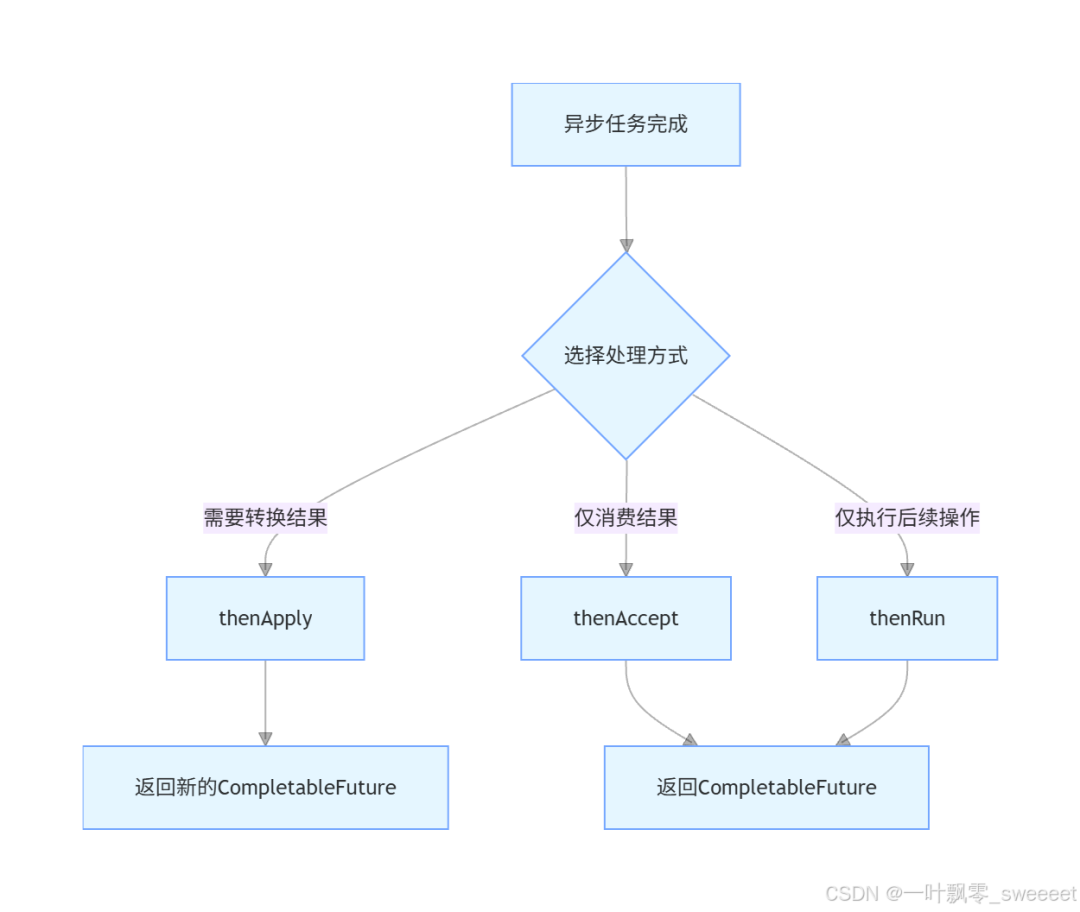
当异步任务完成后,我们通常需要对结果进行处理,CompletableFuture 提供了三种常用方式:
- thenApply:接收上一个任务的结果,返回新的结果
- thenAccept:接收上一个任务的结果,不返回新结果(消费结果)
- thenRun:不关心上一个任务的结果,仅在任务完成后执行
import lombok.extern.slf4j.Slf4j;
import java.util.concurrent.CompletableFuture;

@Slf4j
public class ResultHandlingMethods {
    public static void main(String[] args) {
        // thenApply:转换结果
        CompletableFuture<Integer> thenApplyFuture = CompletableFuture.supplyAsync(() -> {
            log.info("计算原始值");
            return 10;
        }).thenApply(original -> {
            log.info("将原始值 {} 乘以 2", original);
            return original * 2;
        });

        // thenAccept:消费结果
        CompletableFuture<Void> thenAcceptFuture = thenApplyFuture.thenAccept(result -> {
            log.info("thenApply的结果是: {}", result);
        });

        // thenRun:执行后续操作
        CompletableFuture<Void> thenRunFuture = thenAcceptFuture.thenRun(() -> {
            log.info("所有操作完成,执行最终处理");
        });

        // 等待所有操作完成
        thenRunFuture.join();
    }
}
2.2 异步处理的关键:*Async 方法
上面介绍的方法默认在当前线程(可能是任务执行线程)中执行后续操作。如果希望后续操作也在异步线程中执行,需要使用它们的异步版本:
- thenApplyAsync
- thenAcceptAsync
- thenRunAsync
这些异步方法有两个重载版本:一个使用默认线程池,一个可以指定线程池。
import lombok.extern.slf4j.Slf4j;
import java.util.concurrent.CompletableFuture;
import java.util.concurrent.ExecutorService;
import java.util.concurrent.Executors;

@Slf4j
public class AsyncProcessingMethods {
    private static final ExecutorService PROCESS_EXECUTOR = Executors.newSingleThreadExecutor(r ->
        new Thread(r, "process-thread")
    );

    public static void main(String[] args) {
        CompletableFuture<String> future = CompletableFuture.supplyAsync(() -> {
            log.info("执行任务的线程: {}", Thread.currentThread().getName());
            return "原始结果";
        }).thenApplyAsync(result -> {
            log.info("处理结果的线程: {}", Thread.currentThread().getName());
            return result + " - 已处理";
        }, PROCESS_EXECUTOR); // 使用指定线程池处理

        log.info("最终结果: {}", future.join());
        PROCESS_EXECUTOR.shutdown();
    }
}
运行此代码会发现,任务执行和结果处理在不同的线程中进行,这对于避免阻塞任务线程非常重要。
2.3 任务组合:thenCompose 与 thenCombine
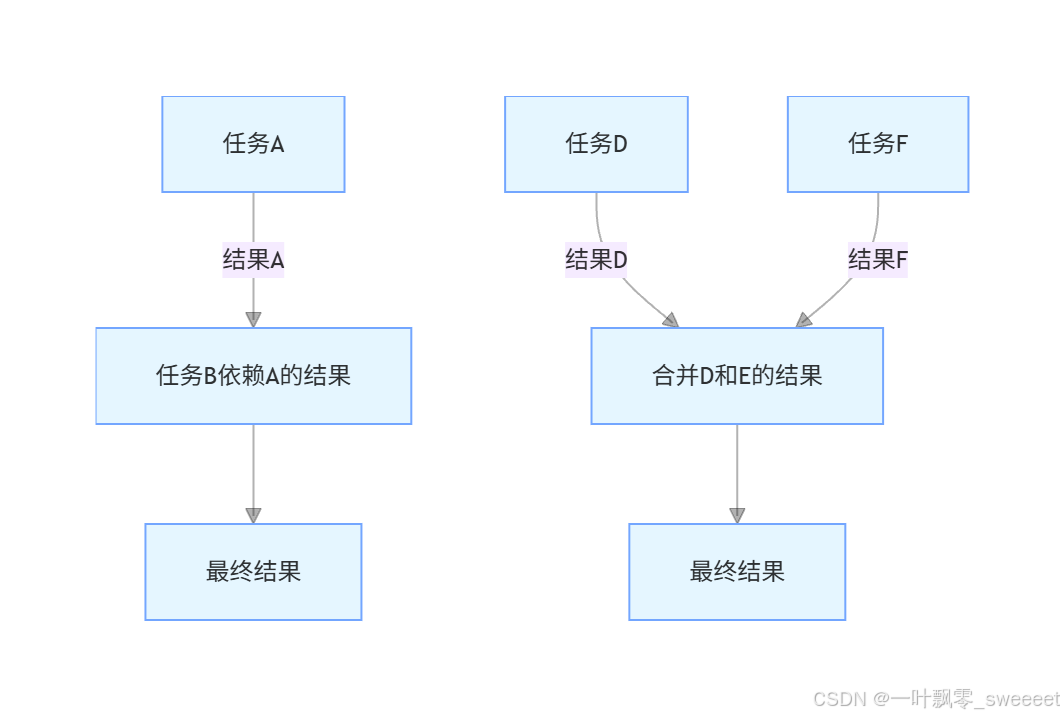
在实际开发中,我们经常需要组合多个异步任务。CompletableFuture 提供了两种主要方式:
- thenCompose:用于组合两个依赖的任务,第二个任务依赖第一个任务的结果
- thenCombine:用于组合两个独立的任务,等两个任务都完成后处理它们的结果
示例代码:
import lombok.extern.slf4j.Slf4j;
import java.util.concurrent.CompletableFuture;

@Slf4j
public class TaskCombination {
    public static void main(String[] args) {
        // thenCompose:组合依赖任务
        CompletableFuture<String> composeFuture = getUserById(1001)
            .thenCompose(userId -> getOrderByUserId(userId));

        // thenCombine:组合独立任务
        CompletableFuture<String> combineFuture = getUserName(1001)
            .thenCombine(getUserAge(1001), (name, age) ->
                String.format("用户信息: 姓名=%s, 年龄=%d", name, age)
            );

        log.info("thenCompose结果: {}", composeFuture.join());
        log.info("thenCombine结果: {}", combineFuture.join());
    }

    /**
     * 根据ID获取用户ID(模拟)
     * @param id 外部ID
     * @return 用户ID
     */
    private static CompletableFuture<Integer> getUserById(int id) {
        return CompletableFuture.supplyAsync(() -> {
            log.info("根据外部ID {} 获取用户ID", id);
            return 10001; // 模拟用户ID
        });
    }

    /**
     * 根据用户ID获取订单
     * @param userId 用户ID
     * @return 订单信息
     */
    private static CompletableFuture<String> getOrderByUserId(int userId) {
        return CompletableFuture.supplyAsync(() -> {
            log.info("根据用户ID {} 获取订单", userId);
            return "订单信息: 用户=" + userId + ", 订单号=2023001";
        });
    }

    /**
     * 获取用户姓名
     * @param userId 用户ID
     * @return 用户名
     */
    private static CompletableFuture<String> getUserName(int userId) {
        return CompletableFuture.supplyAsync(() -> {
            log.info("获取用户 {} 的姓名", userId);
            return "张三";
        });
    }

    /**
     * 获取用户年龄
     * @param userId 用户ID
     * @return 年龄
     */
    private static CompletableFuture<Integer> getUserAge(int userId) {
        return CompletableFuture.supplyAsync(() -> {
            log.info("获取用户 {} 的年龄", userId);
            return 30;
        });
    }
}
注意:thenCompose 和 thenApply 的区别在于,thenCompose 接收的函数返回值是 CompletableFuture,避免了嵌套的 CompletableFuture(CompletableFuture<CompletableFuture<T>>)。
2.4 多任务处理:allOf 与 anyOf
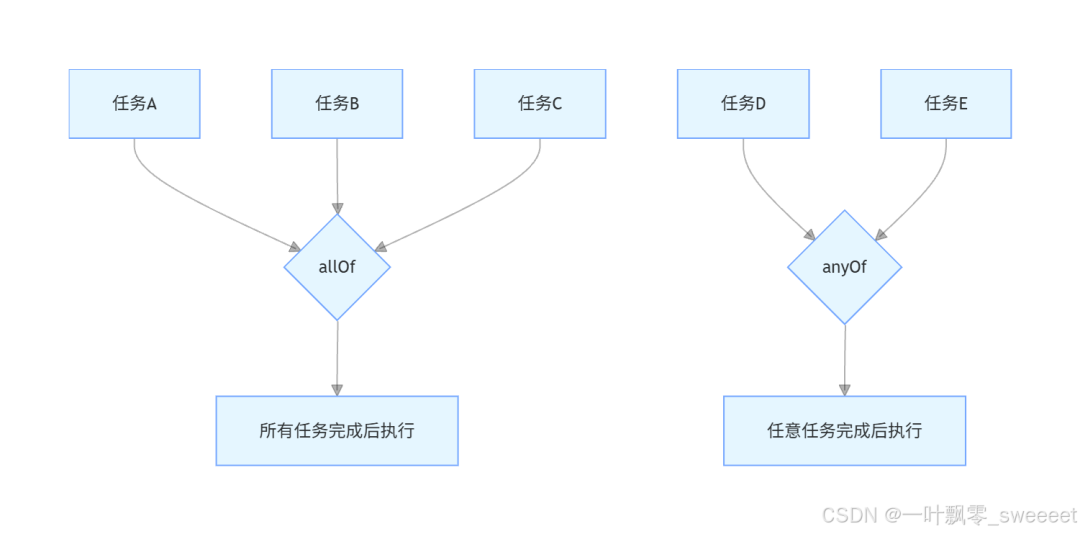
当需要处理多个异步任务时,CompletableFuture 提供了两个非常实用的静态方法:
- allOf:等待所有任务完成
- anyOf:等待任意一个任务完成
import lombok.extern.slf4j.Slf4j;
import java.util.concurrent.CompletableFuture;
import java.util.concurrent.TimeUnit;

@Slf4j
public class MultipleTasksHandling {
    public static void main(String[] args) {
        // 创建三个不同耗时的任务
        CompletableFuture<String> task1 = CompletableFuture.supplyAsync(() -> {
            try {
                TimeUnit.MILLISECONDS.sleep(1000);
            } catch (InterruptedException e) {
                log.error("任务1被中断", e);
            }
            log.info("任务1完成");
            return "结果1";
        });

        CompletableFuture<String> task2 = CompletableFuture.supplyAsync(() -> {
            try {
                TimeUnit.MILLISECONDS.sleep(1500);
            } catch (InterruptedException e) {
                log.error("任务2被中断", e);
            }
            log.info("任务2完成");
            return "结果2";
        });

        CompletableFuture<String> task3 = CompletableFuture.supplyAsync(() -> {
            try {
                TimeUnit.MILLISECONDS.sleep(800);
            } catch (InterruptedException e) {
                log.error("任务3被中断", e);
            }
            log.info("任务3完成");
            return "结果3";
        });

        // 等待所有任务完成
        CompletableFuture<Void> allOfFuture = CompletableFuture.allOf(task1, task2, task3);
        allOfFuture.thenRun(() -> {
            log.info("所有任务都已完成");
            try {
                log.info("任务1结果: {}", task1.get());
                log.info("任务2结果: {}", task2.get());
                log.info("任务3结果: {}", task3.get());
            } catch (Exception e) {
                log.error("获取任务结果异常", e);
            }
        }).join();

        // 等待任意一个任务完成
        CompletableFuture<Object> anyOfFuture = CompletableFuture.anyOf(task1, task2, task3);
        anyOfFuture.thenAccept(result -> {
            log.info("有一个任务已完成,结果: {}", result);
        }).join();
    }
}
注意:allOf 返回 CompletableFuture<Void>,无法直接获取各个任务的结果,需要单独获取;anyOf 返回 CompletableFuture<Object>,结果是第一个完成的任务的结果。
2.5 异常处理:三大处理机制
异步任务中的异常处理至关重要,CompletableFuture 提供了三种主要的异常处理方式:
- exceptionally:仅处理异常情况,返回默认值
- handle:同时处理正常结果和异常,返回新的结果
- whenComplete:同时处理正常结果和异常,不改变结果
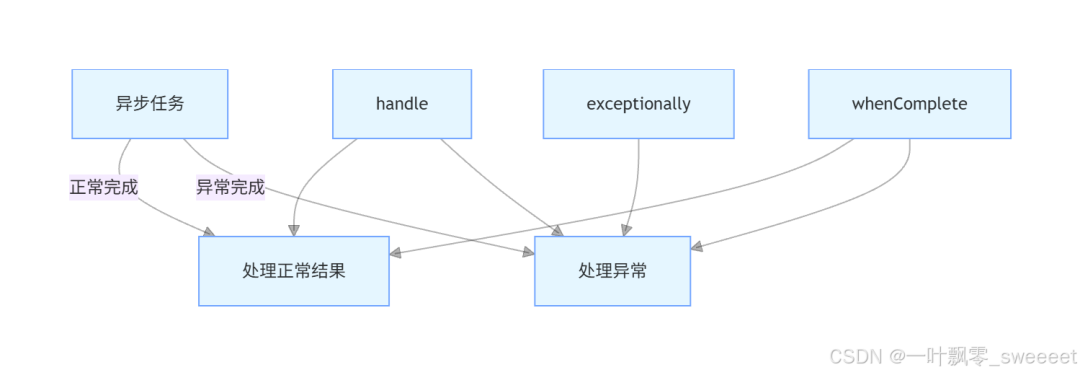
示例代码:
import lombok.extern.slf4j.Slf4j;
import java.util.concurrent.CompletableFuture;

@Slf4j
public class ExceptionHandling {
    public static void main(String[] args) {
        // exceptionally:仅处理异常
        CompletableFuture<String> exceptionallyFuture = CompletableFuture.supplyAsync(() -> {
            log.info("执行可能抛出异常的任务");
            if (true) {
                throw new RuntimeException("任务执行失败");
            }
            return "正常结果";
        }).exceptionally(ex -> {
            log.error("捕获到异常", ex);
            return "异常时的默认结果";
        });

        // handle:处理正常结果和异常
        CompletableFuture<String> handleFuture = CompletableFuture.supplyAsync(() -> {
            log.info("执行任务");
            // 模拟随机成功或失败
            if (Math.random() > 0.5) {
                throw new RuntimeException("随机失败");
            }
            return "正常结果";
        }).handle((result, ex) -> {
            if (ex != null) {
                log.error("handle捕获到异常", ex);
                return "handle处理异常后的结果";
            }
            return result + " - 已通过handle处理";
        });

        // whenComplete:处理完成事件,不改变结果
        CompletableFuture<String> whenCompleteFuture = CompletableFuture.supplyAsync(() -> {
            log.info("执行任务");
            return "正常结果";
        }).whenComplete((result, ex) -> {
            if (ex != null) {
                log.error("whenComplete捕获到异常", ex);
            } else {
                log.info("whenComplete处理正常结果: {}", result);
            }
        });

        log.info("exceptionally结果: {}", exceptionallyFuture.join());
        log.info("handle结果: {}", handleFuture.join());
        log.info("whenComplete结果: {}", whenCompleteFuture.join());
    }
}
这三种方式的选择取决于具体需求:需要恢复异常并返回默认值用 exceptionally;需要统一处理正常和异常情况并转换结果用 handle;仅需要在完成时记录日志或清理资源用 whenComplete。
三、底层原理:CompletableFuture 的工作机制
要真正掌握 CompletableFuture,理解其底层原理是必要的。本节将深入探讨 CompletableFuture 的实现机制。
3.1 状态管理机制
CompletableFuture 内部通过一个 volatile 变量维护任务状态,主要状态包括:
- NEW:初始状态
- COMPLETING:正在完成(中间状态)
- NORMAL:正常完成
- EXCEPTIONAL:异常完成
- CANCELLED:已取消
- INTERRUPTED:已中断
状态转换关系如下:
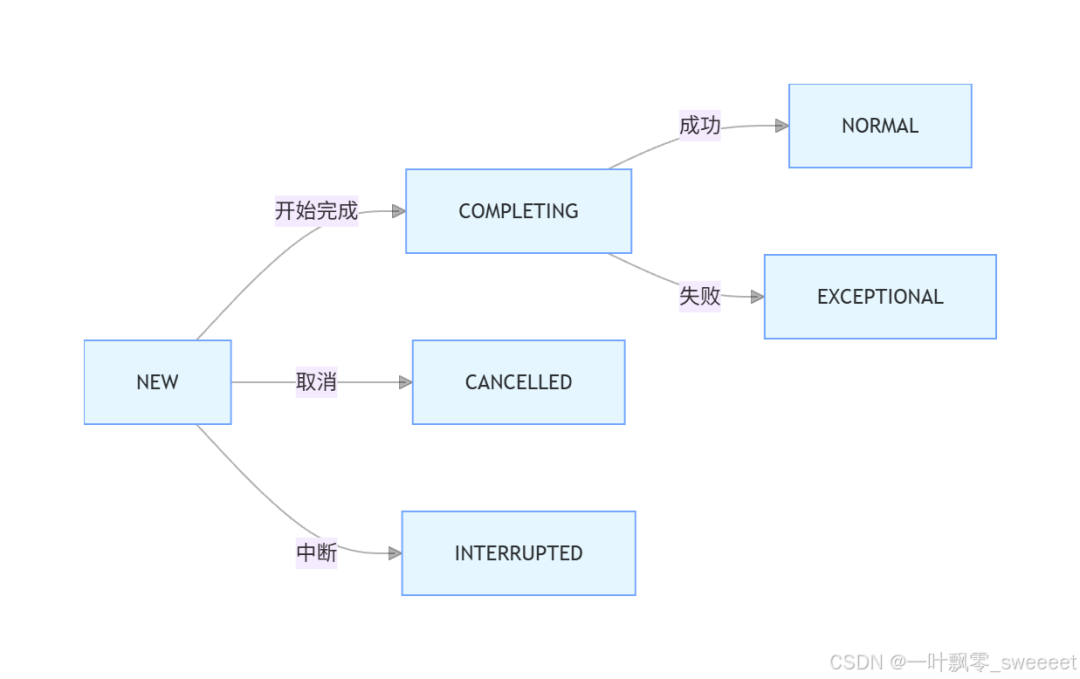
这些状态通过 Unsafe 类进行 CAS 操作来保证原子性,确保多线程环境下的状态一致性。
3.2 依赖链与回调触发
CompletableFuture 的链式调用是通过维护依赖链实现的。每个 CompletableFuture 可以有多个依赖的 CompletableFuture(称为 "依赖者"),当一个 CompletableFuture 完成时,会通知所有依赖者执行。
这种依赖关系通过一个栈结构存储,当调用 thenApply 等方法时,会创建新的 CompletableFuture 并将其添加到当前任务的依赖栈中。
当任务完成时,CompletableFuture 会遍历依赖栈,依次触发每个依赖任务的执行,形成链式反应。这种设计确保了异步操作的高效串联。
3.3 线程池的选择策略
CompletableFuture 在执行异步操作时,线程池选择遵循以下规则:
- 如果方法指定了 Executor,则使用指定的线程池
- 如果没有指定 Executor,则使用 ForkJoinPool.commonPool ()
- 非异步方法(如 thenApply)默认在完成当前任务的线程中执行
ForkJoinPool.commonPool () 是 JVM 级别的共享线程池,其默认并行度为 CPU 核心数减 1。可以通过系统属性调整:
-Djava.util.concurrent.ForkJoinPool.common.parallelism=4
但在生产环境中,强烈建议使用自定义线程池,以便更好地控制资源使用和任务隔离。
四、实战应用:从理论到实践
理论知识需要结合实际应用才能真正内化。本节将通过几个典型场景,展示 CompletableFuture 的实战价值。
4.1 并行查询多个服务并汇总结果
在微服务架构中,我们经常需要调用多个独立服务,然后汇总结果。使用 CompletableFuture 可以并行执行这些调用,大幅提升效率。
import com.alibaba.fastjson2.JSON;
import com.google.common.collect.Maps;
import lombok.AllArgsConstructor;
import lombok.Data;
import lombok.NoArgsConstructor;
import lombok.extern.slf4j.Slf4j;
import org.springframework.util.CollectionUtils;
import java.util.Map;
import java.util.concurrent.CompletableFuture;
import java.util.concurrent.ExecutorService;
import java.util.concurrent.Executors;
import java.util.concurrent.TimeUnit;

@Slf4j
public class ParallelServiceCall {
    // 自定义线程池
    private static final ExecutorService SERVICE_EXECUTOR = Executors.newFixedThreadPool(5);

    public static void main(String[] args) {
        long startTime = System.currentTimeMillis();

        // 并行调用三个独立服务
        CompletableFuture<UserInfo> userInfoFuture = CompletableFuture.supplyAsync(() ->
            getUserInfo(1001), SERVICE_EXECUTOR
        );

        CompletableFuture<OrderList> orderListFuture = CompletableFuture.supplyAsync(() ->
            getOrderList(1001), SERVICE_EXECUTOR
        );

        CompletableFuture<AddressList> addressListFuture = CompletableFuture.supplyAsync(() ->
            getAddressList(1001), SERVICE_EXECUTOR
        );

        // 汇总结果
        CompletableFuture<Map<String, Object>> resultFuture = CompletableFuture.allOf(
                userInfoFuture, orderListFuture, addressListFuture
            ).thenApply(v -> {
                Map<String, Object> resultMap = Maps.newHashMap();
                try {
                    resultMap.put("userInfo", userInfoFuture.get());
                    resultMap.put("orders", orderListFuture.get());
                    resultMap.put("addresses", addressListFuture.get());
                } catch (Exception e) {
                    log.error("汇总结果异常", e);
                }
                return resultMap;
            });

        // 获取最终结果
        Map<String, Object> result = resultFuture.join();
        log.info("汇总结果: {}", JSON.toJSONString(result));

        long endTime = System.currentTimeMillis();
        log.info("总耗时: {}ms", endTime - startTime);

        SERVICE_EXECUTOR.shutdown();
    }

    /**
     * 获取用户信息
     */
    private static UserInfo getUserInfo(int userId) {
        log.info("查询用户信息,userId: {}", userId);
        try {
            // 模拟服务调用耗时
            TimeUnit.MILLISECONDS.sleep(1000);
        } catch (InterruptedException e) {
            log.error("查询用户信息中断", e);
        }
        return new UserInfo(userId, "张三", 30);
    }

    /**
     * 获取订单列表
     */
    private static OrderList getOrderList(int userId) {
        log.info("查询订单列表,userId: {}", userId);
        try {
            // 模拟服务调用耗时
            TimeUnit.MILLISECONDS.sleep(1500);
        } catch (InterruptedException e) {
            log.error("查询订单列表中断", e);
        }
        OrderList orderList = new OrderList();
        orderList.setUserId(userId);
        orderList.setOrders(CollectionUtils.newArrayList(
            new Order(10001, "商品A"),
            new Order(10002, "商品B")
        ));
        return orderList;
    }

    /**
     * 获取地址列表
     */
    private static AddressList getAddressList(int userId) {
        log.info("查询地址列表,userId: {}", userId);
        try {
            // 模拟服务调用耗时
            TimeUnit.MILLISECONDS.sleep(800);
        } catch (InterruptedException e) {
            log.error("查询地址列表中断", e);
        }
        AddressList addressList = new AddressList();
        addressList.setUserId(userId);
        addressList.setAddresses(CollectionUtils.newArrayList(
            new Address(20001, "北京市"),
            new Address(20002, "上海市")
        ));
        return addressList;
    }

    @Data
    @NoArgsConstructor
    @AllArgsConstructor
    static class UserInfo {
        private int userId;
        private String username;
        private int age;
    }

    @Data
    @NoArgsConstructor
    @AllArgsConstructor
    static class Order {
        private int orderId;
        private String productName;
    }

    @Data
    @NoArgsConstructor
    static class OrderList {
        private int userId;
        private java.util.List<Order> orders;
    }

    @Data
    @NoArgsConstructor
    @AllArgsConstructor
    static class Address {
        private int addressId;
        private String address;
    }

    @Data
    @NoArgsConstructor
    static class AddressList {
        private int userId;
        private java.util.List<Address> addresses;
    }
}
这个示例中,三个服务调用并行执行,总耗时约 1500ms(等于耗时最长的服务),而不是三个服务耗时之和(约 3300ms),效率提升非常明显。
4.2 服务调用超时控制与降级处理
在分布式系统中,服务调用超时是常见问题。CompletableFuture 提供了优雅的超时控制方案:
import lombok.extern.slf4j.Slf4j;
import java.util.concurrent.CompletableFuture;
import java.util.concurrent.TimeUnit;

@Slf4j
public class TimeoutHandling {
    // 自定义线程池
    private static final java.util.concurrent.ExecutorService EXECUTOR =
        java.util.concurrent.Executors.newFixedThreadPool(3);

    public static void main(String[] args) {
        // 方式1: 使用get(timeout, unit)
        CompletableFuture<String> future1 = CompletableFuture.supplyAsync(() -> {
            return callExternalService("服务A", 3000);
        }, EXECUTOR);

        try {
            String result1 = future1.get(2, TimeUnit.SECONDS);
            log.info("服务A结果: {}", result1);
        } catch (Exception e) {
            log.error("服务A调用超时或异常", e);
            // 执行降级策略
            log.info("服务A降级处理: 返回缓存数据");
        }

        // 方式2: 使用orTimeout (Java 9+)
        CompletableFuture<String> future2 = CompletableFuture.supplyAsync(() -> {
            return callExternalService("服务B", 3000);
        }, EXECUTOR)
        .orTimeout(2, TimeUnit.SECONDS)
        .exceptionally(ex -> {
            log.error("服务B调用异常", ex);
            return "服务B降级数据";
        });

        log.info("服务B结果: {}", future2.join());

        // 方式3: 使用completeOnTimeout (Java 9+)
        CompletableFuture<String> future3 = CompletableFuture.supplyAsync(() -> {
            return callExternalService("服务C", 3000);
        }, EXECUTOR)
        .completeOnTimeout("服务C默认数据", 2, TimeUnit.SECONDS);

        log.info("服务C结果: {}", future3.join());

        EXECUTOR.shutdown();
    }

    /**
     * 调用外部服务
     * @param serviceName 服务名称
     * @param delay 延迟时间(ms)
     * @return 服务返回结果
     */
    private static String callExternalService(String serviceName, int delay) {
        log.info("调用外部服务: {}", serviceName);
        try {
            TimeUnit.MILLISECONDS.sleep(delay);
        } catch (InterruptedException e) {
            log.error("服务 {} 调用被中断", serviceName, e);
            Thread.currentThread().interrupt();
        }
        return serviceName + "返回结果";
    }
}
注意:orTimeout 和 completeOnTimeout 是 Java 9 引入的方法,如果使用 Java 8,可通过 thenApplyAsync 结合定时任务实现类似功能。
4.3 Spring Boot 中的异步接口实现
在 Spring Boot 应用中,CompletableFuture 可以与 @Async 注解结合,实现高效的异步接口:
1. 首先添加必要依赖 (pom.xml)
<?xml version="1.0" encoding="UTF-8"?>
<project xmlns="http://maven.apache.org/POM/4.0.0" xmlns:xsi="http://www.w3.org/2001/XMLSchema-instance"
         xsi:schemaLocation="http://maven.apache.org/POM/4.0.0 https://maven.apache.org/xsd/maven-4.0.0.xsd">
    <modelVersion>4.0.0</modelVersion>
    <parent>
        <groupId>org.springframework.boot</groupId>
        <artifactId>spring-boot-starter-parent</artifactId>
        <version>3.2.1</version>
        <relativePath/>
    </parent>
    <groupId>com.example</groupId>
    <artifactId>completablefuture-demo</artifactId>
    <version>0.0.1-SNAPSHOT</version>
    <name>completablefuture-demo</name>

    <properties>
        <java.version>17</java.version>
    </properties>

    <dependencies>
        <dependency>
            <groupId>org.springframework.boot</groupId>
            <artifactId>spring-boot-starter-web</artifactId>
        </dependency>

        <dependency>
            <groupId>org.projectlombok</groupId>
            <artifactId>lombok</artifactId>
            <version>1.18.30</version>
            <optional>true</optional>
        </dependency>

        <dependency>
            <groupId>com.alibaba.fastjson2</groupId>
            <artifactId>fastjson2</artifactId>
            <version>2.0.32</version>
        </dependency>

        <dependency>
            <groupId>com.google.guava</groupId>
            <artifactId>guava</artifactId>
            <version>32.1.3-jre</version>
        </dependency>

        <dependency>
            <groupId>org.springdoc</groupId>
            <artifactId>springdoc-openapi-starter-webmvc-ui</artifactId>
            <version>2.1.0</version>
        </dependency>

        <dependency>
            <groupId>org.springframework.boot</groupId>
            <artifactId>spring-boot-starter-test</artifactId>
            <scope>test</scope>
        </dependency>
    </dependencies>

    <build>
        <plugins>
            <plugin>
                <groupId>org.springframework.boot</groupId>
                <artifactId>spring-boot-maven-plugin</artifactId>
                <configuration>
                    <excludes>
                        <exclude>
                            <groupId>org.projectlombok</groupId>
                            <artifactId>lombok</artifactId>
                        </exclude>
                    </excludes>
                </configuration>
            </plugin>
        </plugins>
    </build>
</project>
2. 配置异步线程池
import org.springframework.context.annotation.Bean;
import org.springframework.context.annotation.Configuration;
import org.springframework.scheduling.annotation.EnableAsync;
import org.springframework.scheduling.concurrent.ThreadPoolTaskExecutor;
import java.util.concurrent.Executor;
import java.util.concurrent.ThreadPoolExecutor;

@Configuration
@EnableAsync
public class AsyncConfig {

    /**
     * 自定义异步线程池
     */
    @Bean(name = "apiExecutor")
    public Executor apiExecutor() {
        ThreadPoolTaskExecutor executor = new ThreadPoolTaskExecutor();
        // 核心线程数
        executor.setCorePoolSize(10);
        // 最大线程数
        executor.setMaxPoolSize(20);
        // 队列容量
        executor.setQueueCapacity(100);
        // 线程名称前缀
        executor.setThreadNamePrefix("api-async-");
        // 线程空闲时间
        executor.setKeepAliveSeconds(60);
        // 拒绝策略:当线程和队列都满时,由提交任务的线程执行
        executor.setRejectedExecutionHandler(new ThreadPoolExecutor.CallerRunsPolicy());
        // 初始化
        executor.initialize();
        return executor;
    }
}
3. 实现异步服务
import io.swagger.v3.oas.annotations.media.Schema;
import lombok.AllArgsConstructor;
import lombok.Data;
import lombok.NoArgsConstructor;
import lombok.extern.slf4j.Slf4j;
import org.springframework.scheduling.annotation.Async;
import org.springframework.stereotype.Service;
import java.util.concurrent.CompletableFuture;
import java.util.concurrent.TimeUnit;

@Service
@Slf4j
public class ProductService {

    /**
     * 获取产品基本信息
     * @param productId 产品ID
     * @return 产品基本信息
     */
    @Async("apiExecutor")
    public CompletableFuture<ProductInfo> getProductInfo(Long productId) {
        log.info("查询产品基本信息, productId: {}", productId);
        try {
            // 模拟数据库查询耗时
            TimeUnit.MILLISECONDS.sleep(500);
        } catch (InterruptedException e) {
            log.error("查询产品信息中断", e);
            Thread.currentThread().interrupt();
            return CompletableFuture.failedFuture(e);
        }

        // 模拟返回产品信息
        ProductInfo info = new ProductInfo();
        info.setProductId(productId);
        info.setName("高性能笔记本电脑");
        info.setPrice(5999.99);
        info.setStock(100);

        return CompletableFuture.completedFuture(info);
    }

    /**
     * 获取产品评价
     * @param productId 产品ID
     * @return 产品评价列表
     */
    @Async("apiExecutor")
    public CompletableFuture<ReviewList> getProductReviews(Long productId) {
        log.info("查询产品评价, productId: {}", productId);
        try {
            // 模拟数据库查询耗时
            TimeUnit.MILLISECONDS.sleep(800);
        } catch (InterruptedException e) {
            log.error("查询产品评价中断", e);
            Thread.currentThread().interrupt();
            return CompletableFuture.failedFuture(e);
        }

        // 模拟返回评价列表
        ReviewList reviewList = new ReviewList();
        reviewList.setProductId(productId);
        reviewList.setReviews(org.springframework.util.CollectionUtils.newArrayList(
            new Review(1L, "非常好用", 5),
            new Review(2L, "性能出色", 5),
            new Review(3L, "性价比高", 4)
        ));

        return CompletableFuture.completedFuture(reviewList);
    }

    /**
     * 获取产品推荐
     * @param productId 产品ID
     * @return 推荐产品列表
     */
    @Async("apiExecutor")
    public CompletableFuture<RecommendationList> getRecommendations(Long productId) {
        log.info("查询推荐产品, productId: {}", productId);
        try {
            // 模拟数据库查询耗时
            TimeUnit.MILLISECONDS.sleep(600);
        } catch (InterruptedException e) {
            log.error("查询推荐产品中断", e);
            Thread.currentThread().interrupt();
            return CompletableFuture.failedFuture(e);
        }

        // 模拟返回推荐列表
        RecommendationList recommendationList = new RecommendationList();
        recommendationList.setProductId(productId);
        recommendationList.setRecommendations(org.springframework.util.CollectionUtils.newArrayList(
            new Recommendation(1002L, "轻薄笔记本电脑", 4999.99),
            new Recommendation(1003L, "游戏笔记本电脑", 7999.99)
        ));

        return CompletableFuture.completedFuture(recommendationList);
    }

    @Data
    @NoArgsConstructor
    @Schema(description = "产品基本信息")
    public static class ProductInfo {
        @Schema(description = "产品ID")
        private Long productId;
        @Schema(description = "产品名称")
        private String name;
        @Schema(description = "产品价格")
        private Double price;
        @Schema(description = "库存数量")
        private Integer stock;
    }

    @Data
    @NoArgsConstructor
    @AllArgsConstructor
    @Schema(description = "产品评价")
    public static class Review {
        @Schema(description = "评价ID")
        private Long reviewId;
        @Schema(description = "评价内容")
        private String content;
        @Schema(description = "评分(1-5)")
        private Integer rating;
    }

    @Data
    @NoArgsConstructor
    @Schema(description = "产品评价列表")
    public static class ReviewList {
        @Schema(description = "产品ID")
        private Long productId;
        @Schema(description = "评价列表")
        private java.util.List<Review> reviews;
    }

    @Data
    @NoArgsConstructor
    @AllArgsConstructor
    @Schema(description = "推荐产品")
    public static class Recommendation {
        @Schema(description = "产品ID")
        private Long productId;
        @Schema(description = "产品名称")
        private String name;
        @Schema(description = "产品价格")
        private Double price;
    }

    @Data
    @NoArgsConstructor
    @Schema(description = "推荐产品列表")
    public static class RecommendationList {
        @Schema(description = "当前产品ID")
        private Long productId;
        @Schema(description = "推荐产品列表")
        private java.util.List<Recommendation> recommendations;
    }
}
4. 实现异步控制器
import com.alibaba.fastjson2.JSON;
import com.google.common.collect.Maps;
import io.swagger.v3.oas.annotations.Operation;
import io.swagger.v3.oas.annotations.Parameter;
import io.swagger.v3.oas.annotations.tags.Tag;
import lombok.RequiredArgsConstructor;
import lombok.extern.slf4j.Slf4j;
import org.springframework.web.bind.annotation.GetMapping;
import org.springframework.web.bind.annotation.PathVariable;
import org.springframework.web.bind.annotation.RequestMapping;
import org.springframework.web.bind.annotation.RestController;
import java.util.Map;
import java.util.concurrent.CompletableFuture;

@RestController
@RequestMapping("/products")
@RequiredArgsConstructor
@Slf4j
@Tag(name = "产品接口", description = "提供产品相关信息查询")
public class ProductController {

    private final ProductService productService;

    /**
     * 获取产品详情(包含基本信息、评价和推荐)
     */
    @GetMapping("/{productId}/detail")
    @Operation(summary = "获取产品详情", description = "查询产品完整信息,包括基本信息、评价和推荐")
    public CompletableFuture<Map<String, Object>> getProductDetail(
            @Parameter(description = "产品ID", required = true)
            @PathVariable Long productId) {

        log.info("接收产品详情查询请求, productId: {}", productId);

        // 并行查询产品信息
        CompletableFuture<ProductService.ProductInfo> infoFuture = productService.getProductInfo(productId);
        CompletableFuture<ProductService.ReviewList> reviewFuture = productService.getProductReviews(productId);
        CompletableFuture<ProductService.RecommendationList> recommendationFuture = productService.getRecommendations(productId);

        // 汇总结果
        return CompletableFuture.allOf(infoFuture, reviewFuture, recommendationFuture)
            .thenApply(v -> {
                Map<String, Object> result = Maps.newHashMap();
                try {
                    result.put("basicInfo", infoFuture.get());
                    result.put("reviews", reviewFuture.get());
                    result.put("recommendations", recommendationFuture.get());
                    result.put("success", true);
                    log.info("产品详情查询完成, productId: {}", productId);
                } catch (Exception e) {
                    log.error("产品详情查询异常", e);
                    result.put("success", false);
                    result.put("error", e.getMessage());
                }
                return result;
            });
    }
}
5. 启动类
import org.springframework.boot.SpringApplication;
import org.springframework.boot.autoconfigure.SpringBootApplication;

@SpringBootApplication
public class CompletablefutureDemoApplication {
    public static void main(String[] args) {
        SpringApplication.run(CompletablefutureDemoApplication.class, args);
    }
}
这个 Spring Boot 示例展示了如何利用 CompletableFuture 实现高效的异步接口。通过并行调用三个服务,接口响应时间从约 1900ms(串行)减少到约 800ms(并行),大幅提升了用户体验。
五、最佳实践与避坑指南
CompletableFuture 虽然强大,但使用不当也会带来问题。以下是一些最佳实践和需要避免的陷阱:
5.1 线程池使用规范
- 始终使用自定义线程池:避免使用默认的 ForkJoinPool.commonPool (),它是 JVM 共享的,可能受其他组件影响
- 合理配置线程池参数:根据业务场景调整核心线程数、最大线程数和队列容量
- 设置有意义的线程名称:便于问题排查和日志分析
- 使用合适的拒绝策略:根据业务重要性选择 AbortPolicy、CallerRunsPolicy 等
5.2 异常处理原则
- 不要忽略任何异常:异步任务的异常如果不处理,可能导致难以排查的问题
- 根据场景选择异常处理方式:需要恢复用 exceptionally,需要转换用 handle,仅记录用 whenComplete
- 组合任务的异常处理:allOf/anyOf 的异常需要单独处理每个子任务的异常
5.3 性能优化建议
- 避免过度并行:根据 CPU 核心数和 IO 密集型 / CPU 密集型任务特性合理设置并行度
- 减少线程切换:可以在非异步方法中处理简单逻辑,避免不必要的线程切换
- 合理使用异步方法:IO 密集型任务更适合异步处理,CPU 密集型任务过度并行可能适得其反
5.4 常见陷阱与解决方案
- 阻塞获取结果:避免在异步线程中使用 get () 或 join () 阻塞等待,可能导致线程池耗尽
- 任务依赖循环:避免创建循环依赖的 CompletableFuture,可能导致死锁
- 内存泄漏风险:长时间运行的异步任务可能持有不必要的资源引用,需要注意及时释放
- 过度链式调用:过长的调用链会降低可读性,可适当拆分
六、总结与展望
CompletableFuture 为 Java 异步编程带来了革命性的变化,它提供了丰富的 API 来组合、串联和并行执行异步任务,同时拥有完善的异常处理机制。
掌握 CompletableFuture,不仅能写出更高效的代码,更能提升对 Java 并发编程的理解。希望本文能帮助你在异步编程的道路上更进一步,让你的 Java 代码真正 "飞" 起来。
本文参与 腾讯云自媒体同步曝光计划,分享自微信公众号。
原始发表:2025-09-18,如有侵权请联系 cloudcommunity@tencent.com 删除
评论
登录后参与评论
推荐阅读
目录
腾讯云开发者

Copyright © 2013 - 2026 Tencent Cloud. All Rights Reserved. 腾讯云 版权所有
深圳市腾讯计算机系统有限公司 ICP备案/许可证号:粤B2-20090059  粤公网安备44030502008569号
腾讯云计算(北京)有限责任公司 京ICP证150476号 | 京ICP备11018762号