25-Rust 教程 - 高级类型

25-Rust 教程 - 高级类型

LarryLan
发布于 2026-05-29 13:08:33
发布于 2026-05-29 13:08:33
高级类型
newtype、never 类型:类型系统还能这么玩?
🎬 引入
Rust 的类型系统,表面上看着挺正常:整数、字符串、结构体、枚举...
但深入之后你会发现:这玩意儿能玩出花来。
- newtype 模式:给现有类型穿个"马甲"
- 类型别名:给长名字起个"小名"
- never 类型:一个永远不存在的类型
- Sized 特质:决定类型能不能上栈
我第一次看到 ! 这个类型时,整个人都懵了:"这是个啥?感叹号?"
后来才知道,这玩意儿叫 never type,代表"永远不会返回"。今天咱们就来扒一扒 Rust 类型系统里这些"高级玩家"。
📌 核心概念
newtype 模式:给类型穿马甲
newtype 模式:用元组结构体包装现有类型,获得类型安全。
为什么需要? 看个例子:
// ❌ 没有类型安全
fn login(username: String, password: String) {}
fn register(username: String, password: String) {}

fn main() {
    let user = String::from("larry");
    let pass = String::from("123456");

    // ❌ 参数顺序错了,但编译器不报错!
    login(pass, user);  // 密码当用户名传了...
}
用 newtype 解决:
// ✅ 类型安全
struct Username(String);
struct Password(String);

fn login(username: Username, password: Password) {}
fn register(username: Username, password: Password) {}

fn main() {
    let user = Username(String::from("larry"));
    let pass = Password(String::from("123456"));

    // ❌ 现在顺序错了会编译错误!
    // login(pass, user);  // 类型不匹配!

    login(user, pass);  // ✅ 正确
}
newtype 的优势:
- 类型安全:编译器帮你检查
- 零开销:编译后和直接用一个样
- 可以添加方法:给包装类型加专属方法
- 隐藏实现细节:外面不知道里面是啥
类型别名:给长名字起小名
类型别名:给现有类型起个"小名",不是新类型。
// 长名字
type Result<T> = std::result::Result<T, std::io::Error>;

// 用起来
fn read_file() -> Result<String> {
    // ...
}
类型别名 vs newtype:
特性 | 类型别名 | newtype |
|---|---|---|
类型检查 | 和原类型一样 | 独立类型 |
开销 | 零 | 零 |
添加方法 | 不能 | 能 |
用途 | 简化名字 | 类型安全 |
// 类型别名
type Meters = f64;
type Kilometers = f64;

fn main() {
    let m: Meters = 1000.0;
    let k: Kilometers = 1.0;

    // ❌ 可以相加,但可能没意义
    let sum = m + k;  // 编译器不管
}

// newtype
struct Meters(f64);
struct Kilometers(f64);

fn main() {
    let m = Meters(1000.0);
    let k = Kilometers(1.0);

    // ❌ 不能相加,类型不同
    // let sum = m + k;  // 编译错误!
}
never 类型:永远不返回
never 类型:!,表示"永远不会返回"。
哪些函数返回 !?
panic!()- 程序崩溃loop无限循环(没有 break)std::process::exit()- 退出程序
fn crash() -> ! {
    panic!("boom!");
}

fn forever() -> ! {
    loop {
        // 永远循环
    }
}
never 类型的特点:
- 可以转换成任何类型
- 用在"不会执行到"的地方
let guess: u32 = match some_result {
    Ok(v) => v,
    Err(_) => panic!("出错了!"),  // panic! 返回 !,可以当 u32 用
};
为什么可以? 因为 ! 永远不会真正返回值,所以它可以假装是任何类型。
Sized 特质:类型能不能上栈
Sized 特质:标记类型在编译时是否有固定大小。
规则:
- 大多数类型都是
Sized的(i32、String、结构体等) - 有些类型不是
Sized的(str、[T]、dyn Trait)
// ❌ 不能这样
let s: str = "hello";  // str 不是 Sized

// ✅ 要这样
let s: &str = "hello";  // &str 是 Sized(引用有固定大小)
Sized 作为泛型约束:
// 泛型参数默认是 Sized 的
fn generic<T>(x: T) {}  // 相当于 fn generic<T: Sized>(x: T) {}

// 如果不是 Sized,要显式标注
fn not_sized<T: ?Sized>(x: &T) {}  // ?Sized 表示可以是也可以不是
?Sized 的含义:
T: Sized→ T 必须是 Sized 的T: ?Sized→ T 可以是 Sized 的,也可以不是
// 可以接受 str 和 String
fn print_it<T: ?Sized>(x: &T)
where
    T: std::fmt::Display
{
    println!("{}", x);
}

fn main() {
    print_it("hello");      // &str
    print_it(&String::from("hello"));  // &String
}
💻 代码示例
示例 1:newtype 模式基础
// 包装类型
struct Meters(f64);
struct Seconds(f64);

impl Meters {
    fn new(value: f64) -> Self {
        Meters(value)
    }

    fn to_kilometers(&self) -> Kilometers {
        Kilometers(self. / 1000.0)
    }
}

impl Seconds {
    fn new(value: f64) -> Self {
        Seconds(value)
    }

    fn to_minutes(&self) -> Minutes {
        Minutes(self. / 60.0)
    }
}

struct Kilometers(f64);
struct Minutes(f64);

fn main() {
    let distance = Meters::new(1500.0);
    let time = Seconds::new(120.0);

    println!("距离:{:?} 米", distance.);
    println!("距离:{:?} 公里", distance.to_kilometers().);
    println!("时间:{:?} 秒", time.);
    println!("时间:{:?} 分钟", time.to_minutes().);

    // ❌ 不能混用
    // let speed = distance.0 / time.0;  // 类型不匹配
}
示例 2:newtype 实现 Trait
use std::fmt;

struct Wrapper(Vec<String>);

impl fmt::Display for Wrapper {
    fn fmt(&self, f: &mut fmt::Formatter) -> fmt::Result {
        write!(f, "[{}]", self..join(", "))
    }
}

fn main() {
    let w = Wrapper(vec![
        String::from("hello"),
        String::from("world"),
    ]);

    println!("w = {}", w);  // 输出:w = [hello, world]
}
示例 3:类型别名实战
// 简化复杂类型
type Thunk = Box<dyn Fn() + Send + 'static>;

fn main() {
    let f: Thunk = Box::new(|| {
        println!("hello");
    });

    f();
}

// 带错误的 Result
type IoResult<T> = Result<T, std::io::Error>;

fn read_file(path: &str) -> IoResult<String> {
    std::fs::read_to_string(path)
}
示例 4:never 类型应用
fn main() {
    // match 表达式中的 never 类型
    let result: Result<i32, &str> = Ok();

    let value = match result {
        Ok(v) => v,
        Err(_) => panic!("出错了!"),  // ! 可以当 i32 用
    };

    println!("值:{}", value);

    // 无限循环
    let mut count = ;
    let x: i32 = loop {
        count += ;
        if count ==  {
            break count * ;  // 返回 i32
        }
    };

    println!("x = {}", x);
}
示例 5:?Sized 约束
use std::fmt::Display;

// 可以接受 Sized 和 ?Sized 类型
fn print_it<T: ?Sized>(x: &T)
where
    T: Display
{
    println!("{}", x);
}

// 只能接受 Sized 类型
fn print_sized<T: Display>(x: T) {
    println!("{}", x);
}

fn main() {
    // &str 不是 Sized,但 &(&str) 是
    print_it("hello");  // ✅
    // print_sized("hello");  // ✅ "hello" 是 &str,是 Sized 的

    // dyn Trait 不是 Sized
    let boxed: Box<dyn Display> = Box::new();
    print_it(&*boxed);  // ✅
    // print_sized(*boxed);  // ❌
}
示例 6:newtype 用于 API 设计
// 用 newtype 防止 API 误用
struct Email(String);
struct Password(String);

impl Email {
    fn new(email: &str) -> Result<Self, &'static str> {
        if email.contains('@') {
            Ok(Email(email.to_string()))
        } else {
            Err("无效的邮箱地址")
        }
    }

    fn as_str(&self) -> &str {
        &self.
    }
}

impl Password {
    fn new(password: &str) -> Result<Self, &'static str> {
        if password.len() >=  {
            Ok(Password(password.to_string()))
        } else {
            Err("密码至少 8 位")
        }
    }
}

struct User {
    email: Email,
    password: Password,
}

fn main() {
    let email = Email::new("larry@example.com").unwrap();
    let password = Password::new("secure123").unwrap();

    let user = User {
        email,
        password,
    };

    println!("用户邮箱:{}", user.email.as_str());

    // ❌ 不能直接用字符串
    // let bad_user = User {
    //     email: "bad@email",  // 类型不匹配
    //     password: "123",     // 类型不匹配
    // };
}
错误示例:混淆类型别名和 newtype
// ❌ 错误理解
type Meters = f64;
type Kilometers = f64;

fn add_distance(a: Meters, b: Kilometers) -> f64 {
    a + b  // 可以相加,但语义上可能不对
}

// ✅ 正确:用 newtype
struct Meters2(f64);
struct Kilometers2(f64);

// fn add_distance2(a: Meters2, b: Kilometers2) -> ??? {
//     a.0 + b.0  // 需要显式解包
// }
🐛 常见坑点
坑点 1:newtype 忘记解包
struct Wrapper(i32);

fn main() {
    let w = Wrapper();

    // ❌ 不能直接用
    // let sum = w + 10;

    // ✅ 要解包
    let sum = w. + ;
}
坑点 2:never 类型误解
fn main() {
    // ❌ 不能创建 ! 类型的值
    // let x: !;

    // ✅ ! 只能作为返回值
    fn crash() -> ! {
        panic!();
    }
}
坑点 3:?Sized 忘记加引用
fn print_it<T: ?Sized>(x: &T) {}

fn main() {
    let s = "hello";

    print_it(s);  // ✅ s 是 &str

    // ❌ 不能传值
    // print_it("hello");  // 字面量是 &'static str
}
🎯 实战案例
案例 1:类型安全的 ID 系统
// 用 newtype 区分不同类型的 ID
struct UserId(u64);
struct PostId(u64);
struct CommentId(u64);

impl UserId {
    fn new() -> Self {
        UserId(rand::random())
    }
}

struct User {
    id: UserId,
    name: String,
}

struct Post {
    id: PostId,
    author: UserId,  // 明确是 UserId
    content: String,
}

fn get_user_posts(user_id: UserId, posts: &[Post]) -> Vec<&Post> {
    posts
        .iter()
        .filter(|p| p.author == user_id)
        .collect()
}

fn main() {
    let user = User {
        id: UserId::new(),
        name: String::from("Larry"),
    };

    let posts = vec![
        Post {
            id: PostId(),
            author: user.id,
            content: String::from("Hello"),
        },
    ];

    let user_posts = get_user_posts(user.id, &posts);
    println!("用户有 {} 篇帖子", user_posts.len());

    // ❌ 不能混用 ID 类型
    // get_user_posts(PostId(1), &posts);  // 编译错误!
}
案例 2:单位转换系统
// 用 newtype 实现类型安全的单位转换
#[derive(Debug, Clone, Copy)]
struct Meters(f64);

#[derive(Debug, Clone, Copy)]
struct Feet(f64);

impl Meters {
    fn to_feet(&self) -> Feet {
        Feet(self. * 3.28084)
    }
}

impl Feet {
    fn to_meters(&self) -> Meters {
        Meters(self. / 3.28084)
    }
}

// 实现加法(同单位)
impl std::ops::Add for Meters {
    type Output = Meters;

    fn add(self, other: Meters) -> Meters {
        Meters(self. + other.)
    }
}

fn main() {
    let a = Meters(100.0);
    let b = Meters(50.0);

    let sum = a + b;
    println!("总和:{:?} 米", sum);

    let in_feet = sum.to_feet();
    println!("总和:{:?} 英尺", in_feet);

    // ❌ 不能直接相加不同单位
    // let wrong = Meters(100.0) + Feet(50.0);
}
案例 3:配置类型安全
// 用 newtype 防止配置错误
struct Port(u16);
struct Host(String);
struct Timeout(std::time::Duration);

impl Port {
    fn new(port: u16) -> Result<Self, &'static str> {
        if port ==  || port >  {
            Err("无效端口")
        } else {
            Ok(Port(port))
        }
    }
}

struct DatabaseConfig {
    host: Host,
    port: Port,
    timeout: Timeout,
}

fn connect(config: &DatabaseConfig) {
    println!(
        "连接到 {}:{},超时 {:?}",
        config.host.,
        config.port.,
        config.timeout.
    );
}

fn main() {
    let config = DatabaseConfig {
        host: Host(String::from("localhost")),
        port: Port::new().unwrap(),
        timeout: Timeout(std::time::Duration::from_secs()),
    };

    connect(&config);

    // ❌ 类型安全防止错误
    // let bad_config = DatabaseConfig {
    //     host: Host(String::from("localhost")),
    //     port: Port(99999),  // 超出范围,但构造函数会检查
    //     timeout: Timeout(std::time::Duration::from_secs(30)),
    // };
}
🧠 思维导图
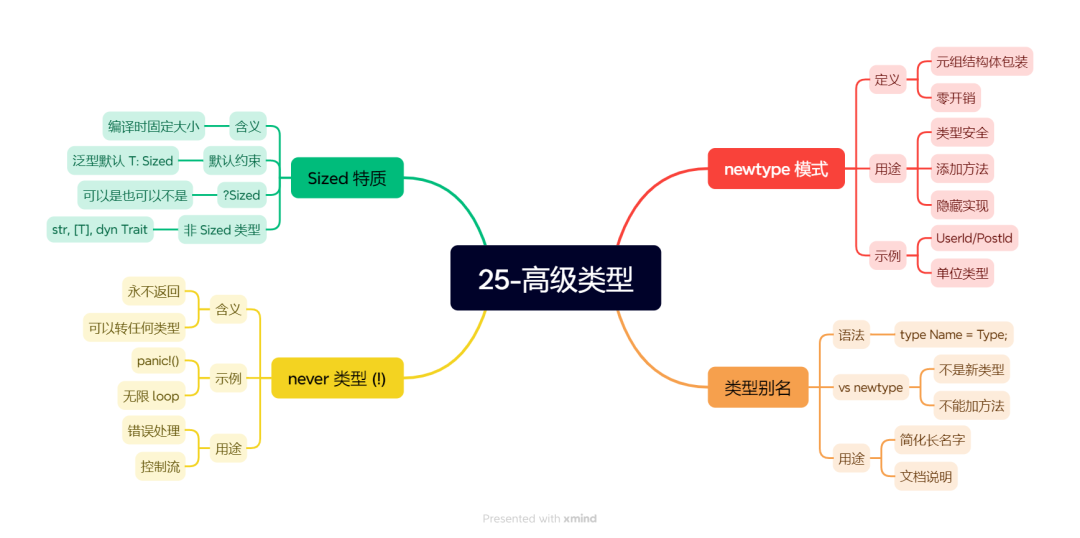
25-高级类型
📝 小结
核心要点:
- newtype 模式:用元组结构体包装,类型安全零开销
- 类型别名:起小名,不是新类型,不能加方法
- never 类型:
!表示永不返回,可以转任何类型 - Sized 特质:标记编译时固定大小的类型
- ?Sized:允许非 Sized 类型,需要配合引用使用
选择指南:
- 需要类型安全 → newtype
- 只是简化名字 → 类型别名
- 永不返回的函数 →
! - 泛型接受切片/str →
?Sized
下篇预告:
类型系统玩得差不多了,咱们来聊聊 Rust 里最让人头大的生命周期进阶。多个生命周期怎么搞?'static 是啥?trait 对象里的生命周期怎么处理?下篇一起攻克这个难关!
互动问题:
你觉得 newtype 模式有用吗?还是觉得太麻烦?有没有被 ?Sized 坑过?评论区聊聊!
🔗 参考资料
- Rust Book - Advanced Types
- Newtype Pattern
- Never Type
- Sized Trait
本文参与 腾讯云自媒体同步曝光计划,分享自微信公众号。
原始发表:2026-05-25,如有侵权请联系 cloudcommunity@tencent.com 删除
评论
登录后参与评论
推荐阅读
目录
腾讯云开发者

Copyright © 2013 - 2026 Tencent Cloud. All Rights Reserved. 腾讯云 版权所有
深圳市腾讯计算机系统有限公司 ICP备案/许可证号:粤B2-20090059  粤公网安备44030502008569号
腾讯云计算(北京)有限责任公司 京ICP证150476号 | 京ICP备11018762号