26-Rust 教程 - 生命周期进阶

26-Rust 教程 - 生命周期进阶

LarryLan
发布于 2026-05-29 13:08:40
发布于 2026-05-29 13:08:40
生命周期进阶
多个生命周期、'static:生命周期终于能看懂了!
🎬 引入
还记得第一次看到生命周期注解时的感受吗?
fn longest<'a>(x: &'a str, y: &'a str) -> &'a str
我: "这 'a 是个啥?为啥到处都要写?"
Rust: "告诉编译器引用能活多久。"
我: "编译器自己不能推断吗?"
Rust: "有些情况可以,有些不行。"
今天咱们就来攻克生命周期的进阶内容:多个生命周期参数、'static 生命周期、trait 对象中的生命周期。
学完这篇,你再看生命周期注解,应该不会再有"这啥玩意儿"的感觉了。
📌 核心概念
多个生命周期参数
问题: 当函数有多个输入引用,但它们的生命周期不同时:
fn longest(x: &str, y: &str) -> &str {
    if x.len() > y.len() {
        x
    } else {
        y
    }
}
编译器: "等等,返回的引用是哪个的?x 还是 y?它们的生命周期可能不一样啊!"
解决: 用多个生命周期参数
fn longest<'a, 'b>(x: &'a str, y: &'b str) -> &'a str {
    // 返回的引用生命周期和 x 一样
    x  // 只能返回 x,不能返回 y
}
但这不合理啊! 有时候 y 更长,为什么不能返回 y?
答案: 生命周期注解是给调用者看的契约,不是给实现者看的。
fn longest<'a, 'b>(x: &'a str, y: &'b str) -> &'a str {
    // 这个函数签名说:"我返回的引用至少能活 'a 这么久"
    // 所以只能返回 x,因为 y 的生命周期是 'b,可能比 'a 短
}
正确的做法: 让返回值的生命周期和两个参数都相关
fn longest<'a>(x: &'a str, y: &'a str) -> &'a str {
    // 两个参数生命周期相同
    // 返回的引用也能活这么久
    if x.len() > y.len() {
        x
    } else {
        y
    }
}
生命周期省略规则
不是所有函数都要写生命周期注解。Rust 有三条省略规则:
规则 1: 每个引用参数获得独立的生命周期
fn first(word: &str) -> &str {
    // 相当于 fn first<'a>(word: &'a str) -> &str
    // 但返回值没有标注,编译器不知道返回哪个的生命周期
}
规则 2: 如果只有一个输入生命周期,它赋给所有输出引用
fn first<'a>(word: &'a str) -> &'a str {
    // ✅ 可以省略
    // 编译器自动推断
}
规则 3: 如果有 &self 或 &mut self,self 的生命周期赋给所有输出引用
impl<'a> MyStruct<'a> {
    fn get_str(&self) -> &str {
        // ✅ 可以省略
        // 相当于 fn get_str<'a>(&'a self) -> &'a str
    }
}
什么时候必须写?
- 多个输入引用,返回值是引用
- 结构体字段有引用
- trait 定义中的引用
'static 生命周期
'static:表示引用可以活在整个程序运行期间。
哪些是 'static?
- 字符串字面量
- 常量
- 静态变量
let s: &'static str = "hello";  // 字面量存在代码段,程序结束才释放

const NAME: &str = "Larry";  // 常量也是 'static

static VERSION: &str = "1.0.0";  // 静态变量
'static 作为约束:
fn print_it<T: 'static>(value: T) {
    // T 必须是 'static 的
    // 意味着 T 不能包含任何非 'static 的引用
}
常见场景:
- 线程(线程可能比创建它的栈帧活得久)
- 全局缓存
- 配置数据
use std::thread;

fn main() {
    let s = "hello";  // &'static str

    thread::spawn(move || {
        println!("{}", s);  // ✅ 可以,s 是 'static
    });

    // 如果用 String 的引用就不行
    let owned = String::from("world");
    // thread::spawn(move || {
    //     println!("{}", &owned);  // ❌ owned 不是 'static
    // });
}
trait 对象中的生命周期
问题: trait 对象也需要生命周期注解
trait DisplayTrait: std::fmt::Display {}

// ❌ 这样不行
// trait Trait {
//     fn get(&self) -> &dyn DisplayTrait;
// }

// ✅ 要这样
trait Trait {
    fn get(&self) -> &dyn DisplayTrait + '_;
}
'_ 的含义: 生命周期省略,让编译器推断。
完整写法:
trait Trait {
    fn get<'a>(&'a self) -> &'a dyn DisplayTrait;
}
Box 中的 trait 对象:
// 默认是 'static
let boxed: Box<dyn std::fmt::Display> = Box::new();

// 显式指定生命周期
let boxed: Box<dyn std::fmt::Display + 'static> = Box::new();

// 非 'static
fn make_ref<'a>(x: &'a i32) -> Box<dyn std::fmt::Display + 'a> {
    Box::new(x)
}
生命周期子类型约束
语法: 'a: 'b 表示 'a 至少和 'b 一样长
fn constrained<'a, 'b>(x: &'a str, y: &'b str) -> &'b str
where
    'a: 'b// 'a 至少和 'b 一样长
{
    // 可以安全返回 x,因为 'a >= 'b
    x
}
实际例子:
struct Ref<'a, T> {
    reference: &'a T,
}

impl<'a, T> Ref<'a, T>
where
    T: 'a// T 必须至少活 'a 这么久
{
    fn new(reference: &'a T) -> Self {
        Ref { reference }
    }
}
为什么需要? 确保结构体里的引用不会比数据本身活得短。
💻 代码示例
示例 1:多个生命周期参数
// 返回第一个参数的引用
fn first<'a, 'b>(x: &'a str, y: &'b str) -> &'a str {
    x
}

// 返回第二个参数的引用
fn second<'a, 'b>(x: &'a str, y: &'b str) -> &'b str {
    y
}

// 返回生命周期较短的那个
fn shorter<'a, 'b>(x: &'a str, y: &'b str) -> &'a str
where
    'b: 'a// 'b 至少和 'a 一样长,所以 'a 是较短的
{
    x
}

fn main() {
    let s1 = String::from("hello");
    let s2 = String::from("world");

    println!("{}", first(&s1, &s2));
    println!("{}", second(&s1, &s2));
}
示例 2:结构体中的多个生命周期
struct TextPair<'a, 'b> {
    first: &'a str,
    second: &'b str,
}

impl<'a, 'b> TextPair<'a, 'b> {
    fn new(first: &'a str, second: &'b str) -> Self {
        TextPair { first, second }
    }

    fn first(&self) -> &str {
        self.first
    }

    fn second(&self) -> &str {
        self.second
    }
}

fn main() {
    let s1 = String::from("hello");
    let s2 = String::from("world");

    let pair = TextPair::new(&s1, &s2);
    println!("{} {}", pair.first(), pair.second());
}
示例 3:'static 生命周期
// 返回 'static 引用
fn get_static_str() -> &'static str {
    "I live forever!"
}

// 接受 'static 生命周期的函数
fn print_static(s: &'static str) {
    println!("{}", s);
}

fn main() {
    let s = get_static_str();
    print_static(s);

    // 字符串字面量
    let literal: &'static str = "hello";
    print_static(literal);

    // 常量
    const CONST: &str = "constant";
    print_static(CONST);
}
示例 4:线程中的 'static
use std::thread;
use std::time::Duration;

fn main() {
    // ✅ 'static 数据可以移到线程
    let s = "hello";
    let handle = thread::spawn(move || {
        println!("{}", s);
    });
    handle.join().unwrap();

    // ✅ 也可以显式标注
    fn spawn_thread<'a>(data: &'a str)
    where
        'a: 'static
    {
        thread::spawn(move || {
            println!("{}", data);
        });
    }

    spawn_thread("from function");

    // ❌ 非 'static 不行
    // let owned = String::from("world");
    // let handle = thread::spawn(move || {
    //     println!("{}", &owned);  // 编译错误
    // });
}
示例 5:trait 对象的生命周期
use std::fmt::Display;

// trait 对象作为返回值
fn make_display<'a>(x: &'a i32) -> Box<dyn Display + 'a> {
    Box::new(x)
}

// 结构体包含 trait 对象
struct Container<'a> {
    data: Box<dyn Display + 'a>,
}

impl<'a> Container<'a> {
    fn new(x: &'a i32) -> Self {
        Container {
            data: Box::new(x),
        }
    }
}

fn main() {
    let num = ;
    let display = make_display(&num);
    println!("{}", display);

    let container = Container::new(&num);
    println!("{}", container.data);
}
示例 6:生命周期子类型约束
// T 必须至少活 'a 这么久
struct Borrowed<'a, T: 'a> {
    data: &'a T,
}

impl<'a, T: 'a> Borrowed<'a, T> {
    fn new(data: &'a T) -> Self {
        Borrowed { data }
    }

    fn get(&self) -> &'a T {
        self.data
    }
}

// 更复杂的约束
fn process<'a, 'b, T>(x: &'a T, y: &'b T) -> &'a T
where
    'b: 'a,  // 'b 至少和 'a 一样长
    T: 'a + 'b,  // T 必须同时满足 'a 和 'b
{
    x
}

fn main() {
    let num = ;
    let borrowed = Borrowed::new(&num);
    println!("{}", borrowed.get());
}
错误示例:生命周期冲突
// ❌ 错误:返回局部变量的引用
fn returns_local() -> &str {
    let s = String::from("hello");
    &s  // s 在函数结束时释放
}

// ✅ 正确:返回 owned String
fn returns_owned() -> String {
    String::from("hello")
}

// ❌ 错误:生命周期不匹配
fn wrong_lifetime<'a>(x: &str, y: &str) -> &'a str {
    // 返回的 'a 和 x、y 都没关系
    y  // 编译器不知道 y 能不能活 'a 这么久
}

// ✅ 正确:明确生命周期关系
fn correct_lifetime<'a>(x: &'a str, y: &'a str) -> &'a str {
    y  // x 和 y 都是 'a,可以返回
}
🐛 常见坑点
坑点 1:过度标注生命周期
// ❌ 不需要标注
fn first(word: &str) -> &str {
    &word[..]
}

// ✅ 编译器可以推断
// 不需要写成 fn first<'a>(word: &'a str) -> &'a str
坑点 2:'static 误解
// ❌ 'static 不是"永远",是"程序运行期间"
fn not_static(s: String) -> &'static str {
    &s  // 错误!s 在函数结束时释放
}

// ✅ 字面量才是 'static
fn is_static() -> &'static str {
    "hello"
}
坑点 3:trait 对象忘记生命周期
// ❌ 错误
// trait Trait {
//     fn get(&self) -> &dyn Display;
// }

// ✅ 正确
trait Trait {
    fn get(&self) -> &dyn Display + '_;
}
🎯 实战案例
案例 1:解析器中的生命周期
// 解析器返回输入字符串的切片
struct Parser<'a> {
    input: &'a str,
    position: usize,
}

impl<'a> Parser<'a> {
    fn new(input: &'a str) -> Self {
        Parser { input, position:  }
    }

    fn peek(&self) -> Option<&'a str> {
        if self.position < self.input.len() {
            Some(&self.input[self.position..])
        } else {
            None
        }
    }

    fn consume(&mut self, n: usize) -> Option<&'a str> {
        let start = self.position;
        self.position += n;

        if self.position <= self.input.len() {
            Some(&self.input[start..self.position])
        } else {
            None
        }
    }
}

fn main() {
    let input = "hello world";
    let mut parser = Parser::new(input);

    println!("{:?}", parser.peek());
    println!("{:?}", parser.consume());
    println!("{:?}", parser.peek());
}
案例 2:配置管理
// 配置引用程序运行期间的数据
struct Config<'a> {
    name: &'a str,
    version: &'static str,  // 版本是编译时确定的
    data: std::collections::HashMap<&'a str, &'a str>,
}

impl<'a> Config<'a> {
    fn new(name: &'a str) -> Self {
        let mut data = std::collections::HashMap::new();
        data.insert("env", "production");

        Config {
            name,
            version: "1.0.0",
            data,
        }
    }

    fn get(&self, key: &str) -> Option<&'a str> {
        self.data.get(key).copied()
    }
}

fn main() {
    let name = String::from("MyApp");
    let config = Config::new(&name);

    println!("配置:{}", config.name);
    println!("版本:{}", config.version);
    println!("环境:{:?}", config.get("env"));
}
案例 3:迭代器适配器
// 自定义迭代器,返回引用的引用
struct WindowIter<'a, T> {
    slice: &'a [T],
    window_size: usize,
    index: usize,
}

impl<'a, T> WindowIter<'a, T> {
    fn new(slice: &'a [T], window_size: usize) -> Self {
        WindowIter {
            slice,
            window_size,
            index: ,
        }
    }
}

impl<'a, T> Iterator for WindowIter<'a, T> {
    type Item = &'a [T];

    fn next(&mut self) -> Option<Self::Item> {
        if self.index + self.window_size <= self.slice.len() {
            let window = &self.slice[self.index..self.index + self.window_size];
            self.index += ;
            Some(window)
        } else {
            None
        }
    }
}

fn main() {
    let data = [, , , , ];

    for window in WindowIter::new(&data, ) {
        println!("{:?}", window);
    }
    // 输出:
    // [1, 2, 3]
    // [2, 3, 4]
    // [3, 4, 5]
}
🧠 思维导图
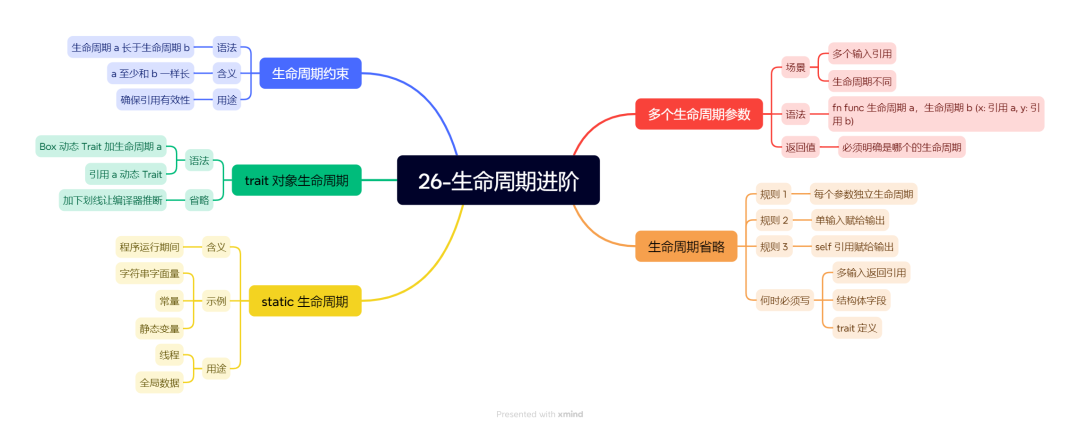
26-生命周期进阶
📝 小结
核心要点:
- 多个生命周期:不同输入引用可能需要不同生命周期参数
- 省略规则:三种情况可以省略,其他时候必须标注
- 'static:程序运行期间,字面量和常量是 'static
- trait 对象:需要生命周期注解,
'_可以省略 - 子类型约束:
'a: 'b表示 'a 至少和 'b 一样长
生命周期标注原则:
- 能省略就省略
- 必须标就标清楚
- 多个引用考虑是否需要不同生命周期
- trait 对象别忘记加生命周期
下篇预告:
生命周期终于搞定了!接下来咱们来聊聊 Rust 的Attribute 与 Derive。属性语法怎么用?内置 derive 有哪些?能不能自定义 attribute?下篇一起探索 Rust 的元编程!
互动问题:
你觉得生命周期最难理解的是啥?有没有被 'static 坑过?评论区聊聊你的"血泪史"!
🔗 参考资料
- Rust Book - Lifetimes
- Lifetime Elision
- 'static Lifetime
本文参与 腾讯云自媒体同步曝光计划,分享自微信公众号。
原始发表:2026-05-25,如有侵权请联系 cloudcommunity@tencent.com 删除
评论
登录后参与评论
推荐阅读
目录
腾讯云开发者

Copyright © 2013 - 2026 Tencent Cloud. All Rights Reserved. 腾讯云 版权所有
深圳市腾讯计算机系统有限公司 ICP备案/许可证号:粤B2-20090059  粤公网安备44030502008569号
腾讯云计算(北京)有限责任公司 京ICP证150476号 | 京ICP备11018762号