32-Rust 教程 - 并发模式

32-Rust 教程 - 并发模式

LarryLan
发布于 2026-06-03 18:22:15
发布于 2026-06-03 18:22:15
并发模式
"会用了工具不代表会写并发——就像有了锤子不代表会盖房子"
🎬 引入
前面三篇我们学了:
- 第 29 篇:如何创建线程
- 第 30 篇:如何用 channel 传递消息
- 第 31 篇:如何用 Mutex/Arc 共享状态
现在你可能想:"太好了,我可以写并发程序了!"
等等,先别急。
给你一堆砖头、水泥、钢筋,你就能盖房子吗?显然不能。你还需要设计图纸和施工规范。
并发编程也是一样。知道工具怎么用只是第一步,更重要的是知道在什么场景下用什么工具,以及如何避免常见的并发陷阱。
今天我们就来学习并发编程的经典模式和最佳实践:线程池、死锁预防、并发设计模式,以及一些"血泪教训"总结出来的经验法则。
📌 核心概念
什么是并发模式?
并发模式是解决常见并发问题的可复用方案。就像设计模式一样,它们是经过验证的最佳实践。
常见的并发模式:
- 线程池:预先创建一批线程,复用它们执行任务
- 生产者 - 消费者:一个/多个线程生产数据,另一个/多个线程消费
- 读写锁模式:读多写少时用 RwLock
- Actor 模式:每个 Actor 维护状态,通过消息通信
- 工作窃取:空闲线程从繁忙线程"偷"任务
为什么需要线程池?
想象你要处理 1000 个任务:
方案 1:每个任务创建一个线程
for task in tasks {
    thread::spawn(|| process(task));  // ❌ 糟糕!
}
问题:
- 创建/销毁线程开销大
- 1000 个线程可能耗尽系统资源
- 线程调度开销大
方案 2:线程池
let pool = ThreadPool::new();  // 只创建 4 个线程
for task in tasks {
    pool.execute(|| process(task));  // 复用线程
}
优点:
- 线程数量可控
- 复用线程,减少开销
- 任务排队,有序执行
死锁的四个必要条件
死锁发生的四个条件(缺一不可):
- 互斥条件:资源一次只能被一个线程占用
- 持有并等待:线程持有资源的同时等待其他资源
- 不可抢占:资源不能被强制剥夺
- 循环等待:存在一个线程等待的循环链
预防死锁 = 破坏至少一个条件
💻 代码示例
实现一个简单的线程池
use std::sync::{mpsc, Arc, Mutex};
use std::thread;

// 任务类型
type Job = Box<dyn FnOnce() + Send + 'static>;

// 线程池
pub struct ThreadPool {
    workers: Vec<Worker>,
    sender: Option<mpsc::Sender<Job>>,
}

// 工作线程
struct Worker {
    id: usize,
    thread: Option<thread::JoinHandle<()>>,
}

impl ThreadPool {
    /// 创建新的线程池
    pub fn new(size: usize) -> ThreadPool {
        assert!(size > );

        let (sender, receiver) = mpsc::channel();
        let receiver = Arc::new(Mutex::new(receiver));

        let mut workers = Vec::with_capacity(size);

        for id in ..size {
            workers.push(Worker::new(id, Arc::clone(&receiver)));
        }

        ThreadPool {
            workers,
            sender: Some(sender),
        }
    }

    /// 执行任务
    pub fn execute<F>(&self, f: F)
    where
        F: FnOnce() + Send + 'static,
    {
        let job = Box::new(f);
        self.sender.as_ref().unwrap().send(job).unwrap();
    }
}

impl Worker {
    fn new(id: usize, receiver: Arc<Mutex<mpsc::Receiver<Job>>>) -> Worker {
        let thread = thread::spawn(move || loop {
            // 获取任务
            let job = receiver.lock().unwrap().recv();

            match job {
                Ok(job) => {
                    println!("工人 {} 收到任务", id);
                    job();
                }
                Err(_) => {
                    println!("工人 {} 断开连接,退出", id);
                    break;
                }
            }
        });

        Worker {
            id,
            thread: Some(thread),
        }
    }
}

impl Drop for ThreadPool {
    fn drop(&mut self) {
        println!("发送关闭信号给所有工人");
        drop(self.sender.take());  // 关闭 channel

        println!("等待所有工人完成");
        for worker in &mut self.workers {
            println!("关闭工人 {}", worker.id);
            if let Some(thread) = worker.thread.take() {
                thread.join().unwrap();
            }
        }
    }
}

fn main() {
    let pool = ThreadPool::new();

    for i in .. {
        pool.execute(move || {
            println!("任务 {} 执行中", i);
            std::thread::sleep(std::time::Duration::from_millis());
            println!("任务 {} 完成", i);
        });
    }

    // 等待任务完成
    std::thread::sleep(std::time::Duration::from_secs());

    // pool 离开作用域,自动清理
}
死锁预防示例
use std::sync::{Arc, Mutex};
use std::thread;

// ❌ 错误示例:可能导致死锁
fn deadlock_example() {
    let mutex1 = Arc::new(Mutex::new());
    let mutex2 = Arc::new(Mutex::new());

    let m1 = Arc::clone(&mutex1);
    let m2 = Arc::clone(&mutex2);

    let t1 = thread::spawn(move || {
        let _lock1 = m1.lock().unwrap();
        thread::sleep(std::time::Duration::from_millis());
        let _lock2 = m2.lock().unwrap();  // 可能死锁
    });

    let t2 = thread::spawn(move || {
        let _lock2 = m2.lock().unwrap();
        thread::sleep(std::time::Duration::from_millis());
        let _lock1 = m1.lock().unwrap();  // 可能死锁
    });

    t1.join().unwrap();
    t2.join().unwrap();
}

// ✅ 正确示例:固定锁顺序
fn no_deadlock() {
    let mutex1 = Arc::new(Mutex::new());
    let mutex2 = Arc::new(Mutex::new());

    let m1 = Arc::clone(&mutex1);
    let m2 = Arc::clone(&mutex2);

    // 两个线程都先锁 mutex1,再锁 mutex2
    let t1 = thread::spawn(move || {
        let _lock1 = m1.lock().unwrap();
        thread::sleep(std::time::Duration::from_millis());
        let _lock2 = m2.lock().unwrap();
    });

    let t2 = thread::spawn(move || {
        let _lock1 = mutex1.lock().unwrap();  // 先锁同一个
        thread::sleep(std::time::Duration::from_millis());
        let _lock2 = mutex2.lock().unwrap();  // 再锁另一个
    });

    t1.join().unwrap();
    t2.join().unwrap();
}

// ✅ 正确示例:使用 try_lock 避免无限等待
fn try_lock_example() {
    let mutex1 = Arc::new(Mutex::new());
    let mutex2 = Arc::new(Mutex::new());

    let m1 = Arc::clone(&mutex1);
    let m2 = Arc::clone(&mutex2);

    let t1 = thread::spawn(move || {
        if let Ok(_lock1) = m1.try_lock() {
            thread::sleep(std::time::Duration::from_millis());
            if let Ok(_lock2) = m2.try_lock() {
                // 成功获取两个锁
            }
        }
    });

    t1.join().unwrap();
}
生产者 - 消费者模式
use std::sync::{mpsc, Arc, Mutex};
use std::thread;
use std::time::Duration;

fn producer_consumer_example() {
    let (tx, rx) = mpsc::channel();
    let rx = Arc::new(Mutex::new(rx));

    // 多个生产者
    let mut producers = vec![];
    for i in .. {
        let tx_clone = tx.clone();
        let handle = thread::spawn(move || {
            for j in .. {
                tx_clone.send(format!("生产者 {} - 消息 {}", i, j)).unwrap();
                thread::sleep(Duration::from_millis());
            }
        });
        producers.push(handle);
    }

    drop(tx);  // 关闭原始发送端

    // 多个消费者
    let mut consumers = vec![];
    for i in .. {
        let rx_clone = Arc::clone(&rx);
        let handle = thread::spawn(move || {
            loop {
                let msg = {
                    let rx = rx_clone.lock().unwrap();
                    rx.recv()
                };

                match msg {
                    Ok(m) => println!("消费者 {} 收到:{}", i, m),
                    Err(_) => break,  // channel 关闭
                }
            }
        });
        consumers.push(handle);
    }

    for handle in producers {
        handle.join().unwrap();
    }
    for handle in consumers {
        handle.join().unwrap();
    }
}
工作窃取模式(简化版)
use std::collections::VecDeque;
use std::sync::{Arc, Mutex};
use std::thread;
use std::time::Duration;

// 每个线程有自己的任务队列
struct WorkStealingPool {
    queues: Vec<Arc<Mutex<VecDeque<i32>>>>,
}

impl WorkStealingPool {
    fn new(num_threads: usize) -> Self {
        let queues = (..num_threads)
            .map(|_| Arc::new(Mutex::new(VecDeque::new())))
            .collect();

        WorkStealingPool { queues }
    }

    fn add_task(&self, thread_id: usize, task: i32) {
        let queue = &self.queues[thread_id];
        queue.lock().unwrap().push_back(task);
    }

    // 从自己的队列获取任务,如果没有就从别人那里"偷"
    fn steal_task(&self, thread_id: usize) -> Option<i32> {
        // 先尝试从自己的队列获取
        {
            let mut queue = self.queues[thread_id].lock().unwrap();
            if let Some(task) = queue.pop_front() {
                return Some(task);
            }
        }

        // 自己的队列为空,从别人那里偷
        for (i, queue) in self.queues.iter().enumerate() {
            if i != thread_id {
                let mut q = queue.lock().unwrap();
                if let Some(task) = q.pop_front() {
                    println!("线程 {} 从线程 {} 偷到任务", thread_id, i);
                    return Some(task);
                }
            }
        }

        None
    }
}
🐛 常见坑点
坑点 1:过度使用锁
use std::sync::Mutex;

struct BadCounter {
    value: Mutex<i32>,
}

impl BadCounter {
    fn increment(&self) {
        // ❌ 锁的粒度过大
        let mut value = self.value.lock().unwrap();
        // 下面这些操作其实不需要锁
        println!("准备增加");
        std::thread::sleep(std::time::Duration::from_millis());
        *value += ;
        println!("增加完成");
        // 锁持有时间过长
    }
}

// ✅ 更好的做法
struct GoodCounter {
    value: Mutex<i32>,
}

impl GoodCounter {
    fn increment(&self) {
        println!("准备增加");
        std::thread::sleep(std::time::Duration::from_millis());

        // 只在必要时持有锁
        {
            let mut value = self.value.lock().unwrap();
            *value += ;
        }

        println!("增加完成");
    }
}
坑点 2:忘记处理 channel 关闭
use std::sync::mpsc;
use std::thread;

fn main() {
    let (tx, rx) = mpsc::channel();

    thread::spawn(move || {
        tx.send("你好").unwrap();
        // tx drop,channel 关闭
    });

    // ❌ 无限循环
    // loop {
    //     let msg = rx.recv().unwrap();  // channel 关闭后会 panic
    //     println!("{}", msg);
    // }

    // ✅ 正确处理
    for msg in rx {
        println!("{}", msg);
    }
    // 或者
    // loop {
    //     match rx.recv() {
    //         Ok(msg) => println!("{}", msg),
    //         Err(_) => break,  // channel 关闭
    //     }
    // }
}
坑点 3:线程池任务 panic
use std::sync::{mpsc, Arc, Mutex};
use std::thread;

struct ThreadPool {
    workers: Vec<Worker>,
    sender: mpsc::Sender<Box<dyn FnOnce() + Send + 'static>>,
}

struct Worker {
    thread: thread::JoinHandle<()>,
}

impl ThreadPool {
    fn new(size: usize) -> Self {
        let (tx, rx) = mpsc::channel();
        let rx = Arc::new(Mutex::new(rx));

        let workers = (..size)
            .map(|id| {
                let rx = Arc::clone(&rx);
                let thread = thread::spawn(move || loop {
                    let job = rx.lock().unwrap().recv();

                    match job {
                        Ok(job) => {
                            // ❌ 如果 job() panic,整个线程就挂了
                            job();
                        }
                        Err(_) => break,
                    }
                });

                Worker { thread }
            })
            .collect();

        ThreadPool { workers, sender: tx }
    }

    fn execute<F>(&self, f: F)
    where
        F: FnOnce() + Send + 'static,
    {
        self.sender.send(Box::new(f)).unwrap();
    }
}

// ✅ 更好的做法:捕获 panic
fn better_worker(rx: Arc<Mutex<mpsc::Receiver<Box<dyn FnOnce() + Send + 'static>>>>) {
    loop {
        let job = rx.lock().unwrap().recv();

        match job {
            Ok(job) => {
                // 用 catch_unwind 捕获 panic
                let result = std::panic::catch_unwind(std::panic::AssertUnwindSafe(|| {
                    job();
                }));

                if let Err(e) = result {
                    eprintln!("任务 panic 了:{:?}", e);
                    // 线程继续运行,处理下一个任务
                }
            }
            Err(_) => break,
        }
    }
}
🎯 实战案例
案例:并行的网页爬虫
use std::collections::HashSet;
use std::sync::{Arc, Mutex};
use std::thread;
use std::time::Duration;

// 简化的爬虫示例
struct WebCrawler {
    visited: Arc<Mutex<HashSet<String>>>,
    to_visit: Arc<Mutex<Vec<String>>>,
}

impl WebCrawler {
    fn new() -> Self {
        WebCrawler {
            visited: Arc::new(Mutex::new(HashSet::new())),
            to_visit: Arc::new(Mutex::new(vec!["https://example.com".to_string()])),
        }
    }

    fn crawl(&self, num_threads: usize) {
        let mut handles = vec![];

        for i in ..num_threads {
            let visited = Arc::clone(&self.visited);
            let to_visit = Arc::clone(&self.to_visit);

            let handle = thread::spawn(move || {
                loop {
                    // 获取下一个 URL
                    let url = {
                        let mut queue = to_visit.lock().unwrap();
                        queue.pop()
                    };

                    match url {
                        Some(url) => {
                            // 检查是否访问过
                            let mut visited_set = visited.lock().unwrap();
                            if visited_set.contains(&url) {
                                continue;
                            }
                            visited_set.insert(url.clone());

                            // 模拟爬取
                            println!("线程 {} 爬取:{}", i, url);
                            thread::sleep(Duration::from_millis());

                            // 模拟发现新链接
                            let new_urls = vec![
                                format!("{}/page1", url),
                                format!("{}/page2", url),
                            ];

                            let mut queue = to_visit.lock().unwrap();
                            for new_url in new_urls {
                                queue.push(new_url);
                            }
                        }
                        None => break,  // 没有更多 URL
                    }
                }
            });

            handles.push(handle);
        }

        for handle in handles {
            handle.join().unwrap();
        }
    }
}
案例:并发数据处理管道
use std::sync::mpsc;
use std::thread;

// 数据处理管道:读取 -> 转换 -> 过滤 -> 输出
fn data_pipeline() {
    let (tx1, rx1) = mpsc::channel();
    let (tx2, rx2) = mpsc::channel();
    let (tx3, rx3) = mpsc::channel();

    // 阶段 1:读取数据
    let reader = thread::spawn(move || {
        for i in ..= {
            tx1.send(i).unwrap();
        }
    });

    // 阶段 2:转换数据(乘以 2)
    let transformer = thread::spawn(move || {
        for num in rx1 {
            tx2.send(num * ).unwrap();
        }
    });

    // 阶段 3:过滤数据(只保留大于 10 的)
    let filter = thread::spawn(move || {
        for num in rx2 {
            if num >  {
                tx3.send(num).unwrap();
            }
        }
    });

    // 阶段 4:输出结果
    let output = thread::spawn(move || {
        for num in rx3 {
            println!("输出:{}", num);
        }
    });

    reader.join().unwrap();
    transformer.join().unwrap();
    filter.join().unwrap();
    output.join().unwrap();
}
🧠 思维导图
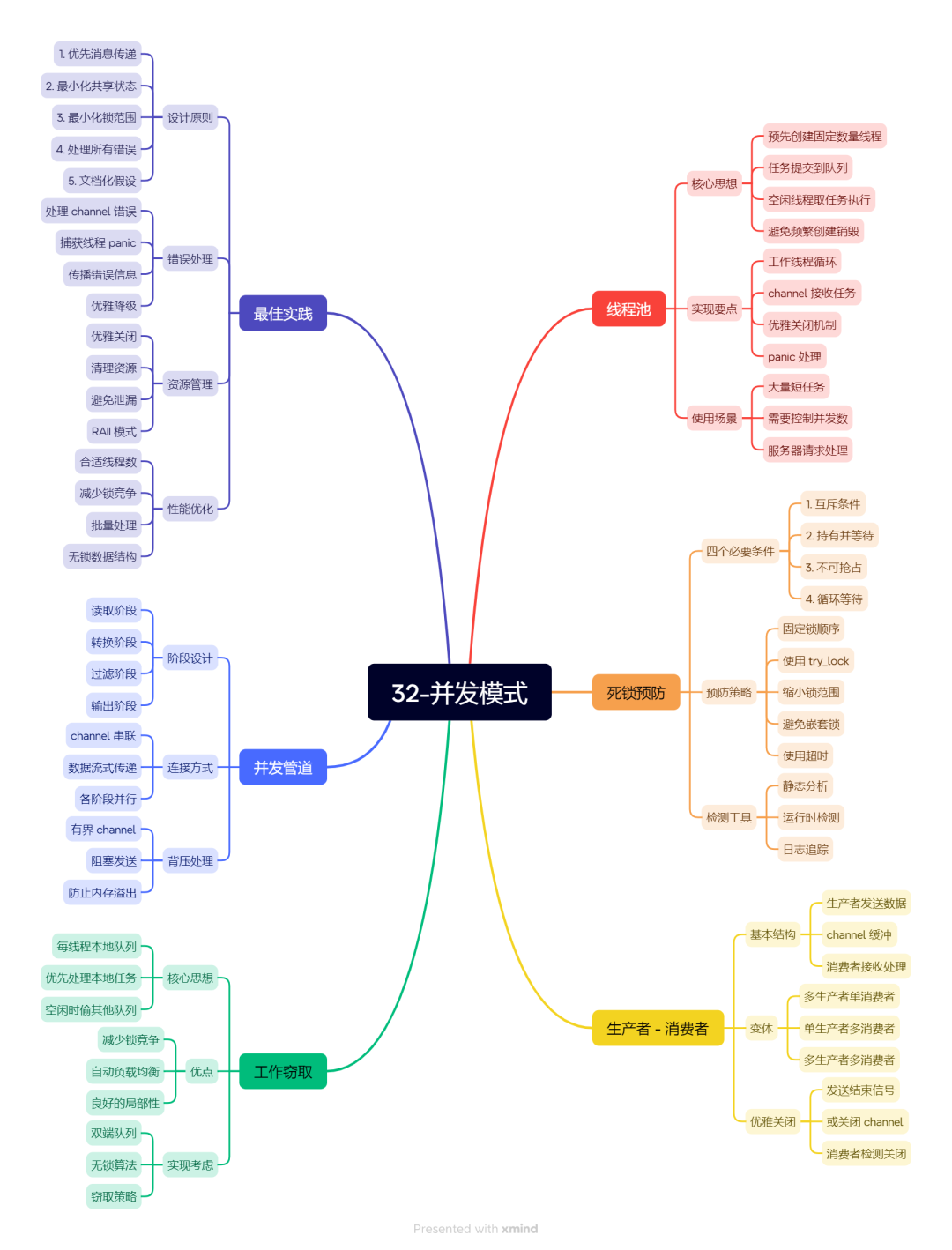
32-并发模式
📝 小结
- 线程池复用线程,避免频繁创建/销毁线程的开销。
- 预防死锁:固定锁顺序、使用
try_lock、缩小锁范围。 - 生产者 - 消费者 是经典模式,用 channel 连接各个阶段。
- 工作窃取 可以自动负载均衡,适合任务不均匀的场景。
- 处理 panic:用
catch_unwind捕获,避免整个线程池挂掉。 - 优雅关闭:确保所有任务完成,资源正确释放。
下篇预告: 线程并发学完了,但还有一种更高效的并发方式——异步编程!不用创建线程就能同时处理成千上万个任务,这是什么魔法?下篇我们学习 async/await、Future、Pin、Waker,揭开异步编程的神秘面纱!
🔗 参考资料
- Rust Book - 并发模式
- 线程池实现
- 死锁预防
- 工作窃取
本文参与 腾讯云自媒体同步曝光计划,分享自微信公众号。
原始发表:2026-06-01,如有侵权请联系 cloudcommunity@tencent.com 删除
目录
腾讯云开发者

Copyright © 2013 - 2026 Tencent Cloud. All Rights Reserved. 腾讯云 版权所有
深圳市腾讯计算机系统有限公司 ICP备案/许可证号:粤B2-20090059  粤公网安备44030502008569号
腾讯云计算(北京)有限责任公司 京ICP证150476号 | 京ICP备11018762号