
如何延长日历周期以完成R中的数据?
在底部发布的代码可以很好地使用包tidyr填充数据,以便在定义为月数的情况下,所有ID的句号都相同(下面代码中的“Period_1”)。Base testDF的ID为1,有5个句点,ID为50和60,每个句点只有3个。tidyr代码为ID为50和60的ID创建额外的句点(" Period_1 "),因此它们也有5个Period_1´s。代码在"Bal“和"State”字段下复制,以便所有ID都以相同数量的Period_1结束,这是正确的。
但是,如何以相同的方式扩展"Period_2“的日历月表达式,如下面所示?
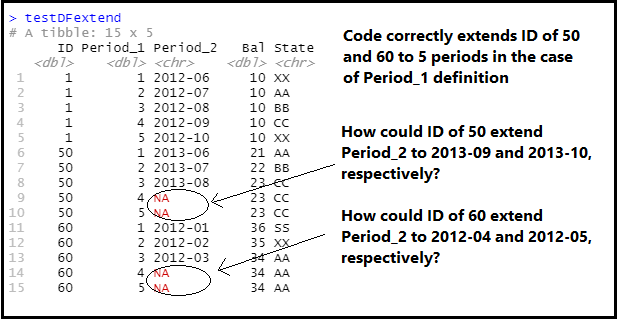
代码:
library(tidyr)

testDF <-
  data.frame(
    ID = as.numeric(c(rep(1,5),rep(50,3),rep(60,3))),
    Period_1 = as.numeric(c(1:5,1:3,1:3)),
    Period_2 = c("2012-06","2012-07","2012-08","2012-09","2012-10","2013-06","2013-07","2013-08","2012-01","2012-02","2012-03"),
    Bal = as.numeric(c(rep(10,5),21:23,36:34)),
    State = c("XX","AA","BB","CC","XX","AA","BB","CC","SS","XX","AA")
  )

testDFextend <-
  testDF %>%
  tidyr::complete(ID, nesting(Period_1)) %>%
  tidyr::fill(Bal, State, .direction = "down")

testDFextend
编辑:从一年滚动到下一个
一个更好的OP示例应该有Period 2 = c("2012-06","2012-07","2012-08","2012-09","2012-10","2013-06","2013-07","2013-08","2012-10","2012-11","2012-12"),它提供了一个示例,在这个示例中,扩展Period_2会导致转到下一年。下面,我将以下的tidyr/dplyr的答案加到下面,以正确地进行一年的滚动:
library(tidyr)
library(dplyr)

testDF <-
  data.frame(
    ID = as.numeric(c(rep(1,5),rep(50,3),rep(60,3))),
    Period_1 = as.numeric(c(1:5,1:3,1:3)),
    Period_2 = c("2012-06","2012-07","2012-08","2012-09","2012-10","2013-06","2013-07","2013-08","2012-10","2012-11","2012-12"),
    Bal = as.numeric(c(rep(10,5),21:23,36:34)),
    State = c("XX","AA","BB","CC","XX","AA","BB","CC","SS","XX","AA")
  )

testDFextend <-
  testDF %>%
  tidyr::complete(ID, nesting(Period_1)) %>%
  tidyr::fill(Bal, State, .direction = "down")

testDFextend %>%
  separate(Period_2, into = c("year", "month"), convert = TRUE) %>%
  fill(year) %>%
  group_by(ID) %>%
  mutate(month = sprintf("%02d", zoo::na.spline(month))) %>%
  unite("Period_2", year, month, sep = "-") %>%
# Now I add the below lines:
  separate(Period_2, into = c("year", "month"), convert = TRUE) %>%
  mutate(month = as.integer(sprintf("%02d", zoo::na.spline(month)))) %>%
  mutate(year1 = ifelse(month > 12, year+trunc(month/12), year)) %>%
  mutate(month1 = ifelse(month > 12 & month%%12!= 0, month%%12, month)) %>%
  mutate(month1 = ifelse(month1 < 10, paste0(0,month1),month1)) %>%
  unite("Period_2", year1, month1, sep = "-") %>%
select("ID","Period_1","Period_2","Bal","State")回答 4
Stack Overflow用户
发布于 2022-11-21 09:52:31
我认为最好的方法是使用padr package,它是为在缺少/不完整列的地方填充data.frame而构建的。
这使用分组和cur_data()在Period_2中生成正确的日期序列。
library(dplyr)
library(tidyr)
library(padr)

n_periods <- 5

testDF %>%
  pad_int(end_val = n_periods , by = "Period_1", group = "ID") %>%
  group_by(ID) %>%
  mutate(Period_2 = as.Date(paste0(Period_2, "-01"))) %>%
  mutate(Period_2 = seq(cur_data()$Period_2[1], by = "months", length.out =
    n_periods) %>% format("%Y-%m")) %>%
  fill(Bal, State) %>%
  ungroup() %>%
select(ID, Period_1, Period_2, Bal, State) ID Period_1 Period_2 Bal State
<dbl> <dbl> <chr> <dbl> <chr>
1 1 1 2012-06 10 XX
2 1 2 2012-07 10 AA
3 1 3 2012-08 10 BB
4 1 4 2012-09 10 CC
5 1 5 2012-10 10 XX
6 50 1 2013-06 21 AA
7 50 2 2013-07 22 BB
8 50 3 2013-08 23 CC
9 50 4 2013-09 23 CC
10 50 5 2013-10 23 CC
11 60 1 2012-01 36 SS
12 60 2 2012-02 35 XX
13 60 3 2012-03 34 AA
14 60 4 2012-04 34 AA
15 60 5 2012-05 34 AA 请注意,在Period_2期间,当该年转到下一年时,这将处理情况。
最后,如果需要不同数量的句点,可以调整n_periods (或者使用一个函数自动计算它,比如jay.sf的答案)。
Stack Overflow用户
发布于 2022-11-21 08:20:54
by ID您可以使用strsplit日期,并使用元素创建一个新的data.frame到merge。
ml <- max(with(testDF, tapply(ID, ID, length))) ## get max. period length
by(testDF, testDF$ID, \(x) {
sp <- strsplit(x$Period_2, '-')
s <- as.numeric(sp[[1]][[2]])
if (ml != nrow(x))
merge(x, data.frame(Period_2=paste0(sp[[1]][[1]], '-', sprintf('%02d', (s + nrow(x)):(s + ml - 1))),
Period_1=(nrow(x) + 1):ml,
ID=x$ID[nrow(x)], Bal=x$Bal[nrow(x)], State=x$State[nrow(x)]), all=TRUE)
else x
}) |> c(make.row.names=FALSE) |> do.call(what=rbind)
# ID Period_1 Period_2 Bal State
# 1 1 1 2012-06 10 XX
# 2 1 2 2012-07 10 AA
# 3 1 3 2012-08 10 BB
# 4 1 4 2012-09 10 CC
# 5 1 5 2012-10 10 XX
# 6 50 1 2013-06 21 AA
# 7 50 2 2013-07 22 BB
# 8 50 3 2013-08 23 CC
# 9 50 4 2013-09 23 CC
# 10 50 5 2013-10 23 CC
# 11 60 1 2012-01 36 SS
# 12 60 2 2012-02 35 XX
# 13 60 3 2012-03 34 AA
# 14 60 4 2012-04 34 AA
# 15 60 5 2012-05 34 AA编辑
对于较早的R版本(尽管建议始终使用更新软件),请执行以下操作:
do.call(c(by(testDF, testDF$ID, function(x) {
sp <- strsplit(x$Period_2, '-')
s <- as.numeric(sp[[1]][[2]])
if (ml != nrow(x))
merge(x, data.frame(Period_2=paste0(sp[[1]][[1]], '-', sprintf('%02d', (s + nrow(x)):(s + ml - 1))),
Period_1=(nrow(x) + 1):ml,
ID=x$ID[nrow(x)], Bal=x$Bal[nrow(x)], State=x$State[nrow(x)]), all=TRUE)
else x
}), make.row.names=FALSE), what=rbind)Stack Overflow用户
发布于 2022-11-21 09:05:44
基于tidyverse的zoo::na.spline解决方案。请注意,它不处理年份更改。这比我想象的要困难,特别是因为zoo::na.spline似乎不适用于yearmon格式。
library(tidyr)
library(dplyr)
testDFextend %>%
separate(Period_2, into = c("year", "month"), convert = TRUE) %>%
fill(year) %>%
group_by(ID) %>%
mutate(month = sprintf("%02d", zoo::na.spline(month))) %>%
unite("Period_2", year, month, sep = "-")输出
      ID Period_1 Period_2   Bal State
   <dbl>    <dbl> <chr>    <dbl> <chr>
 1     1        1 2012-06     10 XX
 2     1        2 2012-07     10 AA
 3     1        3 2012-08     10 BB
 4     1        4 2012-09     10 CC
 5     1        5 2012-10     10 XX
 6    50        1 2013-06     21 AA
 7    50        2 2013-07     22 BB
 8    50        3 2013-08     23 CC
 9    50        4 2013-09     23 CC
10    50        5 2013-10     23 CC
11    60        1 2012-01     36 SS
12    60        2 2012-02     35 XX
13    60        3 2012-03     34 AA
14    60        4 2012-04     34 AA
15 60 5 2012-05 34 AA https://stackoverflow.com/questions/74515720
复制相似问题
腾讯云开发者

Copyright © 2013 - 2026 Tencent Cloud. All Rights Reserved. 腾讯云 版权所有
深圳市腾讯计算机系统有限公司 ICP备案/许可证号:粤B2-20090059  粤公网安备44030502008569号
腾讯云计算(北京)有限责任公司 京ICP证150476号 | 京ICP备11018762号