
Junit没有显示任何使用IntelliJ进行UCB cs61B (org.junit.Assert.assertArrayEquals() )的结果。
我正在自学CS61B - UCB,我是使用IntelliJ和Junit4.12的初学者。我发现my org.junit.Assert.assertArrayEquals()没有结果
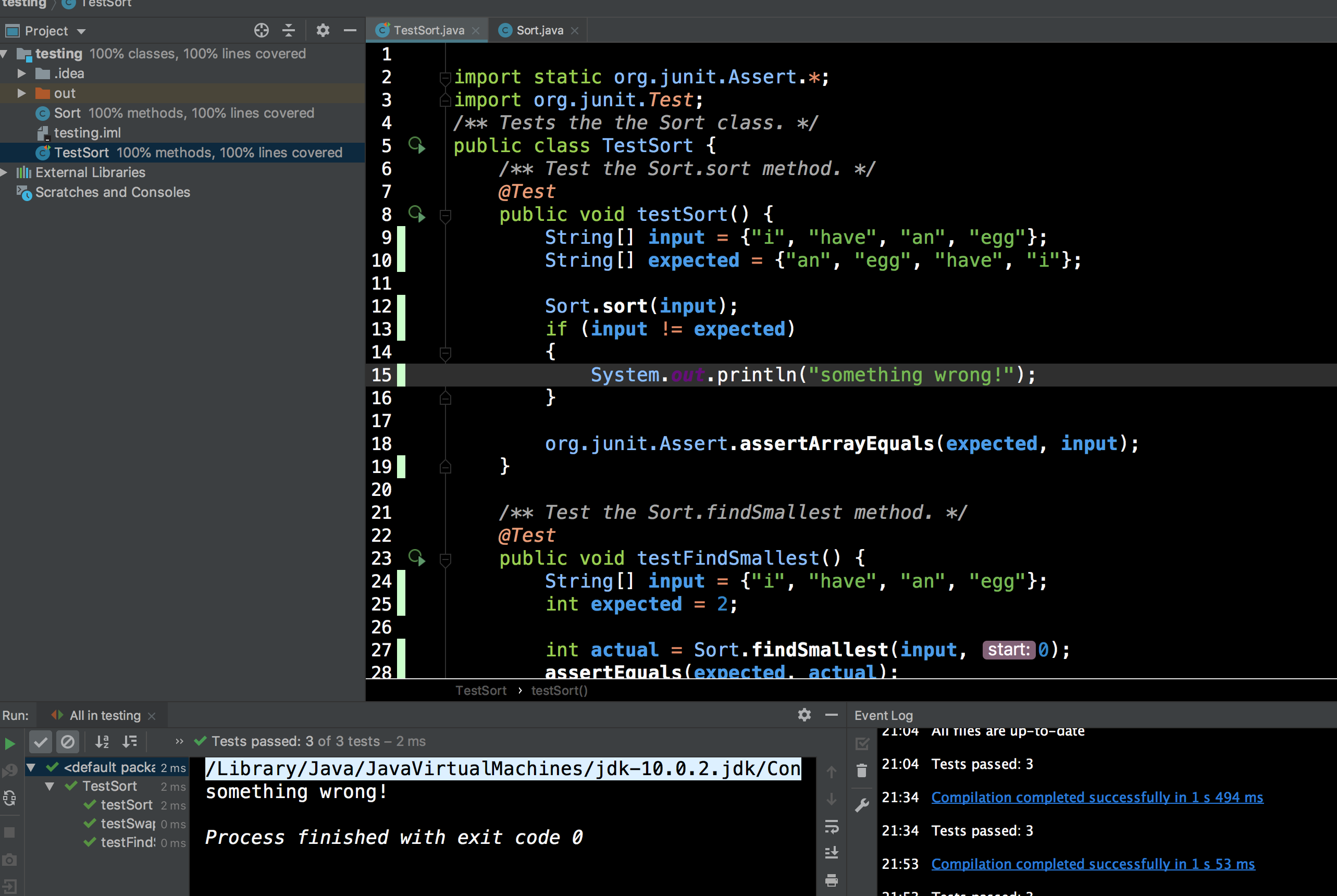
在视频中有这样的节目
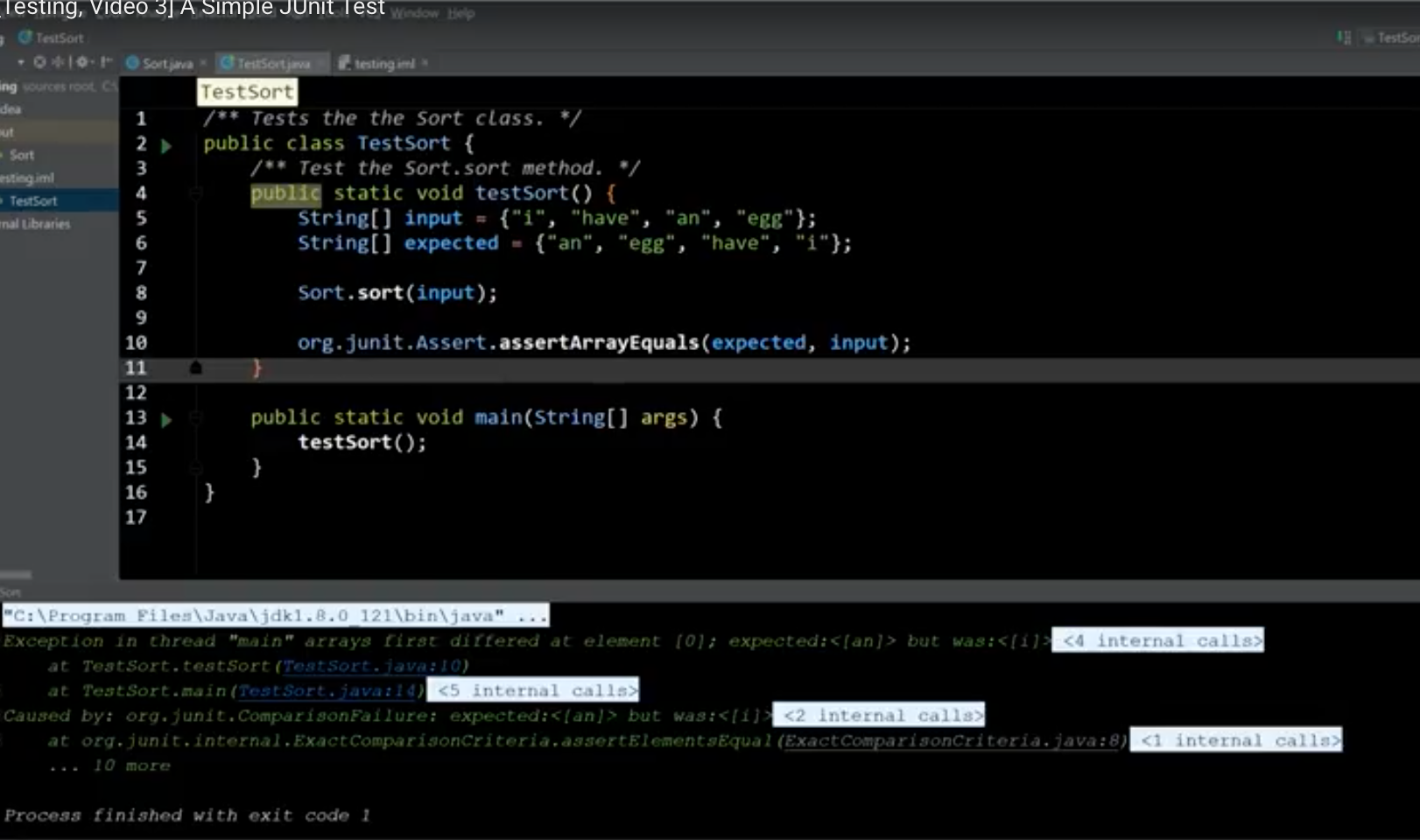
在跑步窗口。
这里是TestSort.java的代码
import static org.junit.Assert.*;
import org.junit.Test;
/** Tests the the Sort class. */
public class TestSort {
/** Test the Sort.sort method. */
@Test
public void testSort() {
    String[] input = {"i", "have", "an", "egg"};
    String[] expected = {"an", "egg", "have", "i"};

    Sort.sort(input);
    if (input != expected)
    {
        System.out.println("something wrong!");
    }

    org.junit.Assert.assertArrayEquals(expected, input);
}
@Test
public void testFindSmallest() {
    String[] input = {"i", "have", "an", "egg"};
    int expected = 2;

    int actual = Sort.findSmallest(input, 0);
    assertEquals(expected, actual);

    String[] input2 = {"there", "are", "many", "pigs"};
    int expected2 = 2;

    int actual2 = Sort.findSmallest(input2, 2);
    assertEquals(expected2, actual2);
}

@Test
public void testSwap() {
    String[] input = {"i", "have", "an", "egg"};
    int a = 0;
    int b = 2;
    String[] expected = {"an", "have", "i", "egg"};

    Sort.swap(input, a, b);
    assertArrayEquals(expected, input);
}
}这里是Sort.java的代码
public class Sort {
public static void sort(String[] x) {
    sort(x, 0);
}

private static void sort(String[] x, int start) {
    if (start == x.length) {
        return;
    }
    int smallestIndex = findSmallest(x, start);
    swap(x, start, smallestIndex);
    sort(x, start + 1);
}

public static void swap(String[] x, int a, int b) {
    String temp = x[a];
    x[a] = x[b];
    x[b] = temp;
}

public static int findSmallest(String[] x, int start) {
    int smallestIndex = start;
    for (int i = start; i < x.length; i += 1) {
        int cmp = x[i].compareTo(x[smallestIndex]);

        if (cmp < 0) {
            smallestIndex = i;
        }
    }
    return smallestIndex;
}
}
我认为Junit的功能是得到绿色部分,它显示了我的代码是如何工作的,并得到了我的两个字符串是否相等的结果。
关于IntelliJ的另一个问题是,我运行它和使用终端编译和操作它之间是否有什么区别?因为当我使用终端时,它会显示这样的东西

我在谷歌上搜索了很多这方面的内容,它总是说我没有把Junit.jar应用到类路径中。我检查过了,我添加了库.在这里输入图像描述

fyi,你可以在这里找到图书馆在这里输入链接描述
我调试了testSort函数,它适用于输入部分和排序函数部分。虽然它给了我在这里输入图像描述的提示,我选择了下载,但它显示源代码没有找到在这里输入图像描述,当我从exist文件在这里输入图像描述中选择源代码时,它使attaching....How保持不变--我能解决这个问题吗?


回答 1
Stack Overflow用户
发布于 2018-12-28 04:39:37
您的代码可能没有像您预期的那样运行,但它的运行与一个更有经验的Java所期望的完全一样。让我解释一下..。
您已经发现了=运算符(或者更准确地说,是!=)的行为,这些操作常常会让经验较少的!=工程师感到意外。=运算符不知道如何处理数组,因此返回到比较引用。在您的例子中,它是比较input和expected,看看它们是否引用了完全相同的对象。在您的代码中,input和expected都声明为新数组,因此它们是不同的、单独的对象;它们不引用相同的对象。
至于assertArrayEquals,它可能根本不使用=操作符。虽然我还没有查看该方法的源代码,但我冒昧地猜测它首先检查引用相等性(它们都引用同一个对象,然后检查它们是否都是数组,然后检查expected的每个元素是否也在input中。
数组可以增加等式的混淆,因为平等有很多定义。平等可以定义为..。
- 两个数组的元素数相同,顺序相同。
- 这两个数组具有相同的元素数,但顺序不同。
- 一个数组有5个元素,另一个数组有10个元素,其中第一个数组的所有5个元素都在第二个数组中。
- 等。
我有一个建议可能会帮助您更好地理解这个问题(以及您将来可能面临的更多问题),就是看看这个方法的源代码,在这个例子中,assertArrayEquals是不起作用的。IntelliJ允许您导航到源代码,或者如果源代码不可用,请查看反编译的字节代码。在Mac上只要命令-点击这个方法。在Windows中可能是Control-click?(对不起,IntelliJ有这么多不同的快捷方式集,我不能说得更具体了。)
关于这个话题的进一步信息..。在Java中,==与equals()之间有什么区别? https://javabeginnerstutorial.com/core-java-tutorial/java-equals-method-vs-operator/
https://stackoverflow.com/questions/53953249
复制相似问题
腾讯云开发者

Copyright © 2013 - 2026 Tencent Cloud. All Rights Reserved. 腾讯云 版权所有
深圳市腾讯计算机系统有限公司 ICP备案/许可证号:粤B2-20090059  粤公网安备44030502008569号
腾讯云计算(北京)有限责任公司 京ICP证150476号 | 京ICP备11018762号