MedImageInsight Image Encoder 过程分析

MedImageInsight Image Encoder 过程分析

AlphaHinex
发布于 2026-03-16 14:42:03
发布于 2026-03-16 14:42:03
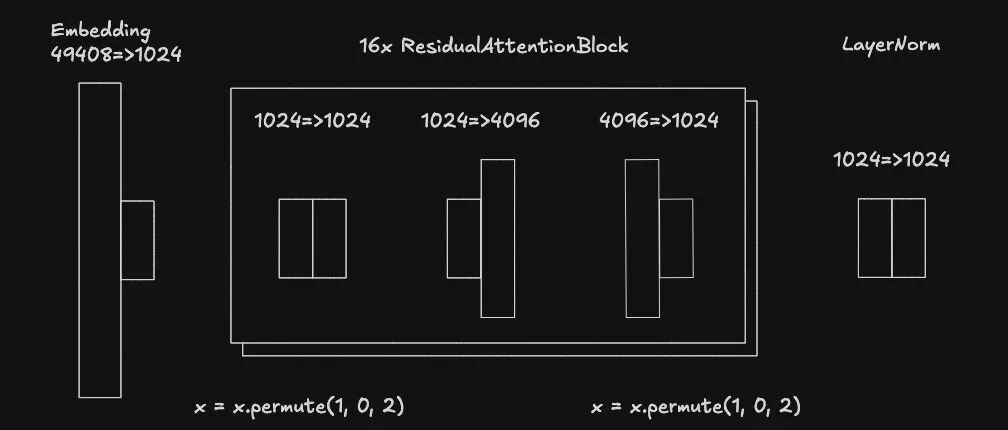
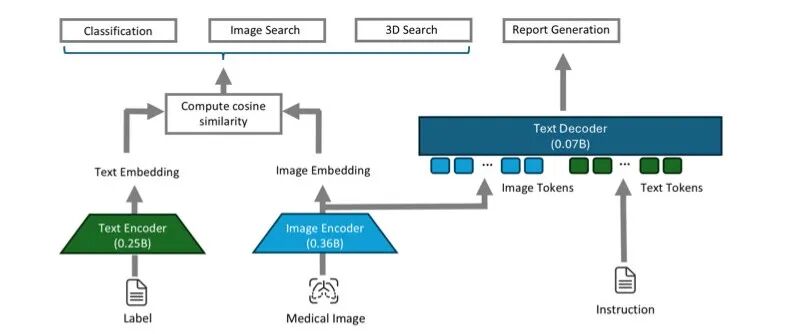
在 浅析 Embedding 模型[1] 中,我们分析了 MedImageInsight 的 Text Encoder,本文将继续基于 lion-ai/MedImageInsights[2] 版本(以下简称 MI2),分析其 Image Encoder,以及 MI2 是如何对图像和文本的嵌入结果进行相似度预测的。
模型结构
MedImageInsight/ImageEncoder[3] 中实现了 Convolutional Swin Transformer 和 DaViT[4] 两个版本的 Encoder。 在 2024.09.27/config.yaml[5] 配置中指定了使用 davit_v1:
IMAGE_ENCODER:
  NAME:davit_v1
...
IMAGE_SIZE:[480,480]
...
SPEC:
    ...
    PATCH_SIZE:[7,3,3,3]
    PATCH_STRIDE:[4,2,2,2]
    PATCH_PADDING:[3,1,1,1]
    ...
    DIM_EMBED:[256,512,1024,2048]
    NUM_HEADS:[8,16,32,64]
    NUM_GROUPS:[8,16,32,64]
    DEPTHS:[1,1,9,1]
    WINDOW_SIZE:12
    ...
按照上述配置,MI2 Image Encoder 接受的输入图像大小为 480 x 480,经过与 DaViT 论文中提出的模型相同的四个 stage 的卷积和 transformer 模块,最终输出一个 2048 维的特征向量。
Output Size | Layer Name | MI2 Image Encoder | |
|---|---|---|---|
stage 1 | 120 x 120 | Patch Embedding | kernel 7, stride 4, pad 3, C1 = 256 |
stage 1 | 120 x 120 | DualTransformerBlock | |
stage 2 | 60 x 60 | Patch Embedding | kernel 3, stride 2, pad 1, C2 = 512 |
stage 2 | 60 x 60 | DualTransformerBlock | |
stage 3 | 30 x 30 | Patch Embedding | kernel 3, stride 2, pad 1, C3 = 1024 |
stage 3 | 30 x 30 | DualTransformerBlock | |
stage 4 | 15 x 15 | Patch Embedding | kernel 3, stride 2, pad 1, C4 = 2048 |
stage 4 | 15 x 15 | DualTransformerBlock |
对比论文中的三个尺寸模型配置如下:
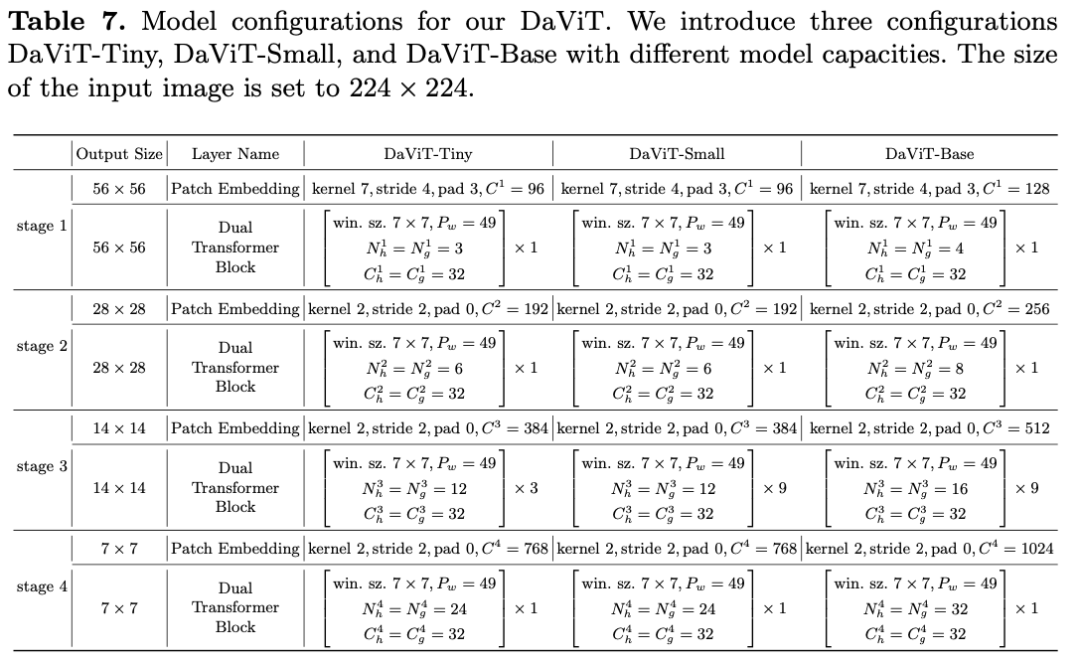
Table7
Table7
MI2 Image Encoder 的模型结构为:
(image_encoder): DaViT(
  (convs): ModuleList(
    (0): ConvEmbed(
      (proj): Conv2d(3, 256, kernel_size=(7, 7), stride=(4, 4), padding=(3, 3))
      (norm): LayerNorm((256,), eps=1e-05, elementwise_affine=True)
    )
    (1): ConvEmbed(
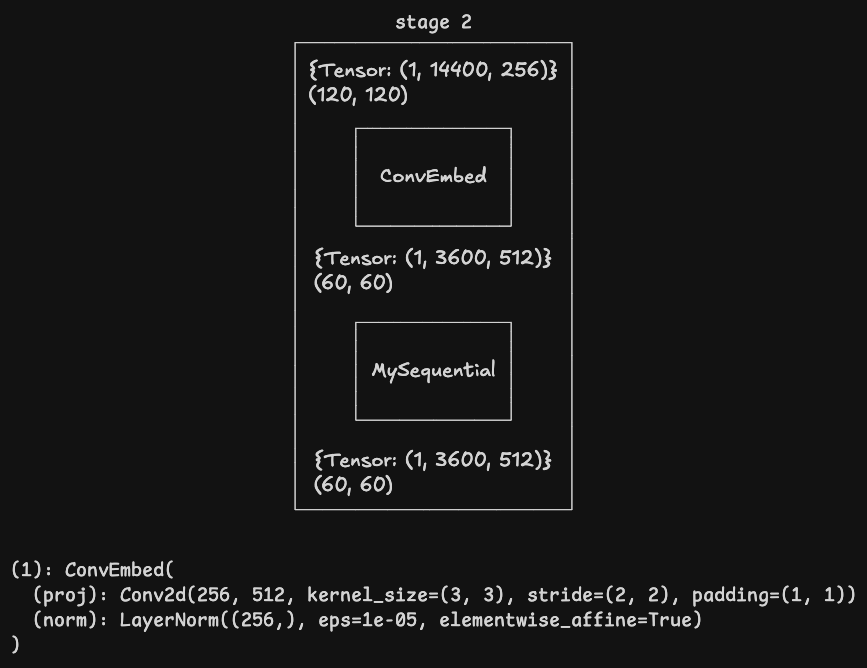
      (proj): Conv2d(256, 512, kernel_size=(3, 3), stride=(2, 2), padding=(1, 1))
      (norm): LayerNorm((256,), eps=1e-05, elementwise_affine=True)
    )
    (2): ConvEmbed(
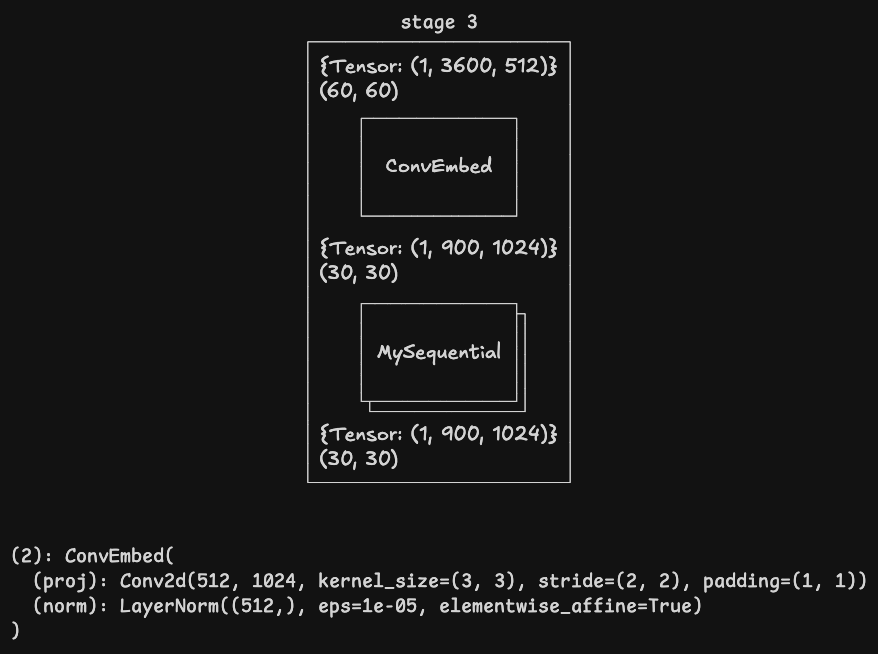
      (proj): Conv2d(512, 1024, kernel_size=(3, 3), stride=(2, 2), padding=(1, 1))
      (norm): LayerNorm((512,), eps=1e-05, elementwise_affine=True)
    )
    (3): ConvEmbed(
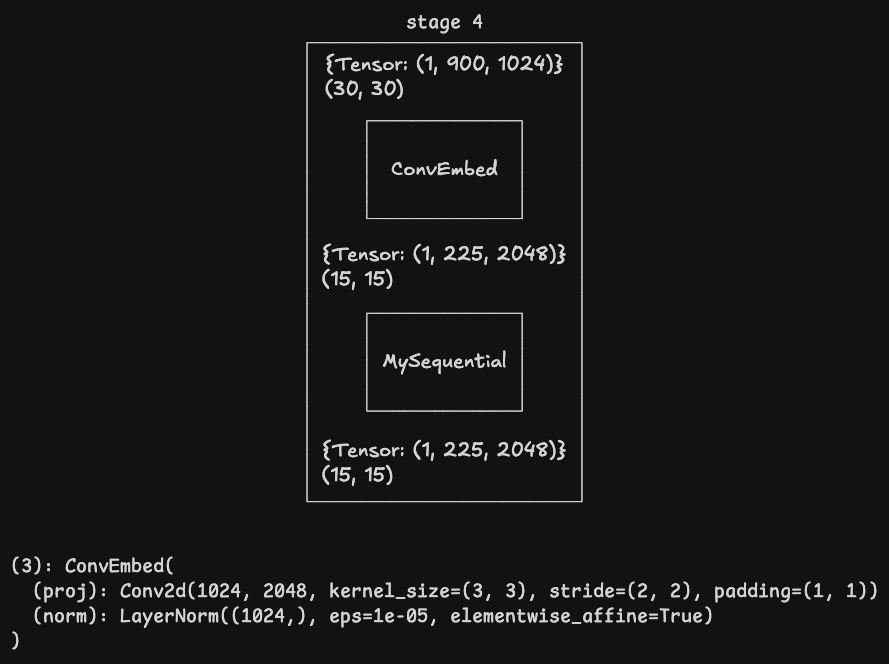
      (proj): Conv2d(1024, 2048, kernel_size=(3, 3), stride=(2, 2), padding=(1, 1))
      (norm): LayerNorm((1024,), eps=1e-05, elementwise_affine=True)
    )
  )
  (blocks): ModuleList(
    (0): MySequential(
      (0): MySequential(
        (spatial_block): SpatialBlock(...)
        (channel_block): ChannelBlock(...)
      )
    )
    (1): MySequential(
      (0): MySequential(
        (spatial_block): SpatialBlock(...)
        (channel_block): ChannelBlock(...)
      )
    )
    (2): MySequential(
      (0): MySequential(
        (spatial_block): SpatialBlock(...)
        (channel_block): ChannelBlock(...)
      )
      (1): MySequential(
        (spatial_block): SpatialBlock(...)
        (channel_block): ChannelBlock(...)
      )
      (2): MySequential(
        (spatial_block): SpatialBlock(...)
        (channel_block): ChannelBlock(...)
      )
      (3): MySequential(
        (spatial_block): SpatialBlock(...)
        (channel_block): ChannelBlock(...)
      )
      (4): MySequential(
        (spatial_block): SpatialBlock(...)
        (channel_block): ChannelBlock(...)
      )
      (5): MySequential(
        (spatial_block): SpatialBlock(...)
        (channel_block): ChannelBlock(...)
      )
      (6): MySequential(
        (spatial_block): SpatialBlock(...)
        (channel_block): ChannelBlock(...)
      )
      (7): MySequential(
        (spatial_block): SpatialBlock(...)
        (channel_block): ChannelBlock(...)
      )
      (8): MySequential(
        (spatial_block): SpatialBlock(...)
        (channel_block): ChannelBlock(...)
      )
    )
    (3): MySequential(
      (0): MySequential(
        (spatial_block): SpatialBlock(...)
        (channel_block): ChannelBlock(...)
      )
    )
  )
  (norms): LayerNorm((2048,), eps=1e-05, elementwise_affine=True)
  (avgpool): AdaptiveAvgPool1d(output_size=1)
  (head): Identity()
)
DaViT 简介
DaViT(Dual Attention Vision Transformers)是一种结合了空间注意力(Spatial Window Multihead Self-attention)和通道注意力(Channel Group Self-attention)的视觉 Transformer 模型。它通过在每个 Transformer 块中同时应用空间注意力和通道注意力来增强特征表示能力,从而提高模型在图像分类、目标检测等任务上的性能。
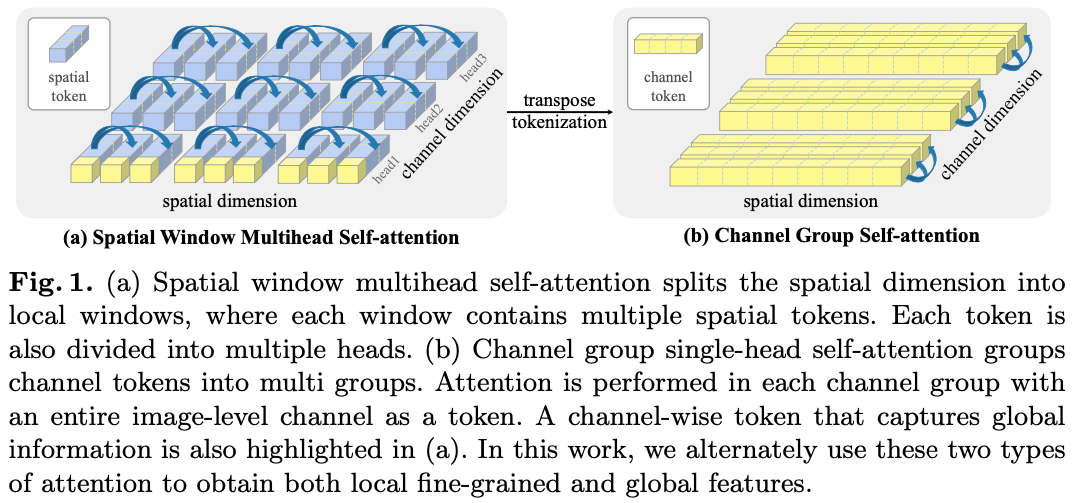
Fig.1.
Fig.1.
结合下图,可以更好的理解上面模型结构中的构块:
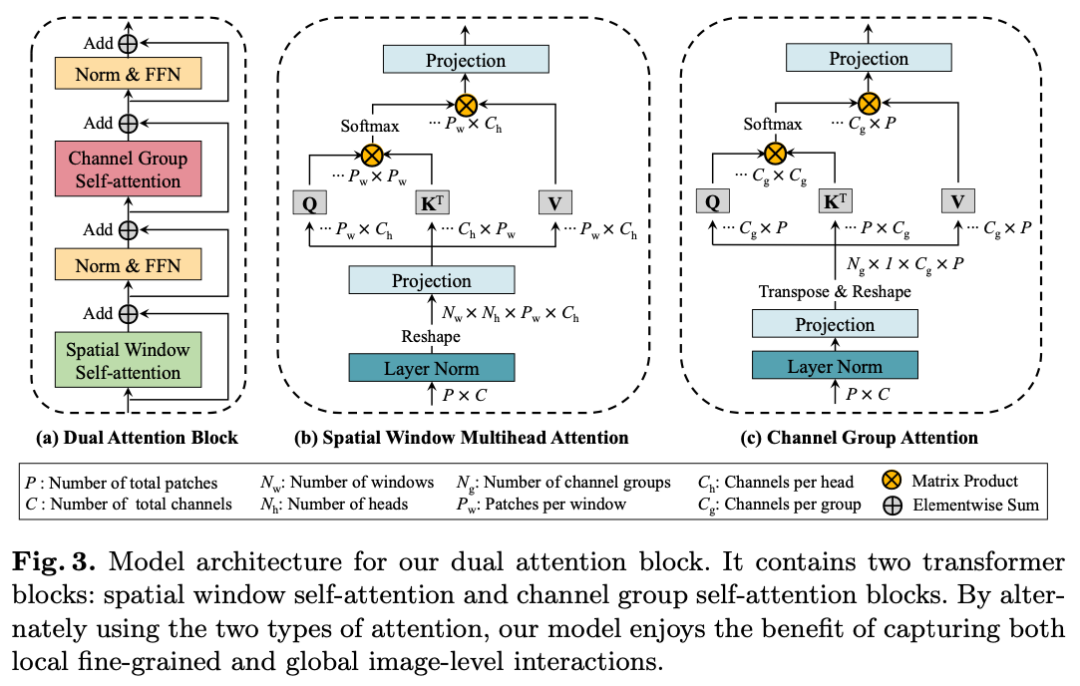
Fig.3.
Fig.3.
更详细的内容可阅读 DaViT: Dual Attention Vision Transformers[6] 论文,或 DaViT:双注意力Vision Transformer[7]。
模型权重
通过读取模型权重文件,可以观察各层的权重维度:
from safetensors.torch import load_file

pretrained = '2024.09.27/vision_model/medimageinsigt-v1.0.0.pt'
pretrained_dict = load_file(pretrained)

for key in pretrained_dict.keys():
    print(f"{key:<70} {pretrained_dict.get(key).shape}")
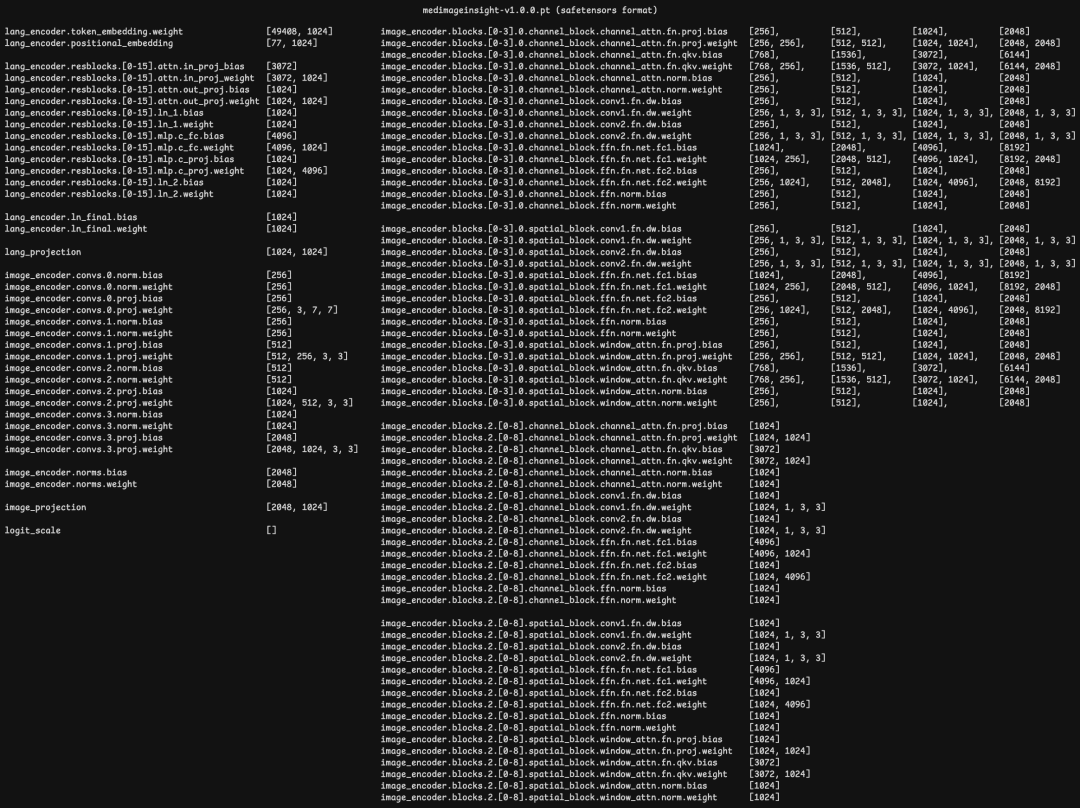
model
model
Encode 过程
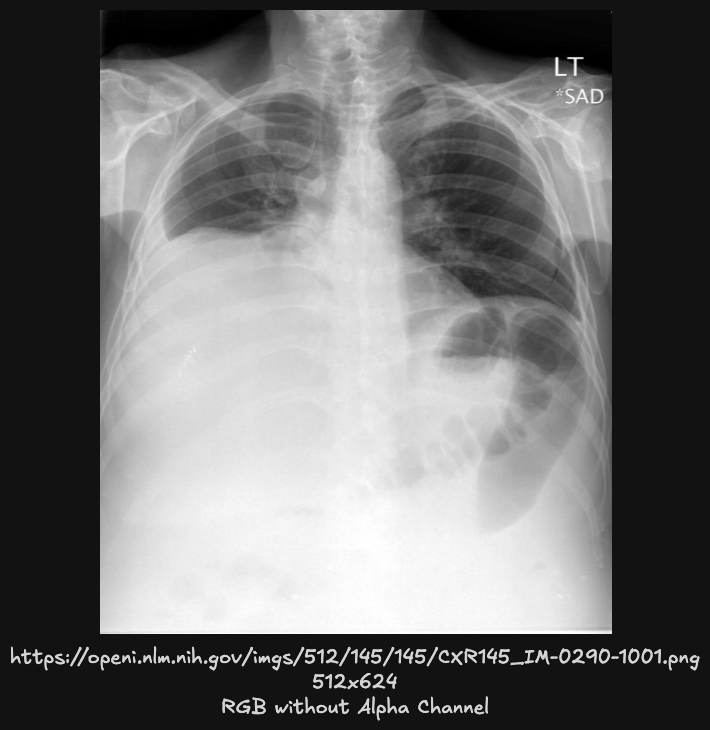
input image
input image
以 https://openi.nlm.nih.gov/imgs/512/145/145/CXR145_IM-0290-1001.png 作为输入图片为例,encode 编码过程可大致分为三步:
- 预处理:将输入图像进行 resize、normalize 等预处理操作,使其符合模型输入要求。
- DaViT:将预处理后的图像输入 DaViT 模块,经过卷积和 transformer 模块的处理,得到一个 2048 维的特征向量。
- 对齐:将图像特征向量与文本特征向量通过投影矩阵进行对齐,使得它们在同一特征空间中进行相似度计算。
预处理
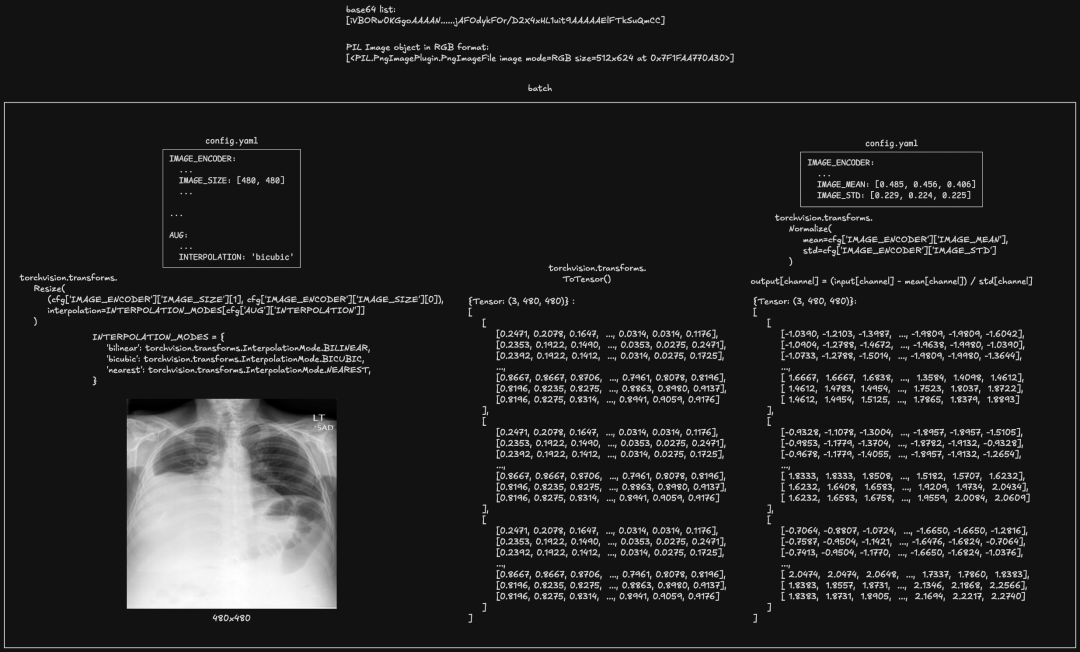
preprocess
preprocess
图像以 Base64 编码的字符串形式批量传递,首先通过 base64.b64decode 解码为二进制数据,然后使用 PIL.Image.open 将其转换为 PIL Image 对象。接着,图像被 resize 到 480 x 480 的大小,并进行转张量及 normalize 操作,使其符合模型输入要求。
此阶段输出的张量形状为 [1, 3, 480, 480],其中 1 是批次大小,3 是图像的通道数(RGB),480 x 480 是图像尺寸。
DaViT
预处理后的图像被输入 DaViT 模块,首先经过四个 stage 进行特征提取,每个 stage 包含一个卷积层和一个 Dual Transformer Block(stage 3 有九个)。卷积层通过不同的 kernel size、stride 和 padding 将图像逐渐 downsample,同时增加特征维度。Dual Transformer Block 则通过空间注意力和通道注意力机制进一步增强特征表示能力。
最终,经过全局平均池化和归一化处理,得到一个 2048 维的图像特征向量。
stage 1
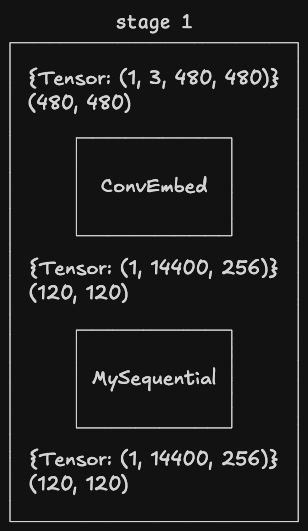
stage 1
stage 1
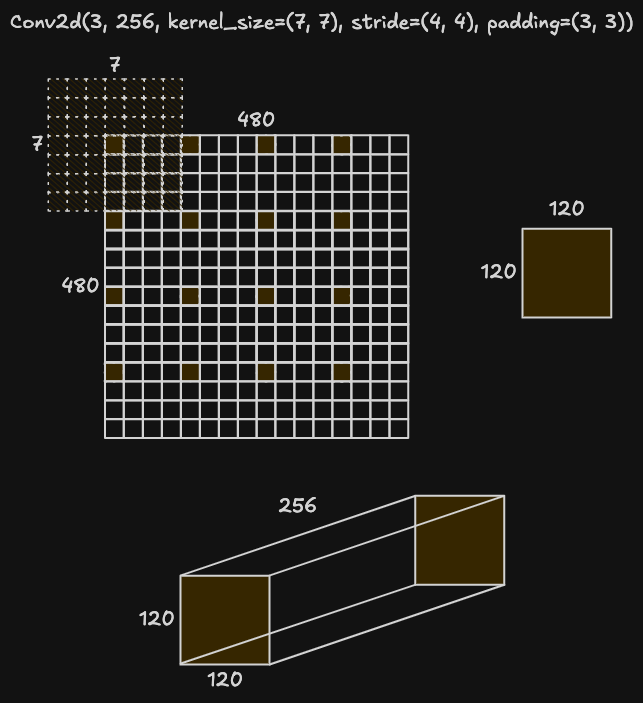
Stage 1 的卷积层 ConvEmbed[8] 结构及权重矩阵维度如下:
(0): ConvEmbed(
  (proj): Conv2d(3, 256, kernel_size=(7, 7), stride=(4, 4), padding=(3, 3))
  (norm): LayerNorm((256,), eps=1e-05, elementwise_affine=True)
)
image_encoder.convs.0.norm.bias   [256]
image_encoder.convs.0.norm.weight [256]
image_encoder.convs.0.proj.bias   [256]
image_encoder.convs.0.proj.weight [256, 3, 7, 7]
前向传播时,ConvEmbed 的 forward 方法接受两个参数:代表图像特征的张量,以及图像尺寸。图像特征张量可以是 [batch, channels, height, width] 维度(如 stage 1 图中所示),也可以是 [batch, tokens, channels](后续 stage 中的情况),forward 方法会先将其统一至 [batch, channels, height, width](b c h w)形式,卷积投影后重排为 [batch, tokens, channels](b (h w) c),返回嵌入后的特征和更新后的尺寸。
def forward(self, x, size):
    H, W = size
    if len(x.size()) == 3:
        if self.norm and self.pre_norm:
            x = self.norm(x)
        x = rearrange(
            x, 'b (h w) c -> b c h w',
            h=H, w=W
        )

    x = self.proj(x)

    _, _, H, W = x.shape
    x = rearrange(x, 'b c h w -> b (h w) c')
    if self.norm andnot self.pre_norm:
        x = self.norm(x)

    return x, (H, W)
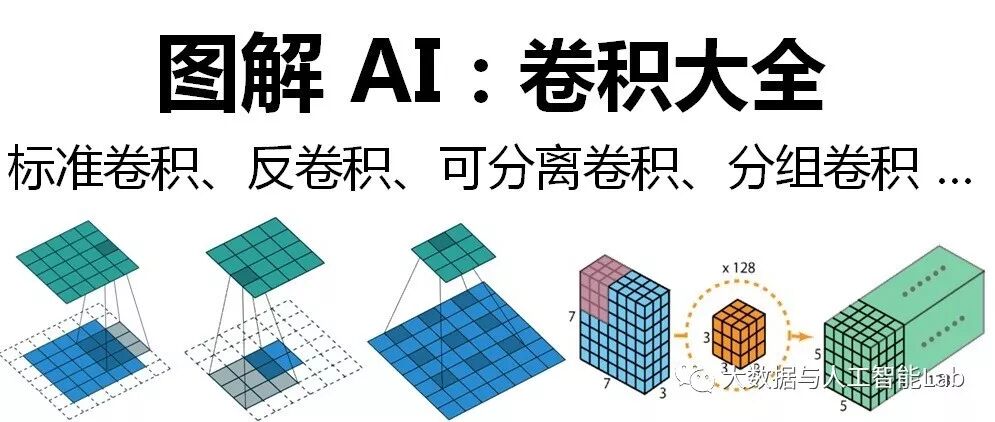
Conv2d[9] 是一个多通道的二维卷积:
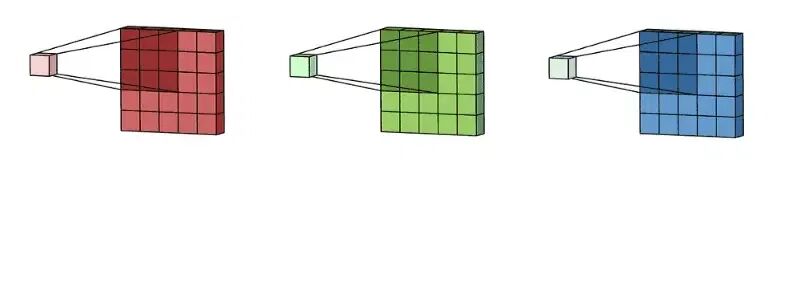
2d-conv-multi-01

2d-conv-multi-02
可将输入 转换为 ,具体公式如下:
其中 相当于单通道二维卷积, 是批次大小(本例中只有一个批次), 表示通道数(stage 1 中 ,), 是图像像素高度, 是宽度。
conv2d
conv2d
其他 stage
stage 2
stage 2
stage 3
stage 3
stage 4
stage 4
经过 stage 4 后输出的张量形状为 [1, 255, 2048],其中 1 是批次大小,255 是图像特征 15 x 15 阶矩阵的按行连接,2048 是通道数。
平均池化及归一化
对每个通道的图像特征做平均池化及归一化,得到一个 2048 维的图像特征向量。
davit_v1.py#L625-L627[10]
x = self.avgpool(x.transpose(1, 2))
x = torch.flatten(x, 1)
x = self.norms(x)
(avgpool): AdaptiveAvgPool1d(output_size=1)
(norms): LayerNorm((2048,), eps=1e-05, elementwise_affine=True)
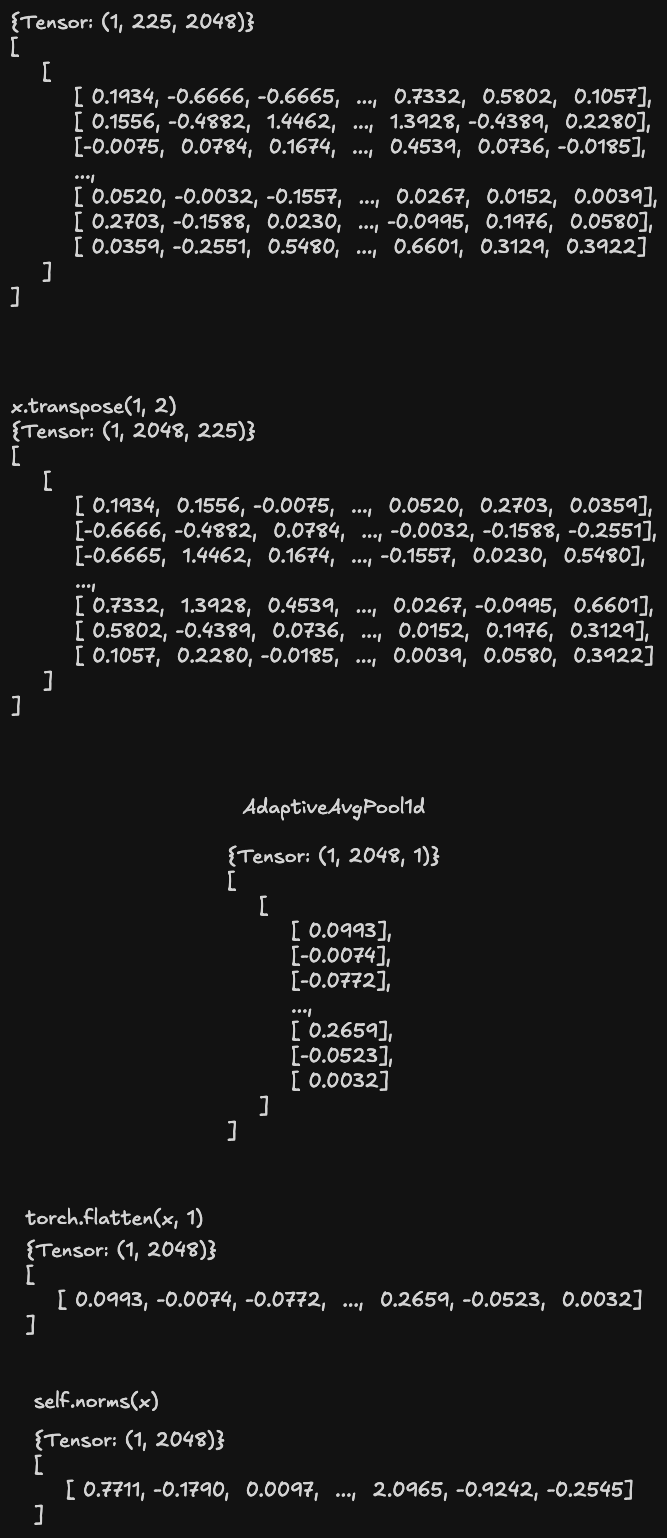
avgpool and norms
avgpool and norms
至此,已基本完成图像的向量嵌入。
对齐
为了与文本的嵌入向量进行相似度比较,还需要对齐图像和文本的嵌入向量,以获得相同向量空间的投影,并再次归一化。
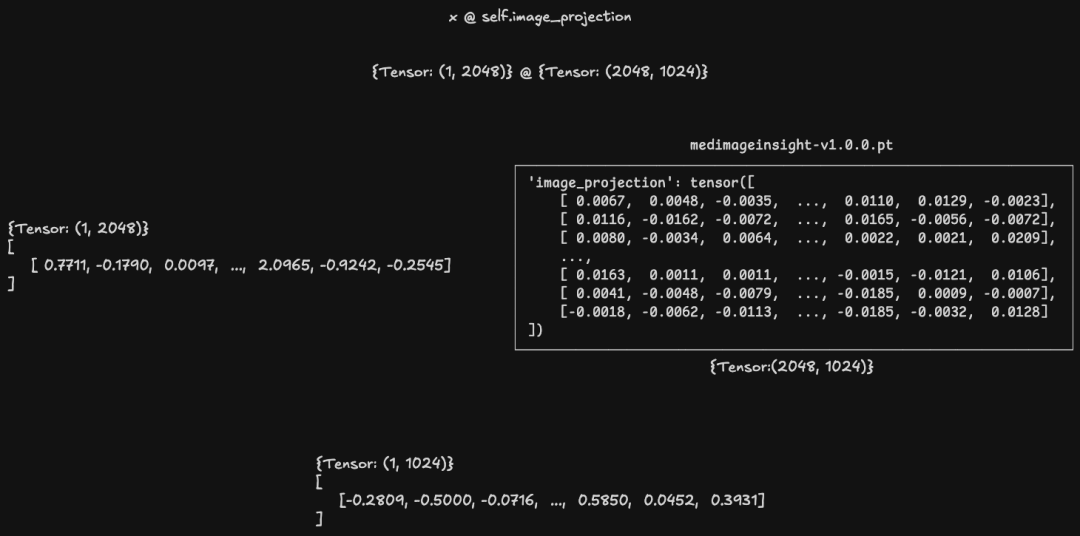
projection
projection
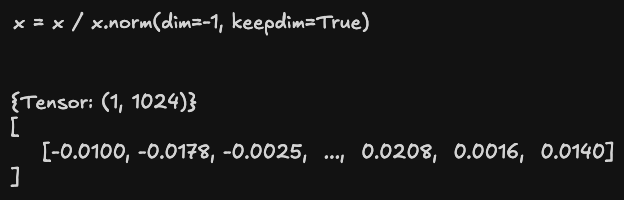
norm
norm
Predict
MI2 在预测图像和文本相似度时,调用 run_inference_batch[11] 方法,计算每对图像和文本向量的余弦相似度,再用一个预训练的缩放参数放大相似度值,增强区分性:
# Run inference
with torch.no_grad():
    outputs = self.model(image=images, text=text_tokens)
    logits_per_image = outputs[0] @ outputs[1].t() * outputs[2]

    if multilabel:
        # Use sigmoid for independent probabilities per label
        probs = torch.sigmoid(logits_per_image)
    else:
        # Use softmax for single-label classification
        probs = logits_per_image.softmax(dim=1)
其中 outputs 是图像向量矩阵、文本向量矩阵和缩放参数常量的集合:
UniCLModel.forward[12]
def forward(self, image, text):
    features_image = self.encode_image(image)
    features_text = self.encode_text(text)

    # cosine similarity as logits
    T = self.logit_scale.exp()

    return features_image, features_text, T
余弦相似度计算方式为:
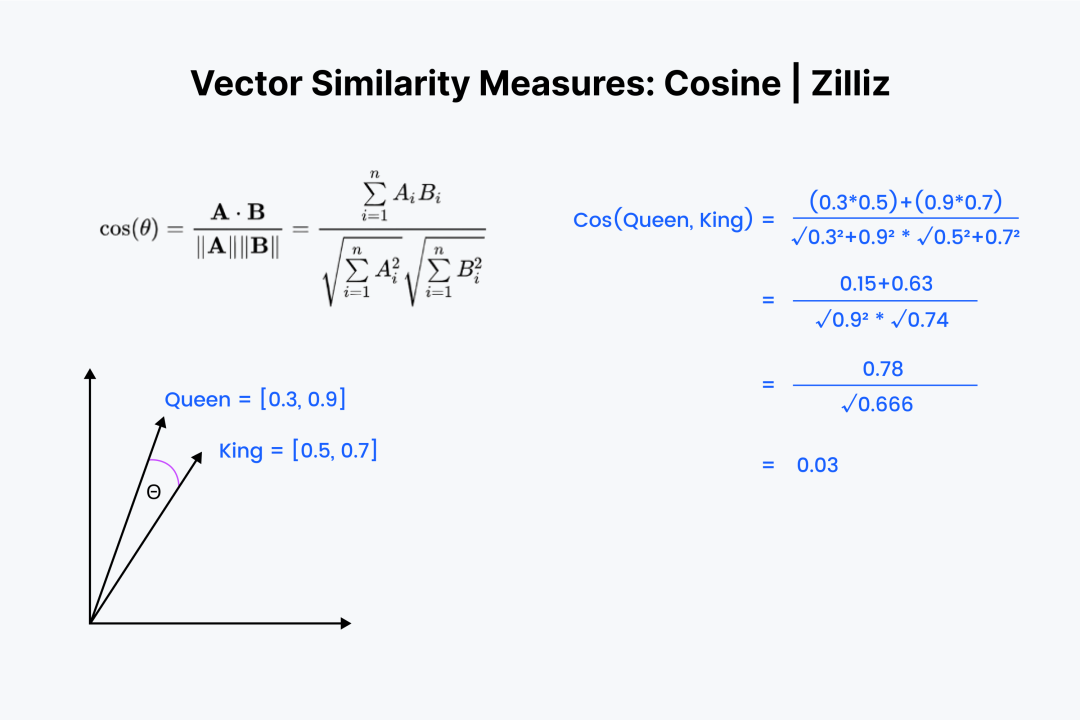
cosine
cosine
因为 MI2 的 Image Encoder 和 Text Encoder 最后都进行了归一化,此时计算余弦相似度与计算内积等同:
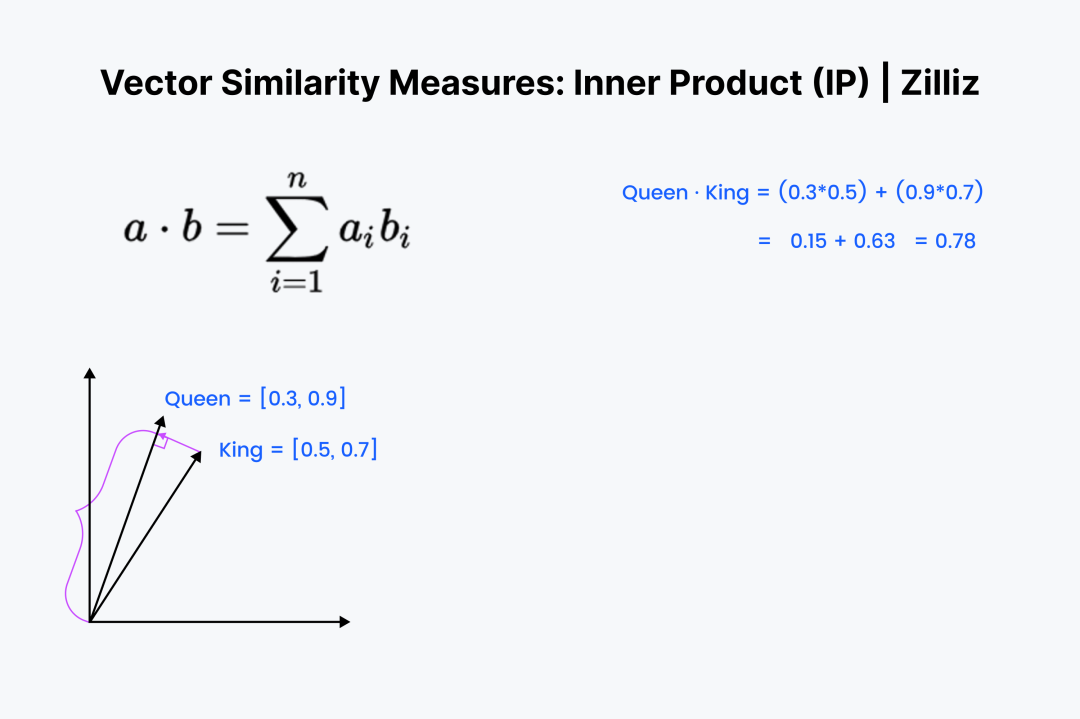
inner product
inner product
参考资料
[1]
浅析 Embedding 模型: https://alphahinex.github.io/2026/01/25/dive-into-embedding-model/
[2]
lion-ai/MedImageInsights: https://huggingface.co/lion-ai/MedImageInsights
[3]
MedImageInsight/ImageEncoder: https://huggingface.co/lion-ai/MedImageInsights/tree/main/MedImageInsight/ImageEncoder
[4]
DaViT: https://arxiv.org/abs/2204.03645
[5]
2024.09.27/config.yaml: https://huggingface.co/lion-ai/MedImageInsights/blob/main/2024.09.27/config.yaml
[6]
DaViT: Dual Attention Vision Transformers: https://arxiv.org/abs/2204.03645
[7]
DaViT:双注意力Vision Transformer: https://zhuanlan.zhihu.com/p/500202422
[8]
ConvEmbed: https://huggingface.co/lion-ai/MedImageInsights/blob/main/MedImageInsight/ImageEncoder/davit_v1.py#L109-L155
[9]
Conv2d: https://docs.pytorch.org/docs/stable/generated/torch.nn.Conv2d.html
[10]
davit_v1.py#L625-L627: https://huggingface.co/lion-ai/MedImageInsights/blob/main/MedImageInsight/ImageEncoder/davit_v1.py#L625-L627
[11]
run_inference_batch: https://huggingface.co/lion-ai/MedImageInsights/blob/main/medimageinsightmodel.py#L225-L235
[12]
UniCLModel.forward: https://huggingface.co/lion-ai/MedImageInsights/blob/main/MedImageInsight/UniCLModel.py#L185-L192
【图解AI:动图】各种类型的卷积,你认全了吗?
【图解AI:动图】各种类型的卷积,你认全了吗?
浅析 Embedding 模型
浅析 Embedding 模型
MedImageInsight
MedImageInsight
torch.nn.Embedding 中 max_norm 的作用
torch.nn.Embedding 中 max_norm 的作用
本文参与 腾讯云自媒体同步曝光计划,分享自微信公众号。
原始发表:2026-02-28,如有侵权请联系 cloudcommunity@tencent.com 删除
目录
腾讯云开发者

Copyright © 2013 - 2026 Tencent Cloud. All Rights Reserved. 腾讯云 版权所有
深圳市腾讯计算机系统有限公司 ICP备案/许可证号:粤B2-20090059  粤公网安备44030502008569号
腾讯云计算(北京)有限责任公司 京ICP证150476号 | 京ICP备11018762号