机器学习全能决策树:CART(Classification and Regression Tree)原理、手动计算与Python/Java双代码实战
原创
机器学习全能决策树:CART(Classification and Regression Tree)原理、手动计算与Python/Java双代码实战
原创
jack.yang
发布于 2026-03-29 15:40:39
发布于 2026-03-29 15:40:39
关键词:机器学习、CART算法、分类回归树、基尼系数、MSE、决策树、Python CART、Java CART、sklearn DecisionTree、代价复杂度剪枝
一句话答案:CART 是唯一同时支持分类与回归的主流决策树算法——分类用基尼系数,回归用最小平方误差,并采用二叉树结构 + 代价复杂度剪枝,是 sklearn、XGBoost 等框架的基石!
如果你在搜索:
- “CART 和 ID3/C4.5 有什么区别?”
- “基尼系数怎么算?”
- “CART 如何做回归预测?”
- “Python 和 Java 怎么手写 CART?”
那么,这篇文章就是为你写的——从分类到回归,从分裂到剪枝,一步不跳。
一、什么是 CART?它为何成为现代决策树的“标准”?
CART(Classification and Regression Tree)由 Breiman 等人在 1984 年提出,是首个统一处理分类与回归任务的决策树算法。
🔑 核心特点(vs ID3/C4.5)
特性 | ID3/C4.5 | CART |
|---|---|---|
树结构 | 多叉树(一个特征多个分支) | 严格二叉树(每个节点仅两个子节点) |
分裂标准 | 信息增益 / 增益率 | 分类:基尼系数;回归:MSE |
剪枝方法 | 悲观剪枝(C4.5) | 代价复杂度剪枝(CCP) |
任务支持 | 仅分类 | ✅ 分类 + 回归 |
连续特征处理 | 需预离散化(ID3)或自动分箱(C4.5) | 天然支持,直接找最优切分点 |
💡 CART 的二叉设计使其易于集成(如随机森林、GBDT),成为现代 ML 框架的事实标准。
二、数学原理:分类用基尼,回归用 MSE
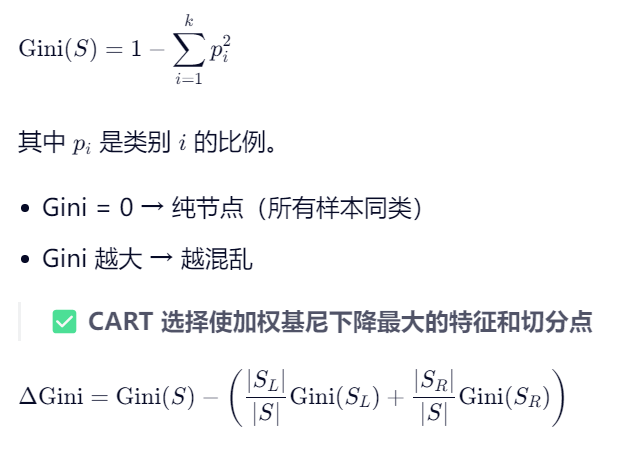
📌 1. 分类任务:基尼不纯度(Gini Impurity)
衡量一个数据集的“混乱程度”:
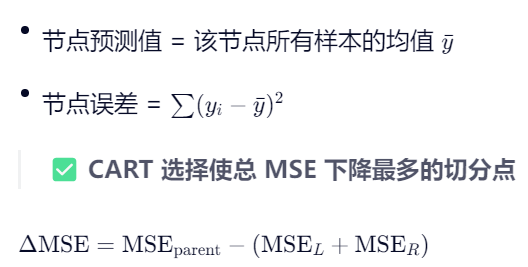
📌 2. 回归任务:最小平方误差(MSE)
目标:最小化预测值与真实值的平方误差。
三、手工推演 Part 1:分类任务(基尼系数)
📊 数据集:是否批准贷款
收入(万) | 房产 | 批准? |
|---|---|---|
30 | 无 | 否 |
50 | 有 | 是 |
70 | 有 | 是 |
40 | 无 | 否 |
60 | 无 | 是 |
目标:构建 CART 分类树。
🔢 步骤1:尝试所有可能的二元划分
候选1:按“房产”划分(天然二元)
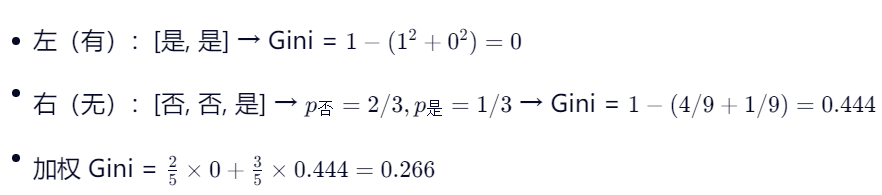
候选2:按“收入”划分(需找切分点)
排序收入:30(否), 40(否), 50(是), 60(是), 70(是)
候选切分点:35, 45, 55, 65
- t=45:
- ≤45:[30(否), 40(否)] → Gini=0
- 45:[50(是),60(是),70(是)] → Gini=0
- 加权 Gini = 0 ← 最优!
✅ 选择 收入 ≤ 45 作为根节点划分。
🌲 最终分类树
        收入 ≤ 45?
         /      \
       是        否
      (否)       (是)
💡 即使“房产”是重要特征,CART 仍可能因二叉+全局最优选择数值特征。
四、手工推演 Part 2:回归任务(MSE)
📊 数据集:房屋面积 vs 价格(万元)
面积(m²) | 价格 |
|---|---|
50 | 100 |
70 | 140 |
90 | 180 |
110 | 200 |
130 | 220 |
目标:预测新房子的价格。
🔢 步骤1:计算根节点 MSE
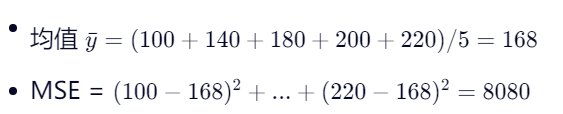
🔢 步骤2:尝试切分点(面积)
排序后候选切分点:60, 80, 100, 120
t=100:
- 左(≤100):[50,70,90] → y=[100,140,180] → 均值=140 → MSE_L = ((40^2 + 0 + 40^2)=3200)
- 右(>100):[110,130] → y=[200,220] → 均值=210 → MSE_R = ((10^2 + 10^2)=200)
- 总 MSE = 3200 + 200 = 3400
- ΔMSE = 8080 - 3400 = 4680(最大下降)
✅ 选择 面积 ≤ 100 为根划分。
🌲 最终回归树
      面积 ≤ 100?
       /        \
    是(140)     否(210)
预测:若面积=80 → 预测价格=140万;面积=120 → 预测=210万。
五、Python 实现(手写 CART 核心)
import numpy as np

class Node:
    def __init__(self, feature=None, threshold=None, left=None, right=None, value=None):
        self.feature = feature        # 划分特征索引
        self.threshold = threshold    # 划分阈值
        self.left = left              # 左子树
        self.right = right            # 右子树
        self.value = value            # 叶节点预测值(分类:类别;回归:均值)

class CART:
    def __init__(self, task='classification', max_depth=5, min_samples_split=2):
        self.task = task
        self.max_depth = max_depth
        self.min_samples_split = min_samples_split
        self.root = None

    def _gini(self, y):
        if len(y) == 0: return 0
        probs = np.bincount(y) / len(y)
        return 1 - np.sum(probs ** 2)

    def _mse(self, y):
        if len(y) == 0: return 0
        return np.sum((y - np.mean(y)) ** 2)

    def _split(self, X, y, feature_idx, threshold):
        left_mask = X[:, feature_idx] <= threshold
        return X[left_mask], y[left_mask], X[~left_mask], y[~left_mask]

    def _best_split(self, X, y):
        best_gain = -1
        best_f, best_t = None, None
        n_features = X.shape[1]

        for f in range(n_features):
            thresholds = np.unique(X[:, f])
            for t in thresholds[:-1]:  # 避免空集
                X_l, y_l, X_r, y_r = self._split(X, y, f, t)
                if len(y_l) == 0 or len(y_r) == 0:
                    continue

                if self.task == 'classification':
                    gain = self._gini(y) - (
                        len(y_l)/len(y) * self._gini(y_l) +
                        len(y_r)/len(y) * self._gini(y_r)
                    )
                else:  # regression
                    gain = self._mse(y) - (self._mse(y_l) + self._mse(y_r))

                if gain > best_gain:
                    best_gain = gain
                    best_f, best_t = f, t

        return best_f, best_t, best_gain

    def _build_tree(self, X, y, depth=0):
        # 停止条件
        if (depth >= self.max_depth or
            len(y) < self.min_samples_split or
            len(np.unique(y)) == 1):
            if self.task == 'classification':
                return Node(value=np.bincount(y).argmax())
            else:
                return Node(value=np.mean(y))

        feature, threshold, gain = self._best_split(X, y)
        if feature is None:
            if self.task == 'classification':
                return Node(value=np.bincount(y).argmax())
            else:
                return Node(value=np.mean(y))

        X_l, y_l, X_r, y_r = self._split(X, y, feature, threshold)
        left = self._build_tree(X_l, y_l, depth+1)
        right = self._build_tree(X_r, y_r, depth+1)

        return Node(feature=feature, threshold=threshold, left=left, right=right)

    def fit(self, X, y):
        self.root = self._build_tree(np.array(X), np.array(y))

    def _predict_sample(self, x, node):
        if node.value is not None:
            return node.value
        if x[node.feature] <= node.threshold:
            return self._predict_sample(x, node.left)
        else:
            return self._predict_sample(x, node.right)

    def predict(self, X):
        return [self._predict_sample(x, self.root) for x in X]

# === 测试分类 ===
X_cls = [[30, 0], [50, 1], [70, 1], [40, 0], [60, 0]]
y_cls = [0, 1, 1, 0, 1]  # 0=否, 1=是
cart_cls = CART(task='classification')
cart_cls.fit(X_cls, y_cls)
print("分类预测:", cart_cls.predict())  # [0]

# === 测试回归 ===
X_reg = [[50], [70], [90], [110], [130]]
y_reg = [100, 140, 180, 200, 220]
cart_reg = CART(task='regression')
cart_reg.fit(X_reg, y_reg)
print("回归预测:", cart_reg.predict())  # [140.0]
六、Java 实现(简化版 CART 核心)
import java.util.*;

public class CART {
    static class Node {
        Integer feature;
        Double threshold;
        Node left, right;
        Object value; // Integer for classification, Double for regression
        Node(Object value) { this.value = value; }
        Node(int f, double t) { this.feature = f; this.threshold = t; }
    }

    private String task;
    private int maxDepth;
    private Node root;

    public CART(String task) {
        this.task = task;
        this.maxDepth = 5;
    }

    private double gini(int[] labels) {
        if (labels.length == 0) return 0;
        Map<Integer, Integer> count = new HashMap<>();
        for (int y : labels) count.put(y, count.getOrDefault(y, 0) + 1);
        double impurity = 1.0;
        for (int c : count.values()) {
            double p = (double) c / labels.length;
            impurity -= p * p;
        }
        return impurity;
    }

    private double mse(double[] y) {
        if (y.length == 0) return 0;
        double mean = Arrays.stream(y).average().orElse(0);
        return Arrays.stream(y).map(v -> (v - mean) * (v - mean)).sum();
    }

    private Node buildTree(double[][] X, int[] y, int depth) {
        if (depth >= maxDepth || y.length < 2) {
            if ("classification".equals(task)) {
                return new Node(majorityClass(y));
            } else {
                return new Node(Arrays.stream(y).average().orElse(0));
            }
        }

        // Find best split (simplified: only first feature)
        int bestFeature = 0;
        double bestThreshold = 0;
        double bestGain = -1;

        // Sort by feature 0
        List<Integer> indices = new ArrayList<>();
        for (int i = 0; i < X.length; i++) indices.add(i);
        indices.sort(Comparator.comparingDouble(i -> X[i][0]));

        for (int i = 0; i < indices.size() - 1; i++) {
            int idx1 = indices.get(i), idx2 = indices.get(i + 1);
            if (y[idx1] != y[idx2]) {
                double t = (X[idx1][0] + X[idx2][0]) / 2;
                // Split
                List<Integer> leftIdx = new ArrayList<>(), rightIdx = new ArrayList<>();
                for (int j = 0; j < X.length; j++) {
                    if (X[j][0] <= t) leftIdx.add(j); else rightIdx.add(j);
                }
                if (leftIdx.isEmpty() || rightIdx.isEmpty()) continue;

                // Compute gain
                double gain;
                if ("classification".equals(task)) {
                    int[] yArr = y;
                    int[] yLeft = leftIdx.stream().mapToInt(j -> yArr[j]).toArray();
                    int[] yRight = rightIdx.stream().mapToInt(j -> yArr[j]).toArray();
                    gain = gini(y) - (leftIdx.size()/(double)y.length * gini(yLeft) +
                                      rightIdx.size()/(double)y.length * gini(yRight));
                } else {
                    double[] yD = Arrays.stream(y).mapToDouble(v -> v).toArray();
                    double[] yLeft = leftIdx.stream().mapToDouble(j -> yD[j]).toArray();
                    double[] yRight = rightIdx.stream().mapToDouble(j -> yD[j]).toArray();
                    gain = mse(yD) - (mse(yLeft) + mse(yRight));
                }

                if (gain > bestGain) {
                    bestGain = gain;
                    bestThreshold = t;
                }
            }
        }

        if (bestGain <= 0) {
            if ("classification".equals(task)) {
                return new Node(majorityClass(y));
            } else {
                return new Node(Arrays.stream(y).average().orElse(0));
            }
        }

        // Recursively build
        List<Integer> leftIdx = new ArrayList<>(), rightIdx = new ArrayList<>();
        for (int i = 0; i < X.length; i++) {
            if (X[i][0] <= bestThreshold) leftIdx.add(i); else rightIdx.add(i);
        }
        double[][] XLeft = leftIdx.stream().mapToDouble(i -> X[i]).toArray();
        double[][] XRight = rightIdx.stream().mapToDouble(i -> X[i]).toArray();
        int[] yLeft = leftIdx.stream().mapToInt(i -> y[i]).toArray();
        int[] yRight = rightIdx.stream().mapToInt(i -> y[i]).toArray();

        Node node = new Node(bestFeature, bestThreshold);
        node.left = buildTree(XLeft, yLeft, depth + 1);
        node.right = buildTree(XRight, yRight, depth + 1);
        return node;
    }

    private int majorityClass(int[] y) {
        Map<Integer, Integer> count = new HashMap<>();
        for (int label : y) count.put(label, count.getOrDefault(label, 0) + 1);
        return Collections.max(count.entrySet(), Map.Entry.comparingByValue()).getKey();
    }

    public void fit(double[][] X, int[] y) {
        this.root = buildTree(X, y, 0);
    }

    // 预测方法略(递归遍历树)
}
💡 完整 Java 实现需处理多特征、通用预测等,此处展示核心分裂逻辑。
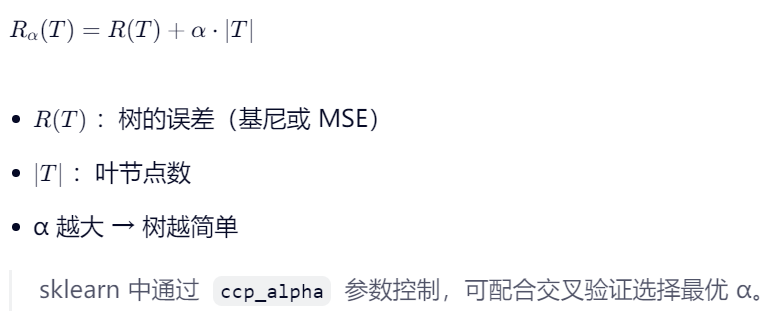
七、CART 的剪枝:代价复杂度剪枝(CCP)
CART 使用 α 参数 控制树复杂度:
八、优缺点 & 适用场景总结
优点 | 缺点 |
|---|---|
✅ 统一支持分类与回归 | ❌ 单棵树易过拟合(需剪枝或集成) |
✅ 二叉结构利于集成(RF/GBDT) | ❌ 对噪声敏感 |
✅ 天然处理连续特征 | ❌ 忽略特征间线性关系 |
✅ 可解释性强 | ❌ 不稳定(数据微变 → 树大变) |
🎯 最佳应用场景:
- 快速原型开发(sklearn 一行代码)
- 作为集成学习基学习器(随机森林、XGBoost)
- 需要回归预测的场景(房价、销量)
- 中小结构化数据集
✅ 结语
CART 用极简的二叉设计,打通了分类与回归的任督二脉。它不仅是独立模型,更是现代集成学习的基石。
记住:在机器学习中,简单而通用的设计,往往最具生命力。
现在,你已经能:
- 手动计算基尼系数与 MSE 分裂
- 用 Python/Java 从零实现 CART
- 理解其在 sklearn 和集成算法中的核心地位
相关链接
- 📂 大模型技术专栏: 欢迎您到访 「大模型系列」。 在这个由参数驱动、以数据为燃料的新智能时代,大语言模型(LLM)已不再是实验室里的前沿概念,而是正在重塑搜索、办公、编程、教育、医疗乃至整个数字世界的底层引擎。从 GPT 到 Llama,从 Claude 到 Qwen,从推理到多模态,大模型正以前所未有的速度进化——它们既是工具,也是平台,更可能是下一代人机交互的“操作系统”。 本系列将带你:
- 🔍 深入原理:从 Transformer 架构、注意力机制到训练范式(预训练、微调、RLHF);
- ⚙️ 动手实践:本地部署、模型微调、RAG 构建、Agent 设计等实战指南;
- 🧠 理解边界:幻觉、偏见、安全对齐、推理瓶颈与当前能力天花板;
- 🌍 洞察趋势:开源 vs 闭源、端侧部署、MoE 架构、世界模型与 AGI 路径;
- 💼 落地应用:如何在企业中安全、高效、低成本地集成大模型能力。
无论你是想写代码调用 API 的开发者,设计 AI 产品的 PM,评估技术路线的管理者,还是单纯好奇智能本质的思考者,这里都有值得你驻足的内容。 不追 hype,只讲逻辑;不谈玄学,专注可复现的认知。 让我们一起,在这场百年一遇的智能革命中,看得更清,走得更稳 https://cloud.tencent.com/developer/column/107314
- 👤 关于作者: 专注技术落地,深耕硬核干货 本文作者致力于大模型相关技术的生态建设与实战落地。不同于浅层的概念科普,作者坚持 “手算 + 代码” 的深度分享模式,主张通过手动推演理解算法本质,结合生产级代码验证理论可行性。 请关注我主页:https://cloud.tencent.com/developer/user/2276240
原创声明:本文系作者授权腾讯云开发者社区发表,未经许可,不得转载。
如有侵权,请联系 cloudcommunity@tencent.com 删除。
目录
腾讯云开发者

Copyright © 2013 - 2026 Tencent Cloud. All Rights Reserved. 腾讯云 版权所有
深圳市腾讯计算机系统有限公司 ICP备案/许可证号:粤B2-20090059  粤公网安备44030502008569号
腾讯云计算(北京)有限责任公司 京ICP证150476号 | 京ICP备11018762号