2026-05-20:最好可到达的塔。用go语言,给定一个二维整数数组 towers,其中每个元素 towers[i] = [x_i, y_i, q_i] 表示第 i 座塔的坐标

2026-05-20:最好可到达的塔。用go语言,给定一个二维整数数组 towers,其中每个元素 towers[i] = [x_i, y_i, q_i] 表示第 i 座塔的坐标

福大大架构师每日一题
发布于 2026-05-20 13:41:54
发布于 2026-05-20 13:41:54
2026-05-20:最好可到达的塔。用go语言,给定一个二维整数数组 towers,其中每个元素 towers[i] = [x_i, y_i, q_i] 表示第 i 座塔的坐标与质量因子。
再给定一个整数数组 center = [c_x, c_y] 表示你的所在位置,以及一个整数 radius。
判断规则:当某座塔与 center 的曼哈顿距离满足
|x_i - c_x| + |y_i - c_y| <= radius
时,这座塔被认为是“可到达”。
目标:在所有可到达的塔里,选择:
1.质量因子 q_i 最大的塔;
2.如果有多个塔的 q_i 相同,则在它们中选择坐标按字典序最小的那一个(先比较 x,x 更小者更优;若 x 相同,再比较 y,y 更小者更优)。
如果没有任何塔可到达,则返回 [-1, -1];否则返回该选中塔的坐标 [x_i, y_i]。
1 <= towers.length <= 100000。
towers[i] = [xi, yi, qi]。
center = [cx, cy]。
0 <= xi, yi, qi, cx, cy <= 100000。
0 <= radius <= 100000。
输入: towers = [[1,2,5], [2,1,7], [3,1,9]], center = [1,1], radius = 2。
输出: [3,1]。
解释:
塔 [1, 2, 5]:曼哈顿距离 = |1 - 1| + |2 - 1| = 1,可到达。
塔 [2, 1, 7]:曼哈顿距离 = |2 - 1| + |1 - 1| = 1,可到达。
塔 [3, 1, 9]:曼哈顿距离 = |3 - 1| + |1 - 1| = 2,可到达。
所有塔都是可到达的。最大质量因子为 9,对应塔 [3, 1]。
题目来自力扣3809。
一、程序整体执行步骤
步骤1:程序启动,进入主函数 main
程序从 main 函数开始运行,首先准备好题目给出的所有输入数据:
- 1. 塔数组 towers:存储了 3 座塔的信息
- • 第 1 座塔:坐标 (1,2),质量因子 5
- • 第 2 座塔:坐标 (2,1),质量因子 7
- • 第 3 座塔:坐标 (3,1),质量因子 9
- 2. 中心位置 center:你的位置坐标 (1,1)
- 3. 半径 radius:可到达的最大曼哈顿距离 2
步骤2:调用核心函数 bestTower,开始筛选最优塔
程序把所有输入数据传入 bestTower 函数,正式开始计算。
子步骤 2.1:初始化筛选变量(设置初始状态)
函数一开始会创建 3 个关键变量,用来记录当前最优塔的信息:
- 1.
maxQ:记录当前找到的最大质量因子,初始值设为 -1(因为质量因子最小是 0,-1 代表还没找到任何可到达塔) - 2.
minX:记录最优塔的 x 坐标,初始 -1 - 3.
minY:记录最优塔的 y 坐标,初始 -1
这三个变量会在遍历过程中不断更新,最终保存最优塔的信息。
子步骤 2.2:遍历每一座塔,逐个判断是否符合条件
函数会依次检查每一座塔,对每一座塔执行以下判断流程:
检查第 1 座塔:(1,2,5)
- 1. 计算曼哈顿距离:|1-1| + |2-1| = 0 + 1 = 1
- 2. 判断是否可到达:1 ≤ 2 → 可到达
- 3. 对比当前最优:
- • 当前最大质量因子是 -1,5 更大
- • 因此更新最优记录:maxQ=5,minX=1,minY=2
检查第 2 座塔:(2,1,7)
- 1. 计算曼哈顿距离:|2-1| + |1-1| = 1 + 0 = 1
- 2. 判断是否可到达:1 ≤ 2 → 可到达
- 3. 对比当前最优:
- • 当前最大质量因子是 5,7 更大
- • 因此更新最优记录:maxQ=7,minX=2,minY=1
检查第 3 座塔:(3,1,9)
- 1. 计算曼哈顿距离:|3-1| + |1-1| = 2 + 0 = 2
- 2. 判断是否可到达:2 ≤ 2 → 可到达
- 3. 对比当前最优:
- • 当前最大质量因子是 7,9 更大
- • 因此更新最优记录:maxQ=9,minX=3,minY=1
子步骤 2.3:遍历完成,返回结果
所有塔检查完毕后:
- •
maxQ = 9(不是 -1,说明找到可到达塔) - • 最优坐标是 (3,1)
函数直接返回
[3, 1]
步骤3:主函数接收结果并打印
main 函数拿到结果 [3,1],输出到控制台,程序结束。
二、关键筛选规则(严格按题目要求)
遍历每一座可到达塔时,只有满足以下任一条件,才会更新最优塔:
- 1. 当前塔的质量因子 > 记录的最大质量因子
- 2. 质量因子相等,且:
- • 当前塔 x 坐标 < 记录的 x 坐标
- • 或者 x 相等,当前塔 y 坐标 < 记录的 y 坐标
如果没有任何塔可到达,最终返回 [-1, -1]。
三、时间复杂度 & 额外空间复杂度
1. 时间复杂度
- • 程序只做了一次完整遍历,逐个检查每一座塔
- • 遍历次数 = 塔的数量 n
- • 每一次遍历内部只做:计算距离、判断、赋值,都是常数时间 O(1)
- • 总时间复杂度:O(n)
- • n 是 towers 数组的长度(塔的数量)
- • 即使 n 达到 10 万,这个算法也能高效运行
2. 额外空间复杂度
- • 程序只创建了固定数量的变量:cx、cy、maxQ、minX、minY、循环临时变量等
- • 这些变量的数量不随塔的数量 n 变化
- • 没有使用动态数组、哈希表等随输入变大的数据结构
- • 总额外空间复杂度:O(1)(常数级空间)
总结
- 1. 执行过程:初始化 → 遍历每座塔 → 计算曼哈顿距离 → 按规则更新最优塔 → 返回结果
- 2. 时间复杂度:O(n)(线性遍历)
- 3. 额外空间复杂度:O(1)(仅使用固定变量)
Go完整代码如下:
.
package main

import (
    "fmt"
)

func bestTower(towers [][]int, center []int, radius int) []int {
    cx, cy := center[0], center[1]
    maxQ, minX, minY := -1, -1, -1
    for _, t := range towers {
        x, y, q := t[0], t[1], t[2]
        if abs(x-cx)+abs(y-cy) <= radius &&
            (q > maxQ || q == maxQ && (x < minX || x == minX && y < minY)) {
            maxQ, minX, minY = q, x, y
        }
    }
    return []int{minX, minY}
}

func abs(x int)int {
    if x < 0 {
        return -x
    }
    return x
}

func main() {
    towers := [][]int{{1, 2, 5}, {2, 1, 7}, {3, 1, 9}}
    center := []int{1, 1}
    radius := 2
    result := bestTower(towers, center, radius)
    fmt.Println(result)
}
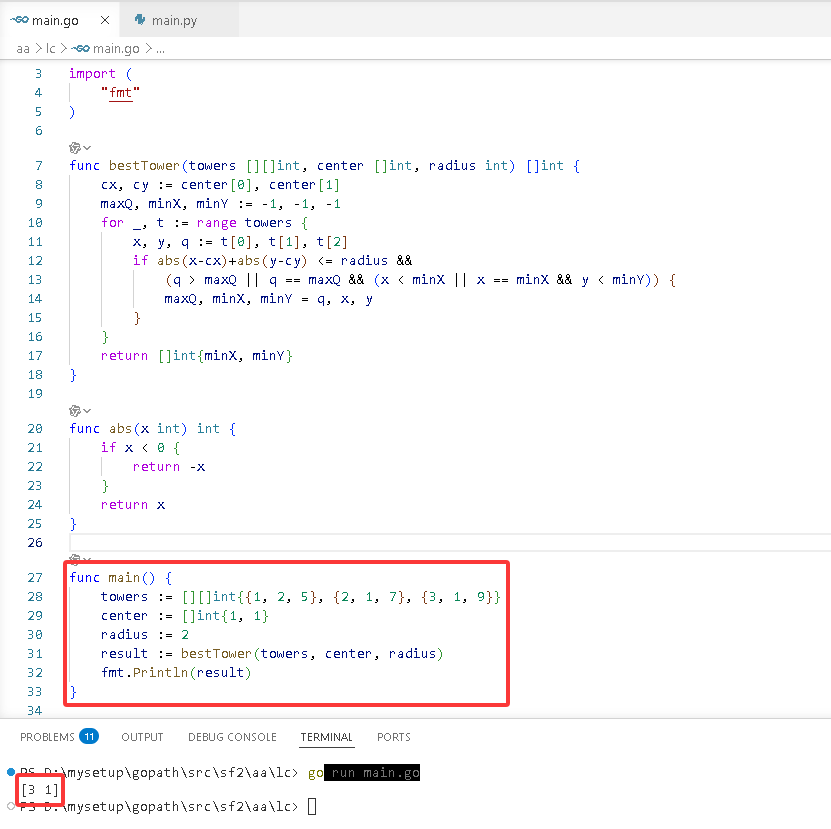
在这里插入图片描述
Python完整代码如下:
.
# -*-coding:utf-8-*-

def best_tower(towers, center, radius):
    cx, cy = center[0], center[1]
    max_q, min_x, min_y = -1, -1, -1

    for x, y, q in towers:
        if abs(x - cx) + abs(y - cy) <= radius:
            if (q > max_q or
                q == max_q and (x < min_x or (x == min_x and y < min_y))):
                max_q, min_x, min_y = q, x, y

    return [min_x, min_y]


def main():
    towers = [[1, 2, 5], [2, 1, 7], [3, 1, 9]]
    center = [1, 1]
    radius = 2
    result = best_tower(towers, center, radius)
    print(result)


if __name__ == "__main__":
    main()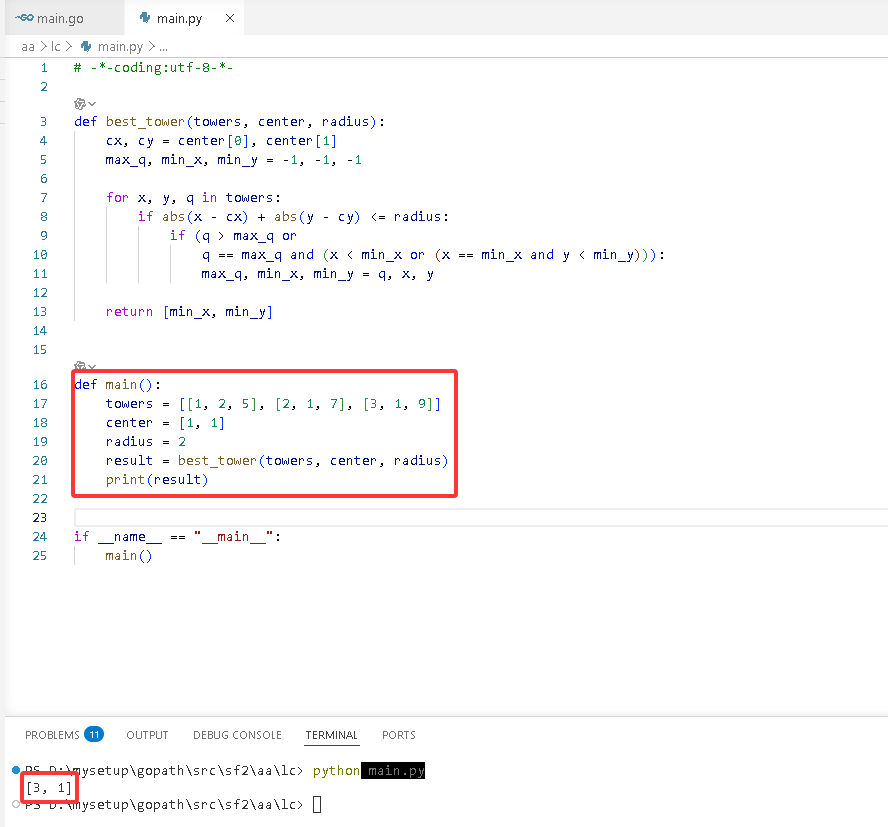
在这里插入图片描述
C++完整代码如下:
.
#include <iostream>
#include <vector>
#include <cmath>

using namespace std;

vector<int> bestTower(vector<vector<int>>& towers, vector<int>& center, int radius) {
    int cx = center[0];
    int cy = center[1];
    int maxQ = -1;
    int minX = -1;
    int minY = -1;

    for (const auto& tower : towers) {
        int x = tower[0];
        int y = tower[1];
        int q = tower[2];

        int manhattanDistance = abs(x - cx) + abs(y - cy);

        if (manhattanDistance <= radius) {
            if (q > maxQ) {
                maxQ = q;
                minX = x;
                minY = y;
            } elseif (q == maxQ) {
                if (x < minX) {
                    minX = x;
                    minY = y;
                } elseif (x == minX && y < minY) {
                    minY = y;
                }
            }
        }
    }

    return {minX, minY};
}

int main() {
    vector<vector<int>> towers = {{1, 2, 5}, {2, 1, 7}, {3, 1, 9}};
    vector<int> center = {1, 1};
    int radius = 2;

    vector<int> result = bestTower(towers, center, radius);

    cout << "[" << result[0] << ", " << result[1] << "]" << endl;

    return0;
}
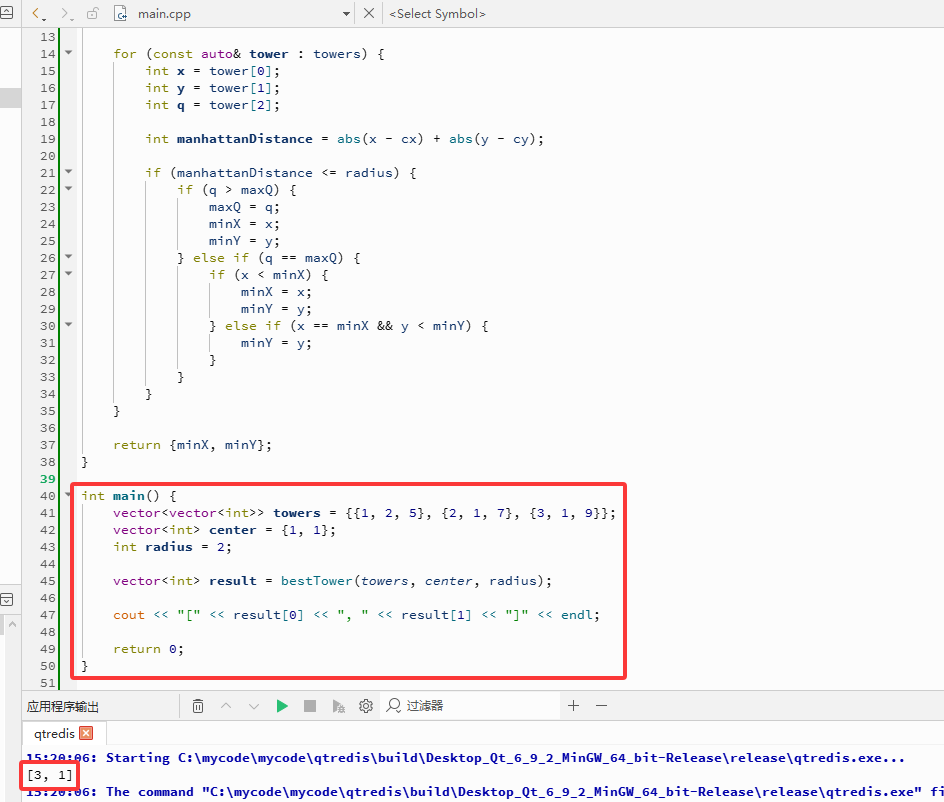
在这里插入图片描述
本文参与 腾讯云自媒体同步曝光计划,分享自微信公众号。
原始发表:2026-05-19,如有侵权请联系 cloudcommunity@tencent.com 删除
评论
登录后参与评论
推荐阅读
目录
腾讯云开发者

Copyright © 2013 - 2026 Tencent Cloud. All Rights Reserved. 腾讯云 版权所有
深圳市腾讯计算机系统有限公司 ICP备案/许可证号:粤B2-20090059  粤公网安备44030502008569号
腾讯云计算(北京)有限责任公司 京ICP证150476号 | 京ICP备11018762号