智胜|The Forward Deployed Engineer Competency Model

智胜|The Forward Deployed Engineer Competency Model

凯哥
发布于 2026-05-25 13:03:11
发布于 2026-05-25 13:03:11
智胜 | The Intelligence Edge · Lean AI Series
The Forward Deployed Engineer Competency Model
From AI demos to production impact: a field-tested framework for the most important role in enterprise AI transformation.
By Kai Shi · Founder of Lean AI Methodology · Distilled from 30+ enterprise AI and digital transformation projects
This article introduces my FDE-C6 Competency Model, distilled from more than 30 hands-on enterprise AI, data, digital transformation, agentic workflow, and industry AI implementation projects. It is not a theoretical job description. It is a practical model for hiring, training, evaluating, and scaling Forward Deployed Engineers in the AI-native enterprise.
Over the past few years, I have worked across transportation, energy, manufacturing, finance, urban operations, data platforms, high-quality datasets, AI agents, and enterprise digital transformation. The same pattern keeps appearing: enterprises do not fail because they lack models. They fail because they cannot move AI from a promising demo into a real workflow, a real system, a real operating model, and a measurable business result.
That gap is exactly where the Forward Deployed Engineer, or FDE, becomes critical.
Palantir popularized the forward-deployed engineering model by embedding engineers directly with customers to solve mission-critical problems. In Palantir’s own framing, an FDSE focuses on enabling many capabilities for a single customer, while working close to real customer operations. In the AI era, Anthropic’s Forward Deployed Engineer role points in an even more explicit direction: build production applications with Claude inside customer systems, deliver artifacts such as MCP servers, sub-agents, and agent skills, support enterprise deployment, and codify repeatable deployment patterns back into product and engineering teams.
In the AI era, the FDE is no longer just a customer-facing engineer. The FDE is the person who turns AI capability into operational capability.
Why FDEs Matter More in the AI Era
Traditional software projects were mostly about digitizing workflows. AI projects are different. They are about embedding judgment, knowledge, prediction, generation, reasoning, and action into workflows.
A traditional system answers the question: “What should the process do next?” An AI-native system answers a harder question: “What does this situation mean, what should we infer, what should we recommend, and what action should be taken under which control boundary?”
That shift changes the talent model. Enterprises no longer need only software developers, data engineers, solution architects, consultants, or product managers. They need people who can combine all of those capabilities in the field.
A true FDE can enter a complex customer environment, identify a high-value business problem, map the workflow, understand the data, design an AI solution, build the first production-grade version, integrate it with enterprise systems, set governance boundaries, measure business value, and then turn the project into a reusable deployment pattern.
The Definition: What Is an FDE?
My working definition is:
A Forward Deployed Engineer is an AI-native field engineering role that embeds into customer reality, identifies high-value operational problems, connects data, models, tools, workflows, and governance, and delivers production-grade AI systems that create measurable business impact.
This definition contains five important ideas:
- Field reality: the FDE works close to the actual users, systems, constraints, and operating environment.
- Value orientation: the FDE starts from business outcomes, not model features.
- Engineering ownership: the FDE can build, integrate, deploy, and iterate.
- AI-native thinking: the FDE understands LLMs, RAG, agents, tools, evaluations, workflows, and human-in-the-loop controls.
- Compounding leverage: the FDE turns one project into reusable templates, connectors, playbooks, and product feedback.
The FDE-C6 Competency Model
Based on my project experience, I propose a six-dimensional model:
FDE-C6 = Customer × Context × Code × Cognition × Control × Compounding

In plain language, a strong FDE must be able to win trust, frame the right problem, build real systems, understand the business and AI architecture, design safe operating boundaries, and compound each deployment into repeatable organizational capability.
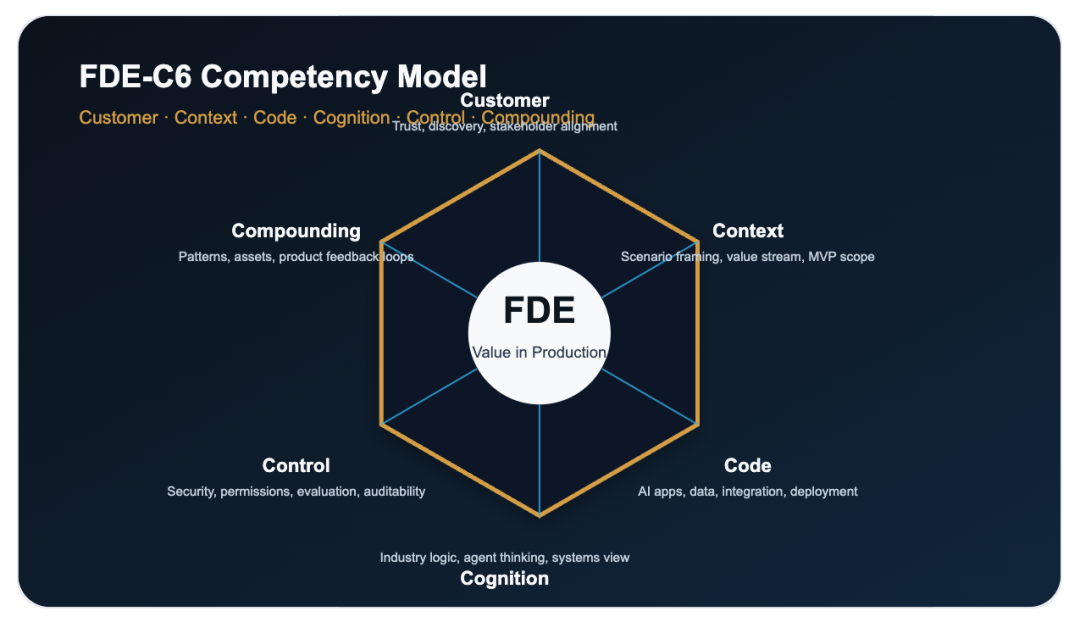
FDE-C6 Competency ModelCustomer · Context · Code · Cognition · Control · CompoundingFDEValue in ProductionCustomerContextCodeCognitionControlCompoundingTrust, discovery, stakeholder alignmentScenario framing, value stream, MVP scopeAI apps, data, integration, deploymentIndustry logic, agent thinking, systems viewSecurity, permissions, evaluation, auditabilityPatterns, assets, product feedback loops
1. Customer: Enter the Real Business Scene
The first competency of an FDE is not coding. It is earning the right to enter the real business scene. Many enterprise AI projects fail because the stated requirement is not the real problem. A customer may ask for a knowledge base, but the real issue is slow onboarding. A team may ask for a chatbot, but the real issue is fragmented operational knowledge. A business unit may ask for an agent, but the real issue is that no one has mapped the decision workflow.
A strong FDE can interview executives, frontline users, data owners, IT teams, security teams, and process owners. More importantly, they can translate between these groups.
Customer Competency | What It Looks Like in Practice |
|---|---|
Discovery | Identifies the actual operational pain behind the requested AI solution. |
Stakeholder alignment | Aligns business, IT, data, security, and leadership expectations. |
Trust building | Earns access to real workflows, real data, and real user feedback. |
Translation | Turns business language into technical design and technical constraints into business tradeoffs. |
2. Context: Frame the Right AI Scenario
The most expensive AI projects often start with the wrong scenario. In Lean AI, scenario selection is not brainstorming. It is a disciplined prioritization process.
I often use a simple field formula:
AI Scenario Priority = Business Value × Frequency × Expert Dependency × Data Readiness × Workflow Embedability ÷ Risk Complexity
This is not meant to be mathematically perfect. It is meant to prevent AI teams from chasing shiny demos. The best FDEs know how to identify scenarios where AI can create value quickly, safely, and repeatedly.
In a 90-day MVP, the question is not “Can we build an impressive AI feature?” The question is “Can we improve a measurable business workflow with acceptable data, acceptable risk, and real users?”
3. Code: Build Production-Grade AI, Not Slideware
FDEs must build. They do not stop at strategy. They do not stop at architecture diagrams. They do not stop at demos.
A modern FDE should be comfortable with full-stack development, API integration, data pipelines, vector databases, RAG systems, agent orchestration, tool calling, MCP-style integration patterns, evaluation frameworks, observability, security, and deployment.
The practical test is simple:
Can this person turn a vague business problem into a working AI system that survives contact with real users, real data, real permissions, real latency, real exceptions, and real enterprise constraints?
4. Cognition: Understand Business, AI, and Organizational Logic
The FDE needs cognitive range. They must understand not only technology, but also industry logic, process logic, decision logic, and organizational logic.
In the agentic AI era, this becomes even more important. An agent is not a chatbot. An enterprise agent is a bounded work unit: it has a role, a task, knowledge, data access, tools, permissions, evaluation, and audit trails.
A weak FDE asks, “Which model should we use?” A strong FDE asks:
- Which business role is this agent augmenting?
- What decision or action is it responsible for?
- What knowledge and data can it access?
- What tools can it call?
- Which actions require human confirmation?
- How do we evaluate quality, risk, and business impact?
5. Control: Design the Governance Boundary
In enterprise AI, the most dangerous system is not the one that fails loudly. It is the one that appears useful while quietly violating permissions, hallucinating decisions, leaking data, or automating actions that should require human approval.
Therefore, governance is not a compliance afterthought. For FDEs, governance is a design material.
Control Area | Core FDE Question |
|---|---|
Data control | What data can be used, by whom, under what purpose, and with what masking or retention rule? |
Permission control | What can the agent see, reason over, recommend, or execute? |
Action control | Which actions are automatic, which require approval, and which are prohibited? |
Evaluation control | How do we test accuracy, completeness, safety, and business usefulness? |
Audit control | Can we reconstruct what happened, why, and under whose authority? |
6. Compounding: Turn Delivery into Reusable Capability
A normal delivery team finishes a project and moves on. A great FDE team finishes a project and leaves behind a stronger organization.
Every serious FDE deployment should generate reusable assets:
- Scenario assets: use-case templates, workflow maps, ROI logic, user stories.
- Data assets: data dictionaries, sample datasets, labeling guidelines, evaluation sets.
- Agent assets: role definitions, task flows, tool access patterns, prompt policies, HITL rules.
- Engineering assets: connectors, MCP servers, API wrappers, deployment scripts, monitoring templates.
- Operating assets: adoption playbooks, metric dashboards, feedback loops, governance checklists.
This compounding effect is what separates FDE from project staffing. The best FDEs do not merely deliver customer value. They convert customer value into product learning, platform capability, and repeatable methodology.
The FDE Maturity Ladder
For hiring, training, and evaluation, I recommend a four-level maturity model.
FDE Maturity LadderFrom AI application delivery to reusable enterprise AI operating capabilityL1L2L3L4AI App EngineerScenario FDESolution FDEPlatform FDEBuilds AI featuresShips 90-day MVPsOwns complex deploymentsTurns projects into platformsIncreasing business ownership and organizational leverage
Level | Role | Core Capability | Limitation |
|---|---|---|---|
L1 | AI Application Engineer | Builds AI features from defined requirements. | Needs others to define the scenario and value logic. |
L2 | Scenario FDE | Discovers business pain and ships a 90-day MVP. | May still need support on complex integration and governance. |
L3 | Solution FDE | Owns complex customer deployments end to end. | May not yet convert every deployment into platform leverage. |
L4 | Platform FDE | Turns repeated deployments into product patterns, platforms, and operating systems. | This is rare and should be treated as strategic talent. |
The FDE Production Impact Loop
In my experience, the best FDEs follow a loop, not a waterfall.
The FDE Production Impact LoopHow AI moves from demo to embedded workflow and measurable business valueProductionAI Value1. Discover2. Frame3. Build4. Govern5. Operate6. Compoundreal pain, real users, real workflowscenario, ROI, MVP boundariesagents, RAG, tools, integrationpermissions, evals, audit, HITLusage, feedback, metrics, iterationtemplates, connectors, playbooks
- Discover: observe real users, workflows, pain points, and constraints.
- Frame: define the AI scenario, business value, success metric, and MVP boundary.
- Build: integrate data, models, tools, agents, workflows, and user interfaces.
- Govern: design permissions, evaluation, human review, safety, and auditability.
- Operate: monitor adoption, quality, feedback, cost, latency, and business impact.
- Compound: codify what worked into reusable templates, connectors, playbooks, and product improvements.
How to Hire FDEs
Hiring FDEs only by traditional software engineering criteria is a mistake. Coding matters, but it is not enough. Consulting communication matters, but it is not enough. AI experience matters, but it is not enough.
I would look for seven forms of evidence:
Evidence | What to Look For |
|---|---|
Production experience | Has built systems that real users depended on. |
Customer-facing maturity | Can handle ambiguity, pressure, conflicting stakeholders, and executive conversations. |
AI-native engineering | Understands LLMs, RAG, agents, tool use, evaluations, and deployment tradeoffs. |
Data fluency | Can reason about data quality, lineage, permission, schema, and evaluation sets. |
Scenario judgment | Can select the right use case instead of chasing technical novelty. |
Integration discipline | Can connect AI into existing enterprise systems and workflows. |
Pattern thinking | Can turn one deployment into a reusable asset. |
Five Interview Questions I Would Ask
1. A manufacturer asks for an “enterprise knowledge base.” What would you do in the first two weeks?
Strong candidates will not start with vector databases. They will identify users, decisions, knowledge sources, failure modes, workflow moments, success metrics, and governance requirements.
2. Design a quality root-cause analysis agent for a factory.
Strong candidates will discuss work orders, defect history, equipment logs, batch data, process parameters, expert review, evidence traceability, and action boundaries.
3. A CEO wants an AI MVP in three weeks, but IT says system integration will take two months. What do you do?
Strong candidates will propose a staged plan: offline data MVP, controlled workflow pilot, interface backlog, risk boundary, and measurable adoption target.
4. Should an AI agent be allowed to change production parameters automatically?
Strong candidates will classify actions by risk. Low-risk actions may be automated. Medium-risk actions require human confirmation. High-risk actions require formal approval. Some actions must be prohibited.
5. What assets should remain after the project ends?
Strong candidates will mention scenario templates, data dictionaries, evaluation sets, agent configurations, connectors, governance policies, monitoring dashboards, and product feedback.
Why This Role Will Define Enterprise AI
The next phase of enterprise AI will not be won by companies with the most impressive demos. It will be won by companies that can repeatedly turn AI into measurable operational value.
That requires a new kind of builder. Someone who can sit with executives in the morning, map a frontline workflow in the afternoon, build a prototype at night, talk to security the next day, and then turn the result into a repeatable product pattern.
The FDE is the bridge between model intelligence and organizational intelligence.
Models will become stronger. Tools will become cheaper. Infrastructure will become more standardized. The scarce resource will be people who can connect intelligence to reality.
In the Lean AI view, value does not live inside model parameters. Value lives in the business scene — in the workflow, in the decision, in the exception, in the human-machine handoff, in the measurable improvement.
The FDE is the person who brings AI into that scene.
Final Thought
If software engineers built the digital enterprise, Forward Deployed Engineers will help build the AI-native enterprise.
Not by writing more code alone. Not by selling more platforms alone. Not by producing more strategy slides alone.
But by doing the hardest work in enterprise AI:
Finding the real problem, building the real system, governing the real risk, measuring the real value, and turning one deployment into repeatable organizational capability.
That is the work. That is the model. That is why the FDE will become one of the most important roles in the AI-native enterprise.
References and notes
- Palantir’s description of Forward Deployed Software Engineer roles and the FDSE operating model: Palantir blog and Palantir careers pages.
- Anthropic’s Forward Deployed Engineer, Applied AI job description, including production applications, MCP servers, sub-agents, agent skills, enterprise deployment support, and codifying repeatable deployment patterns.
- The FDE-C6 model, maturity ladder, scenario prioritization logic, and Lean AI interpretation are original frameworks developed by Kai Shi based on 30+ project practices.
© Kai Shi · 智胜 | The Intelligence Edge · Lean AI Series
“精益数据方法,是基于20年中国信息化,数字化市场的深度实践,超过100家大型头部企业的数字化转型规划,实施的落地总结沉淀出的,以数据要素为核心,以价值场景为抓手的中国特色的数字化转型方法论和体系化实践工具。
2023年已经出版了原创著作《精益数据方法论-数据驱动的数字化转型》,并且已经在多个全球头部行业领军企业落地。
精益数据方法,将精益思想深度融合到企业数字化转型领域,以创造价值,消除浪费为目标,打造高质量发展的数字化企业,助力企业在新的数字化时代获得高响应力,建立数据驱动的企业。”
如何找场景? 如何让场景落地?
如何让企业建立起持续生产高质量场景的组织能力?
精益数据训练营/解决方案架构师特训营
从数据到价值:精益数据工作坊
数字化咨询教练陪跑服务:
数字化转型规划 | 顶层设计 |企业创新与运营
IT战略规划 | IT服务管理体系 | 数据治理
本文参与 腾讯云自媒体同步曝光计划,分享自微信公众号。
原始发表:2026-05-25,如有侵权请联系 cloudcommunity@tencent.com 删除
目录
腾讯云开发者

Copyright © 2013 - 2026 Tencent Cloud. All Rights Reserved. 腾讯云 版权所有
深圳市腾讯计算机系统有限公司 ICP备案/许可证号:粤B2-20090059  粤公网安备44030502008569号
腾讯云计算(北京)有限责任公司 京ICP证150476号 | 京ICP备11018762号