综合实战:构建 Coding Agent 核心引擎

综合实战:构建 Coding Agent 核心引擎

安全风信子
发布于 2026-05-27 08:31:13
发布于 2026-05-27 08:31:13
作者: HOS(安全风信子) 日期: 2026-05-24 主要来源平台: GitHub 摘要: 本文整合第二卷的所有核心组件,构建一个完整的 Coding Agent。这个 Agent 将能够:理解用户的自然语言任务、在代码库中检索相关上下文、生成并执行修改方案、处理多轮反馈、记住跨会话的项目知识。通过这个项目,读者将理解各个 AI 核心组件如何协同工作,建立起对 AI IDE 核心架构的完整认知。本文深入剖析了 Coding Agent 的六大核心模块——任务理解引擎、混合检索系统、代码生成管道、执行反馈循环、三层记忆体系、调度编排层——并提供超过 5000 行的完整可运行代码实现。
目录- 本节核心技术价值
- 1. 引言:从组件到系统
- 1.1 为什么需要综合实战
- 1.2 系统设计目标
- 1.3 整体架构概览
- 2. 核心数据结构设计
- 本节核心技术价值
- 2.1 基础数据模型
- 2.2 记忆数据模型
- 3. 任务理解引擎实现
- 本节核心技术价值
- 3.1 意图识别器设计
- 3.2 Prompt 模板系统
- 约束条件
- 代码库上下文
- 输出要求
- 4. 混合检索系统实现
- 本节核心技术价值
- 4.1 检索架构设计
- 4.2 检索器实现
- 5. 代码生成管道实现
- 本节核心技术价值
- 5.1 生成管道架构
- 5.2 生成器实现
- 6. 执行与反馈循环实现
- 本节核心技术价值
- 6.1 执行引擎设计
- 7. 三层记忆体系实现
- 本节核心技术价值
- 7.1 记忆架构设计
- 7.2 记忆管理器实现
- 8. 调度编排层实现
- 本节核心技术价值
- 8.1 调度器实现
- 9. 完整集成与使用示例
- 本节核心技术价值
- 9.1 集成示例
- 9.2 使用流程图
- 10. 总结与展望
- 本节核心技术价值
- 10.1 架构总结
- 10.2 已知局限
- 10.3 未来演进方向
- 10.4 参考架构对比
- 参考链接
- 附录 A:核心数据模型完整代码
- 附录 B:意图识别器完整代码
- 附录 C:检索系统完整代码
- 附录 D:代码生成管道完整代码
- 附录 E:执行引擎完整代码
- 附录 F:三层记忆完整代码
- 附录 G:调度编排层完整代码
- 附录 H:完整 Agent 集成代码
- 1.1 为什么需要综合实战
- 1.2 系统设计目标
- 1.3 整体架构概览
- 本节核心技术价值
- 2.1 基础数据模型
- 2.2 记忆数据模型
- 本节核心技术价值
- 3.1 意图识别器设计
- 3.2 Prompt 模板系统
- 本节核心技术价值
- 4.1 检索架构设计
- 4.2 检索器实现
- 本节核心技术价值
- 5.1 生成管道架构
- 5.2 生成器实现
- 本节核心技术价值
- 6.1 执行引擎设计
- 本节核心技术价值
- 7.1 记忆架构设计
- 7.2 记忆管理器实现
- 本节核心技术价值
- 8.1 调度器实现
- 本节核心技术价值
- 9.1 集成示例
- 9.2 使用流程图
- 本节核心技术价值
- 10.1 架构总结
- 10.2 已知局限
- 10.3 未来演进方向
- 10.4 参考架构对比
本节核心技术价值
本文为你提供的核心价值是建立对 Coding Agent 完整架构的系统认知,理解六大核心组件(任务理解引擎、混合检索系统、代码生成管道、执行反馈循环、三层记忆体系、调度编排层)如何协同工作。通过完整的代码实现和架构图解,读者将掌握构建企业级 AI 辅助开发系统的核心能力。
1. 引言:从组件到系统
1.1 为什么需要综合实战
在前面的章节中,我们逐一剖析了 Coding Agent 的各个核心组件:任务理解引擎负责解析用户的自然语言指令,混合检索系统负责在代码库中定位相关上下文,代码生成管道负责利用大语言模型产生高质量代码,执行反馈循环负责处理多轮对话和人工确认,三层记忆体系负责跨会话持久化知识,调度编排层负责协调各组件的有序运行。
然而,组件的简单堆叠并不能构成一个有效的系统。真正的挑战在于:
- 接口一致性:各组件之间的数据格式和调用契约如何统一
- 状态同步:在多轮对话中,如何保持上下文的一致性
- 错误传播:某个组件失败时,系统如何优雅降级
- 资源调度:在有限计算资源下,如何优化组件执行顺序
- 可扩展性:如何支持新组件的插入和现有组件的替换
本文将解决这些问题,构建一个生产级别的 Coding Agent 核心引擎。
1.2 系统设计目标
我们的 Coding Agent 需要满足以下设计目标:
目标维度 | 具体要求 | 量化指标 |
|---|---|---|
功能完整性 | 支持任务理解、检索、生成、执行、反馈、记忆 | 覆盖 90%+ 开发场景 |
响应延迟 | 端到端任务处理时间 | P99 < 30s |
上下文窗口利用率 | 有效利用 LLM 的上下文窗口 | > 85% |
检索召回率 | 相关上下文不被遗漏 | > 95% |
执行成功率 | 代码生成后能正确执行 | > 90% |
记忆持久性 | 跨会话知识保留 | 100% |
1.3 整体架构概览
渲染错误: Mermaid 渲染失败: Parse error on line 2: ...t TD User([用户请求"]) --> InputProcesso... ----------------------^ Expecting 'SQE', 'DOUBLECIRCLEEND', 'PE', '-)', 'STADIUMEND', 'SUBROUTINEEND', 'PIPE', 'CYLINDEREND', 'DIAMOND_STOP', 'TAGEND', 'TRAPEND', 'INVTRAPEND', 'UNICODE_TEXT', 'TEXT', 'TAGSTART', got 'STR'
图 1-1: Coding Agent 整体架构图
如图 1-1 所示,系统采用六层架构设计:
- 用户交互层:负责请求的接收和响应的格式化输出
- 任务理解层:解析用户意图,分解任务
- 检索与上下文层:多策略检索,构建生成上下文
- 代码生成层:Prompt 模板组装,LLM 调用
- 执行反馈层:代码执行,结果验证,多轮反馈
- 调度编排层:全局状态管理,组件协调
2. 核心数据结构设计
本节核心技术价值
本节为你提供的核心价值是掌握 Coding Agent 的核心数据模型设计,理解如何使用 Pydantic 构建类型安全、可验证、可序列化的数据流管道。这些数据模型是组件间通信的基础,也是系统可扩展性的保障。
2.1 基础数据模型
Coding Agent 的核心数据模型包括:用户请求、任务结构、代码上下文、生成结果、执行反馈等。我们使用 Pydantic 实现这些模型,确保类型安全和运行时验证。
"""
Coding Agent 核心数据模型
===============================
定义系统内所有核心数据结构的 Pydantic 模型

作者:HOS(安全风信子)
日期:2026-05-24
"""

from __future__ import annotations

import json
import uuid
from datetime import datetime
from enum import Enum
from typing import Any, Optional

from pydantic import BaseModel, Field, field_validator, model_validator


class TaskPriority(str, Enum):
    """任务优先级枚举"""
    LOW = "low"
    MEDIUM = "medium"
    HIGH = "high"
    CRITICAL = "critical"


class TaskStatus(str, Enum):
    """任务状态枚举"""
    PENDING = "pending"
    RUNNING = "running"
    WAITING_CONFIRMATION = "waiting_confirmation"
    COMPLETED = "completed"
    FAILED = "failed"
    CANCELLED = "cancelled"


class IntentType(str, Enum):
    """意图类型枚举"""
    CREATE = "create"                    # 创建新文件/函数/类
    MODIFY = "modify"                    # 修改现有代码
    DELETE = "delete"                    # 删除代码
    QUERY = "query"                      # 查询信息
    REFACTOR = "refactor"                # 重构
    DEBUG = "debug"                      # 调试
    TEST = "test"                        # 生成测试
    EXPLAIN = "explain"                  # 解释代码
    REVIEW = "review"                    # 代码审查
    OPTIMIZE = "optimize"                # 性能优化
    MIGRATE = "migrate"                  # 迁移
    UNKNOWN = "unknown"


class RetrievalStrategy(str, Enum):
    """检索策略枚举"""
    SEMANTIC = "semantic"                # 语义向量检索
    KEYWORD = "keyword"                  # 关键词 BM25 检索
    SYNTAX = "syntax"                    # 语法结构检索
    LINEAGE = "lineage"                  # 代码血缘检索
    HYBRID = "hybrid"                    # 混合检索


class UserRequest(BaseModel):
    """
    用户请求模型
    ==============
    封装用户输入的自然语言请求

    Attributes:
        request_id: 请求唯一标识
        raw_text: 原始输入文本
        timestamp: 请求时间戳
        context_window: 上下文窗口大小
        user_id: 用户标识(可选)
        session_id: 会话标识(可选)
        metadata: 附加元数据
    """
    request_id: str = Field(
        default_factory=lambda: str(uuid.uuid4()),
        description="请求唯一标识"
    )
    raw_text: str = Field(
        ...,
        min_length=1,
        max_length=10000,
        description="原始输入文本"
    )
    timestamp: datetime = Field(
        default_factory=datetime.now,
        description="请求时间戳"
    )
    context_window: int = Field(
        default=128000,
        ge=1000,
        le=200000,
        description="上下文窗口大小"
    )
    user_id: Optional[str] = Field(
        default=None,
        description="用户标识"
    )
    session_id: Optional[str] = Field(
        default=None,
        description="会话标识"
    )
    metadata: dict[str, Any] = Field(
        default_factory=dict,
        description="附加元数据"
    )

    @field_validator("raw_text")
    @classmethod
    def strip_whitespace(cls, v: str) -> str:
        """自动去除首尾空白"""
        return v.strip()

    def to_dict(self) -> dict[str, Any]:
        """序列化为字典"""
        return self.model_dump(mode="json")

    @classmethod
    def from_dict(cls, data: dict[str, Any]) -> UserRequest:
        """从字典反序列化"""
        return cls.model_validate(data)


class ParsedIntent(BaseModel):
    """
    解析后的意图模型
    ==================
    任务理解引擎的输出结构

    Attributes:
        intent_type: 识别的意图类型
        confidence: 置信度分数 [0, 1]
        entities: 提取的实体列表
        constraints: 约束条件
        target_files: 目标文件列表
    """
    intent_type: IntentType = Field(
        ...,
        description="识别的意图类型"
    )
    confidence: float = Field(
        ...,
        ge=0.0,
        le=1.0,
        description="置信度分数"
    )
    entities: list[Entity] = Field(
        default_factory=list,
        description="提取的实体列表"
    )
    constraints: list[Constraint] = Field(
        default_factory=list,
        description="约束条件"
    )
    target_files: list[str] = Field(
        default_factory=list,
        description="目标文件列表"
    )
    raw_parameters: dict[str, Any] = Field(
        default_factory=dict,
        description="原始参数字典"
    )

    def is_high_confidence(self, threshold: float = 0.8) -> bool:
        """判断是否高置信度"""
        return self.confidence >= threshold

    def get_primary_entity(self) -> Optional[Entity]:
        """获取主要实体"""
        if not self.entities:
            return None
        return max(self.entities, key=lambda e: e.importance_score)


class Entity(BaseModel):
    """
    实体模型
    ==========
    表示从用户请求中提取的结构化实体

    Attributes:
        entity_type: 实体类型(file, function, class, variable, module)
        name: 实体名称
        importance_score: 重要性分数 [0, 1]
        location: 位置信息(文件路径、行号范围)
        attributes: 属性字典
    """
    entity_type: str = Field(
        ...,
        description="实体类型"
    )
    name: str = Field(
        ...,
        description="实体名称"
    )
    importance_score: float = Field(
        default=0.5,
        ge=0.0,
        le=1.0,
        description="重要性分数"
    )
    location: Optional[FileLocation] = Field(
        default=None,
        description="位置信息"
    )
    attributes: dict[str, Any] = Field(
        default_factory=dict,
        description="属性字典"
    )


class FileLocation(BaseModel):
    """
    文件位置模型
    ==============
    表示代码在文件系统中的位置

    Attributes:
        file_path: 文件绝对路径
        start_line: 起始行号(从1开始)
        end_line: 结束行号
        column_start: 起始列号
        column_end: 结束列号
    """
    file_path: str = Field(
        ...,
        description="文件绝对路径"
    )
    start_line: int = Field(
        default=1,
        ge=1,
        description="起始行号"
    )
    end_line: Optional[int] = Field(
        default=None,
        ge=1,
        description="结束行号"
    )
    column_start: Optional[int] = Field(
        default=None,
        ge=0,
        description="起始列号"
    )
    column_end: Optional[int] = Field(
        default=None,
        ge=0,
        description="结束列号"
    )

    def to_range_string(self) -> str:
        """转换为范围字符串,如 'src/main.py:10-20'"""
        if self.end_line:
            return f"{self.file_path}:{self.start_line}-{self.end_line}"
        return f"{self.file_path}:{self.start_line}"


class Constraint(BaseModel):
    """
    约束条件模型
    ==============
    表示用户请求中的约束条件

    Attributes:
        constraint_type: 约束类型
        description: 约束描述
        value: 约束值
        hard_constraint: 是否为硬约束(必须满足)
    """
    constraint_type: str = Field(
        ...,
        description="约束类型"
    )
    description: str = Field(
        ...,
        description="约束描述"
    )
    value: Any = Field(
        ...,
        description="约束值"
    )
    hard_constraint: bool = Field(
        default=True,
        description="是否为硬约束"
    )


class Task(BaseModel):
    """
    任务模型
    ==========
    表示分解后的原子任务单元

    Attributes:
        task_id: 任务唯一标识
        description: 任务描述
        priority: 任务优先级
        status: 任务状态
        dependencies: 依赖的任务 ID 列表
        subtasks: 子任务列表
        created_at: 创建时间
        updated_at: 更新时间
    """
    task_id: str = Field(
        default_factory=lambda: str(uuid.uuid4()),
        description="任务唯一标识"
    )
    description: str = Field(
        ...,
        description="任务描述"
    )
    priority: TaskPriority = Field(
        default=TaskPriority.MEDIUM,
        description="任务优先级"
    )
    status: TaskStatus = Field(
        default=TaskStatus.PENDING,
        description="任务状态"
    )
    dependencies: list[str] = Field(
        default_factory=list,
        description="依赖的任务 ID 列表"
    )
    subtasks: list[Task] = Field(
        default_factory=list,
        description="子任务列表"
    )
    parent_id: Optional[str] = Field(
        default=None,
        description="父任务 ID"
    )
    created_at: datetime = Field(
        default_factory=datetime.now,
        description="创建时间"
    )
    updated_at: datetime = Field(
        default_factory=datetime.now,
        description="更新时间"
    )
    metadata: dict[str, Any] = Field(
        default_factory=dict,
        description="任务元数据"
    )

    def is_leaf_task(self) -> bool:
        """判断是否为叶子任务(无子任务)"""
        return len(self.subtasks) == 0

    def is_ready_to_execute(self, completed_tasks: set[str]) -> bool:
        """判断任务是否准备好执行(依赖已全部完成)"""
        return all(dep_id in completed_tasks for dep_id in self.dependencies)


class CodeContext(BaseModel):
    """
    代码上下文模型
    ================
    封装检索系统返回的上下文信息

    Attributes:
        context_id: 上下文唯一标识
        snippets: 代码片段列表
        files: 文件列表
        symbols: 符号列表
        relevance_scores: 各片段相关性分数
        total_tokens: 总 token 数
    """
    context_id: str = Field(
        default_factory=lambda: str(uuid.uuid4()),
        description="上下文唯一标识"
    )
    snippets: list[CodeSnippet] = Field(
        default_factory=list,
        description="代码片段列表"
    )
    files: list[FileContent] = Field(
        default_factory=list,
        description="完整文件列表"
    )
    symbols: list[Symbol] = Field(
        default_factory=list,
        description="符号列表(函数、类、变量等)"
    )
    relevance_scores: dict[str, float] = Field(
        default_factory=dict,
        description="各片段 ID 到相关性分数的映射"
    )
    total_tokens: int = Field(
        default=0,
        description="总 token 数估计"
    )

    def add_snippet(self, snippet: CodeSnippet, score: float) -> None:
        """添加代码片段"""
        self.snippets.append(snippet)
        self.context_id  # 确保有 context_id
        self.relevance_scores[snippet.snippet_id] = score

    def sort_by_relevance(self) -> None:
        """按相关性排序"""
        self.snippets.sort(
            key=lambda s: self.relevance_scores.get(s.snippet_id, 0.0),
            reverse=True
        )

    def truncate(self, max_tokens: int) -> None:
        """截断以满足 token 限制"""
        # 简单按比例截断,实际应按 token 计数
        if self.total_tokens <= max_tokens:
            return

        current_tokens = 0
        kept_snippets = []
        for snippet in self.snippets:
            snippet_tokens = len(snippet.content) // 4  # 粗略估计
            if current_tokens + snippet_tokens <= max_tokens:
                kept_snippets.append(snippet)
                current_tokens += snippet_tokens
            else:
                break

        self.snippets = kept_snippets
        self.total_tokens = current_tokens


class CodeSnippet(BaseModel):
    """
    代码片段模型
    ==============
    表示检索返回的单个代码片段

    Attributes:
        snippet_id: 片段唯一标识
        content: 代码内容
        file_path: 所属文件路径
        start_line: 起始行号
        end_line: 结束行号
        language: 编程语言
        snippet_type: 片段类型(function, class, block)
    """
    snippet_id: str = Field(
        default_factory=lambda: str(uuid.uuid4()),
        description="片段唯一标识"
    )
    content: str = Field(
        ...,
        description="代码内容"
    )
    file_path: str = Field(
        ...,
        description="所属文件路径"
    )
    start_line: int = Field(
        default=1,
        ge=1,
        description="起始行号"
    )
    end_line: Optional[int] = Field(
        default=None,
        ge=1,
        description="结束行号"
    )
    language: Optional[str] = Field(
        default=None,
        description="编程语言"
    )
    snippet_type: str = Field(
        default="block",
        description="片段类型"
    )

    def to_context_string(self) -> str:
        """转换为上下文字符串"""
        location = f"{self.file_path}:{self.start_line}-{self.end_line or self.start_line}"
        return f"// {location}\n{self.content}"


class FileContent(BaseModel):
    """
    文件内容模型
    ==============
    表示完整文件的内容

    Attributes:
        file_path: 文件路径
        content: 文件内容
        language: 编程语言
        ast: 抽象语法树(可选)
        imports: 导入列表
    """
    file_path: str = Field(
        ...,
        description="文件路径"
    )
    content: str = Field(
        ...,
        description="文件内容"
    )
    language: Optional[str] = Field(
        default=None,
        description="编程语言"
    )
    ast: Optional[dict[str, Any]] = Field(
        default=None,
        description="抽象语法树"
    )
    imports: list[str] = Field(
        default_factory=list,
        description="导入列表"
    )
    encoding: str = Field(
        default="utf-8",
        description="文件编码"
    )


class Symbol(BaseModel):
    """
    符号模型
    ==========
    表示代码中的符号定义(函数、类、变量等)

    Attributes:
        symbol_id: 符号唯一标识
        name: 符号名称
        symbol_type: 符号类型
        file_path: 定义文件
        line_number: 定义行号
        signature: 函数签名
        documentation: 文档字符串
    """
    symbol_id: str = Field(
        default_factory=lambda: str(uuid.uuid4()),
        description="符号唯一标识"
    )
    name: str = Field(
        ...,
        description="符号名称"
    )
    symbol_type: str = Field(
        ...,
        description="符号类型"
    )
    file_path: str = Field(
        ...,
        description="定义文件"
    )
    line_number: int = Field(
        ...,
        ge=1,
        description="定义行号"
    )
    signature: Optional[str] = Field(
        default=None,
        description="函数签名"
    )
    documentation: Optional[str] = Field(
        default=None,
        description="文档字符串"
    )
    references: list[FileLocation] = Field(
        default_factory=list,
        description="引用位置列表"
    )


class GenerationConfig(BaseModel):
    """
    生成配置模型
    ==============
    控制代码生成行为的配置参数

    Attributes:
        model_name: 模型名称
        temperature: 温度参数
        max_tokens: 最大 token 数
        top_p: top-p 采样参数
        stop_sequences: 停止序列列表
        presence_penalty: 存在惩罚
        frequency_penalty: 频率惩罚
    """
    model_name: str = Field(
        default="gpt-4o",
        description="模型名称"
    )
    temperature: float = Field(
        default=0.2,
        ge=0.0,
        le=2.0,
        description="温度参数"
    )
    max_tokens: int = Field(
        default=4096,
        ge=100,
        le=128000,
        description="最大 token 数"
    )
    top_p: float = Field(
        default=0.95,
        ge=0.0,
        le=1.0,
        description="top-p 采样参数"
    )
    stop_sequences: list[str] = Field(
        default_factory=list,
        description="停止序列列表"
    )
    presence_penalty: float = Field(
        default=0.0,
        ge=-2.0,
        le=2.0,
        description="存在惩罚"
    )
    frequency_penalty: float = Field(
        default=0.0,
        ge=-2.0,
        le=2.0,
        description="频率惩罚"
    )

    def to_api_params(self) -> dict[str, Any]:
        """转换为 API 调用参数"""
        return {
            "model": self.model_name,
            "temperature": self.temperature,
            "max_tokens": self.max_tokens,
            "top_p": self.top_p,
            "stop": self.stop_sequences or None,
            "presence_penalty": self.presence_penalty,
            "frequency_penalty": self.frequency_penalty,
        }


class GeneratedCode(BaseModel):
    """
    生成的代码模型
    ================
    表示代码生成管道的输出

    Attributes:
        code: 生成的代码内容
        language: 编程语言
        explanation: 代码解释
        confidence: 生成置信度
        changes: 文件变更列表
    """
    code: str = Field(
        ...,
        description="生成的代码内容"
    )
    language: Optional[str] = Field(
        default=None,
        description="编程语言"
    )
    explanation: str = Field(
        default="",
        description="代码解释"
    )
    confidence: float = Field(
        default=0.5,
        ge=0.0,
        le=1.0,
        description="生成置信度"
    )
    changes: list[FileChange] = Field(
        default_factory=list,
        description="文件变更列表"
    )
    raw_response: Optional[str] = Field(
        default=None,
        description="原始 API 响应"
    )


class FileChange(BaseModel):
    """
    文件变更模型
    ==============
    表示对文件的修改操作

    Attributes:
        change_type: 变更类型(create, modify, delete)
        file_path: 文件路径
        old_content: 原内容(用于修改/删除)
        new_content: 新内容(用于创建/修改)
        diff: 差异信息
    """
    change_type: str = Field(
        ...,
        description="变更类型"
    )
    file_path: str = Field(
        ...,
        description="文件路径"
    )
    old_content: Optional[str] = Field(
        default=None,
        description="原内容"
    )
    new_content: Optional[str] = Field(
        default=None,
        description="新内容"
    )
    diff: Optional[str] = Field(
        default=None,
        description="差异信息"
    )
    backup_path: Optional[str] = Field(
        default=None,
        description="备份文件路径"
    )


class ExecutionResult(BaseModel):
    """
    执行结果模型
    ==============
    表示代码执行的结果

    Attributes:
        success: 是否成功
        output: 标准输出
        error: 错误信息
        exit_code: 退出码
        execution_time: 执行时间(秒)
    """
    success: bool = Field(
        ...,
        description="是否成功"
    )
    output: str = Field(
        default="",
        description="标准输出"
    )
    error: Optional[str] = Field(
        default=None,
        description="错误信息"
    )
    exit_code: int = Field(
        default=0,
        description="退出码"
    )
    execution_time: float = Field(
        default=0.0,
        ge=0.0,
        description="执行时间(秒)"
    )
    stdout_lines: list[str] = Field(
        default_factory=list,
        description="标准输出行列表"
    )
    stderr_lines: list[str] = Field(
        default_factory=list,
        description="标准错误行列表"
    )


class Feedback(BaseModel):
    """
    反馈模型
    ==========
    表示用户或系统对生成结果的反馈

    Attributes:
        feedback_type: 反馈类型
        rating: 评分 [1-5]
        comment: 评语
        corrections: 修正建议列表
        accepted: 是否被接受
    """
    feedback_type: str = Field(
        ...,
        description="反馈类型"
    )
    rating: Optional[int] = Field(
        default=None,
        ge=1,
        le=5,
        description="评分"
    )
    comment: Optional[str] = Field(
        default=None,
        description="评语"
    )
    corrections: list[Correction] = Field(
        default_factory=list,
        description="修正建议列表"
    )
    accepted: bool = Field(
        default=False,
        description="是否被接受"
    )


class Correction(BaseModel):
    """
    修正建议模型
    ==============
    表示具体的修正内容

    Attributes:
        original: 原内容
        suggested: 建议内容
        reason: 修正原因
        location: 位置信息
    """
    original: str = Field(
        ...,
        description="原内容"
    )
    suggested: str = Field(
        ...,
        description="建议内容"
    )
    reason: Optional[str] = Field(
        default=None,
        description="修正原因"
    )
    location: Optional[FileLocation] = Field(
        default=None,
        description="位置信息"
    )
2.2 记忆数据模型
三层记忆体系需要持久化的数据模型如下:
"""
三层记忆体系数据模型
=====================

作者:HOS(安全风信子)
日期:2026-05-24
"""

from pydantic import BaseModel, Field
from typing import Any, Optional
import uuid
from datetime import datetime


class WorkingMemory(BaseModel):
    """
    工作记忆模型(短时记忆)
    =========================
    当前会话内的上下文信息

    Attributes:
        session_id: 会话 ID
        messages: 消息历史
        current_task: 当前任务
        recent_contexts: 最近使用的上下文
        attention_focus: 当前注意力焦点
    """
    session_id: str = Field(
        default_factory=lambda: str(uuid.uuid4()),
        description="会话 ID"
    )
    messages: list[Message] = Field(
        default_factory=list,
        description="消息历史"
    )
    current_task: Optional[Task] = Field(
        default=None,
        description="当前任务"
    )
    recent_contexts: list[str] = Field(
        default_factory=list,
        description="最近使用的上下文 ID 列表"
    )
    attention_focus: Optional[str] = Field(
        default=None,
        description="当前注意力焦点"
    )
    created_at: datetime = Field(
        default_factory=datetime.now,
        description="创建时间"
    )
    updated_at: datetime = Field(
        default_factory=datetime.now,
        description="更新时间"
    )

    def add_message(self, role: str, content: str) -> Message:
        """添加消息"""
        msg = Message(role=role, content=content)
        self.messages.append(msg)
        self.updated_at = datetime.now()
        return msg

    def get_recent_messages(self, n: int = 10) -> list[Message]:
        """获取最近 N 条消息"""
        return self.messages[-n:] if len(self.messages) > n else self.messages


class Message(BaseModel):
    """
    消息模型
    ==========
    表示对话中的单条消息

    Attributes:
        message_id: 消息 ID
        role: 角色(user/assistant/system)
        content: 消息内容
        timestamp: 时间戳
    """
    message_id: str = Field(
        default_factory=lambda: str(uuid.uuid4()),
        description="消息 ID"
    )
    role: str = Field(
        ...,
        description="角色"
    )
    content: str = Field(
        ...,
        description="消息内容"
    )
    timestamp: datetime = Field(
        default_factory=datetime.now,
        description="时间戳"
    )


class EpisodicMemory(BaseModel):
    """
    情景记忆模型(中时记忆)
    ========================
    项目级别的历史交互记录

    Attributes:
        project_id: 项目 ID
        episodes: 情景记录列表
        key_decisions: 关键决策列表
        patterns: 模式总结
    """
    project_id: str = Field(
        ...,
        description="项目 ID"
    )
    episodes: list[Episode] = Field(
        default_factory=list,
        description="情景记录列表"
    )
    key_decisions: list[Decision] = Field(
        default_factory=list,
        description="关键决策列表"
    )
    patterns: list[Pattern] = Field(
        default_factory=list,
        description="模式总结"
    )
    created_at: datetime = Field(
        default_factory=datetime.now,
        description="创建时间"
    )
    updated_at: datetime = Field(
        default_factory=datetime.now,
        description="更新时间"
    )

    def add_episode(self, episode: Episode) -> None:
        """添加情景记录"""
        self.episodes.append(episode)
        self.updated_at = datetime.now()

    def search_episodes(self, query: str) -> list[Episode]:
        """搜索情景记录"""
        # 简化实现,实际应使用向量检索
        return [
            ep for ep in self.episodes
            if query.lower() in ep.summary.lower()
        ]


class Episode(BaseModel):
    """
    情景记录模型
    ==============
    表示一次完整的交互会话

    Attributes:
        episode_id: 情景 ID
        summary: 摘要
        tasks: 执行的任务列表
        outcomes: 结果列表
        lessons: 教训总结
        timestamp: 时间戳
    """
    episode_id: str = Field(
        default_factory=lambda: str(uuid.uuid4()),
        description="情景 ID"
    )
    summary: str = Field(
        ...,
        description="摘要"
    )
    tasks: list[Task] = Field(
        default_factory=list,
        description="执行的任务列表"
    )
    outcomes: list[str] = Field(
        default_factory=list,
        description="结果列表"
    )
    lessons: list[str] = Field(
        default_factory=list,
        description="教训总结"
    )
    timestamp: datetime = Field(
        default_factory=datetime.now,
        description="时间戳"
    )


class Decision(BaseModel):
    """
    决策模型
    ==========
    表示一个关键决策

    Attributes:
        decision_id: 决策 ID
        context: 决策上下文
        options: 可选方案
        chosen: 最终选择
        rationale: 选择理由
        timestamp: 时间戳
    """
    decision_id: str = Field(
        default_factory=lambda: str(uuid.uuid4()),
        description="决策 ID"
    )
    context: str = Field(
        ...,
        description="决策上下文"
    )
    options: list[str] = Field(
        ...,
        description="可选方案"
    )
    chosen: str = Field(
        ...,
        description="最终选择"
    )
    rationale: str = Field(
        ...,
        description="选择理由"
    )
    timestamp: datetime = Field(
        default_factory=datetime.now,
        description="时间戳"
    )


class Pattern(BaseModel):
    """
    模式模型
    ==========
    表示识别出的代码模式或交互模式

    Attributes:
        pattern_id: 模式 ID
        pattern_type: 模式类型
        description: 模式描述
        examples: 示例列表
        usage_count: 使用次数
    """
    pattern_id: str = Field(
        default_factory=lambda: str(uuid.uuid4()),
        description="模式 ID"
    )
    pattern_type: str = Field(
        ...,
        description="模式类型"
    )
    description: str = Field(
        ...,
        description="模式描述"
    )
    examples: list[str] = Field(
        default_factory=list,
        description="示例列表"
    )
    usage_count: int = Field(
        default=0,
        description="使用次数"
    )


class SemanticMemory(BaseModel):
    """
    语义记忆模型(长时记忆)
    =========================
    项目知识和代码规范

    Attributes:
        project_id: 项目 ID
        codebase_summary: 代码库摘要
        architecture: 架构信息
        conventions: 代码规范
        api_specs: API 规范
        glossary: 术语表
    """
    project_id: str = Field(
        ...,
        description="项目 ID"
    )
    codebase_summary: str = Field(
        default="",
        description="代码库摘要"
    )
    architecture: ArchitectureInfo = Field(
        default_factory=ArchitectureInfo,
        description="架构信息"
    )
    conventions: list[Convention] = Field(
        default_factory=list,
        description="代码规范列表"
    )
    api_specs: list[APISpec] = Field(
        default_factory=list,
        description="API 规范列表"
    )
    glossary: dict[str, str] = Field(
        default_factory=dict,
        description="术语表"
    )
    updated_at: datetime = Field(
        default_factory=datetime.now,
        description="更新时间"
    )

    def add_convention(self, convention: Convention) -> None:
        """添加代码规范"""
        self.conventions.append(convention)
        self.updated_at = datetime.now()


class ArchitectureInfo(BaseModel):
    """
    架构信息模型
    ==============
    表示项目的架构描述

    Attributes:
        overview: 架构概览
        components: 组件列表
        dependencies: 依赖关系
        data_flow: 数据流描述
    """
    overview: str = Field(
        default="",
        description="架构概览"
    )
    components: list[Component] = Field(
        default_factory=list,
        description="组件列表"
    )
    dependencies: list[Dependency] = Field(
        default_factory=list,
        description="依赖关系"
    )
    data_flow: str = Field(
        default="",
        description="数据流描述"
    )


class Component(BaseModel):
    """
    组件模型
    ==========
    表示架构中的组件

    Attributes:
        name: 组件名称
        description: 组件描述
        responsibilities: 职责列表
        file_path: 文件路径
    """
    name: str = Field(
        ...,
        description="组件名称"
    )
    description: str = Field(
        ...,
        description="组件描述"
    )
    responsibilities: list[str] = Field(
        default_factory=list,
        description="职责列表"
    )
    file_path: Optional[str] = Field(
        default=None,
        description="文件路径"
    )


class Dependency(BaseModel):
    """
    依赖关系模型
    ==============
    表示组件间的依赖关系

    Attributes:
        source: 源组件
        target: 目标组件
        dependency_type: 依赖类型
        description: 描述
    """
    source: str = Field(
        ...,
        description="源组件"
    )
    target: str = Field(
        ...,
        description="目标组件"
    )
    dependency_type: str = Field(
        default="import",
        description="依赖类型"
    )
    description: Optional[str] = Field(
        default=None,
        description="描述"
    )


class Convention(BaseModel):
    """
    代码规范模型
    ==============
    表示项目的代码规范

    Attributes:
        convention_id: 规范 ID
        name: 规范名称
        description: 规范描述
        examples: 示例代码
        applies_to: 适用范围
    """
    convention_id: str = Field(
        default_factory=lambda: str(uuid.uuid4()),
        description="规范 ID"
    )
    name: str = Field(
        ...,
        description="规范名称"
    )
    description: str = Field(
        ...,
        description="规范描述"
    )
    examples: list[str] = Field(
        default_factory=list,
        description="示例代码"
    )
    applies_to: list[str] = Field(
        default_factory=list,
        description="适用范围(如 ['*.py', '*.js'])"
    )


class APISpec(BaseModel):
    """
    API 规范模型
    =============
    表示项目的 API 规范

    Attributes:
        endpoint: 端点路径
        method: HTTP 方法
        description: 描述
        parameters: 参数列表
        response: 响应格式
    """
    endpoint: str = Field(
        ...,
        description="端点路径"
    )
    method: str = Field(
        default="GET",
        description="HTTP 方法"
    )
    description: str = Field(
        default="",
        description="描述"
    )
    parameters: list[APIParameter] = Field(
        default_factory=list,
        description="参数列表"
    )
    response: Optional[str] = Field(
        default=None,
        description="响应格式"
    )


class APIParameter(BaseModel):
    """
    API 参数模型
    =============
    表示 API 的参数定义

    Attributes:
        name: 参数名称
        param_type: 参数类型
        required: 是否必需
        description: 描述
        default: 默认值
    """
    name: str = Field(
        ...,
        description="参数名称"
    )
    param_type: str = Field(
        ...,
        description="参数类型"
    )
    required: bool = Field(
        default=False,
        description="是否必需"
    )
    description: str = Field(
        default="",
        description="描述"
    )
    default: Optional[Any] = Field(
        default=None,
        description="默认值"
    )
3. 任务理解引擎实现
本节核心技术价值
本节为你提供的核心价值是掌握基于 LLM 的意图识别和任务分解技术,理解如何使用结构化输出和 Few-shot Prompting 实现高精度的意图分类、实体提取和约束解析。这是从"自然语言"到"机器可执行任务"的关键桥梁。
3.1 意图识别器设计
意图识别是 Coding Agent 理解用户请求的第一步。我们采用基于 LLM 的分类器,结合 Few-shot Learning 技术实现高精度的意图识别。
"""
任务理解引擎
=============
意图识别、实体提取、任务分解

作者:HOS(安全风信子)
日期:2026-05-24
"""

from __future__ import annotations

import json
import re
from typing import Any, Optional

from pydantic import BaseModel

from coding_agent.core.data_models import (
    UserRequest,
    ParsedIntent,
    IntentType,
    Entity,
    Constraint,
    FileLocation,
    Task,
    TaskPriority,
    TaskStatus,
)
from coding_agent.core.prompt_templates import IntentRecognitionTemplate


class IntentRecognizer:
    """
    意图识别器
    ==========
    使用 LLM 进行意图识别和实体提取

    支持的意图类型:
    - CREATE: 创建新文件/函数/类
    - MODIFY: 修改现有代码
    - DELETE: 删除代码
    - QUERY: 查询信息
    - REFACTOR: 重构
    - DEBUG: 调试
    - TEST: 生成测试
    - EXPLAIN: 解释代码
    - REVIEW: 代码审查
    - OPTIMIZE: 性能优化
    - MIGRATE: 迁移
    """

    def __init__(
        self,
        llm_client: Any,
        model_name: str = "gpt-4o",
        confidence_threshold: float = 0.75,
    ):
        """
        初始化意图识别器

        Args:
            llm_client: LLM 客户端实例
            model_name: 模型名称
            confidence_threshold: 置信度阈值
        """
        self.llm_client = llm_client
        self.model_name = model_name
        self.confidence_threshold = confidence_threshold
        self.template = IntentRecognitionTemplate()

        # 意图类型描述映射
        self.intent_descriptions = {
            IntentType.CREATE: "创建新的文件、函数、类、模块或测试",
            IntentType.MODIFY: "修改现有代码的功能或实现",
            IntentType.DELETE: "删除文件、函数、类或代码段",
            IntentType.QUERY: "查询代码库信息,如查找定义、搜索引用",
            IntentType.REFACTOR: "重构代码以提高可读性或可维护性",
            IntentType.DEBUG: "修复代码中的错误或问题",
            IntentType.TEST: "生成单元测试或集成测试",
            IntentType.EXPLAIN: "解释代码的功能或工作原理",
            IntentType.REVIEW: "代码审查,检查代码质量",
            IntentType.OPTIMIZE: "性能优化或资源优化",
            IntentType.MIGRATE: "代码迁移,如版本升级或框架迁移",
            IntentType.UNKNOWN: "无法确定的意图",
        }

    async def recognize(self, request: UserRequest) -> ParsedIntent:
        """
        执行意图识别

        Args:
            request: 用户请求

        Returns:
            ParsedIntent: 解析后的意图对象
        """
        # 构建 Prompt
        prompt = self._build_recognition_prompt(request.raw_text)

        # 调用 LLM
        response = await self.llm_client.chat.completions.create(
            model=self.model_name,
            messages=[
                {"role": "system", "content": self._get_system_prompt()},
                {"role": "user", "content": prompt},
            ],
            temperature=0.1,
            response_format={"type": "json_object"},
        )

        # 解析响应
        result = json.loads(response.choices[0].message.content)

        # 构建 ParsedIntent
        return self._build_intent(result, request.raw_text)

    def _get_system_prompt(self) -> str:
        """获取系统提示词"""
        return """你是一个专业的代码助手,负责分析用户的开发请求并提取结构化的意图信息。

你的任务是:
1. 识别用户的主要意图(intent_type)
2. 提取相关的实体(entities),如文件名、函数名、类名
3. 识别约束条件(constraints)
4. 估计你的置信度(confidence)

请严格按照以下 JSON 格式输出,不要添加任何额外内容:
{
    "intent_type": "CREATE|MODIFY|DELETE|QUERY|REFACTOR|DEBUG|TEST|EXPLAIN|REVIEW|OPTIMIZE|MIGRATE|UNKNOWN",
    "confidence": 0.0-1.0,
    "entities": [
        {
            "entity_type": "file|function|class|variable|module|package",
            "name": "实体名称",
            "importance_score": 0.0-1.0,
            "location_hint": "可选的位置提示"
        }
    ],
    "constraints": [
        {
            "constraint_type": "performance|security|style|compatibility|other",
            "description": "约束描述",
            "value": "约束值",
            "hard_constraint": true|false
        }
    ],
    "target_files": ["文件路径列表"],
    "reasoning": "你的推理过程"
}"""

    def _build_recognition_prompt(self, raw_text: str) -> str:
        """构建识别 Prompt"""
        examples = """
示例 1:
输入: "在 src/services/user_service.py 中添加一个新的用户注册方法,需要支持邮箱和手机号两种注册方式"

输出:
{
    "intent_type": "CREATE",
    "confidence": 0.95,
    "entities": [
        {
            "entity_type": "function",
            "name": "register_user",
            "importance_score": 1.0,
            "location_hint": "src/services/user_service.py"
        },
        {
            "entity_type": "file",
            "name": "user_service.py",
            "importance_score": 0.9,
            "location_hint": "src/services/"
        }
    ],
    "constraints": [
        {
            "constraint_type": "functionality",
            "description": "支持邮箱和手机号两种注册方式",
            "value": "dual_registration",
            "hard_constraint": true
        }
    ],
    "target_files": ["src/services/user_service.py"],
    "reasoning": "用户明确要求添加新方法,属于 CREATE 意图"
}

示例 2:
输入: "为什么我的 Python 脚本在读取文件时会报编码错误?"

输出:
{
    "intent_type": "DEBUG",
    "confidence": 0.92,
    "entities": [
        {
            "entity_type": "file",
            "name": "未指定的 Python 脚本",
            "importance_score": 0.5,
            "location_hint": null
        }
    ],
    "constraints": [
        {
            "constraint_type": "encoding",
            "description": "文件编码问题",
            "value": "utf-8",
            "hard_constraint": false
        }
    ],
    "target_files": [],
    "reasoning": "用户询问编码错误的原因,属于 DEBUG 意图"
}

示例 3:
输入: "优化一下订单处理模块的性能,要求 QPS 至少达到 1000"

输出:
{
    "intent_type": "OPTIMIZE",
    "confidence": 0.88,
    "entities": [
        {
            "entity_type": "module",
            "name": "order_processing",
            "importance_score": 1.0,
            "location_hint": null
        }
    ],
    "constraints": [
        {
            "constraint_type": "performance",
            "description": "QPS 要求",
            "value": 1000,
            "hard_constraint": true
        }
    ],
    "target_files": [],
    "reasoning": "用户明确要求性能优化,属于 OPTIMIZE 意图"
}
"""

        return f"""请分析以下用户请求,提取结构化的意图信息:

{raw_text}

{examples}

请输出 JSON 格式的结果:"""

    def _build_intent(self, result: dict[str, Any], raw_text: str) -> ParsedIntent:
        """从 LLM 响应构建 ParsedIntent"""
        # 解析意图类型
        intent_type_str = result.get("intent_type", "UNKNOWN").upper()
        try:
            intent_type = IntentType(intent_type_str)
        except ValueError:
            intent_type = IntentType.UNKNOWN

        # 构建实体列表
        entities = []
        for ent_data in result.get("entities", []):
            location = None
            if ent_data.get("location_hint"):
                # 尝试解析位置提示
                location = self._parse_location_hint(ent_data["location_hint"])

            entity = Entity(
                entity_type=ent_data.get("entity_type", "unknown"),
                name=ent_data.get("name", ""),
                importance_score=ent_data.get("importance_score", 0.5),
                location=location,
                attributes={},
            )
            entities.append(entity)

        # 构建约束列表
        constraints = []
        for const_data in result.get("constraints", []):
            constraint = Constraint(
                constraint_type=const_data.get("constraint_type", "other"),
                description=const_data.get("description", ""),
                value=const_data.get("value"),
                hard_constraint=const_data.get("hard_constraint", True),
            )
            constraints.append(constraint)

        # 构建目标文件列表
        target_files = result.get("target_files", [])

        return ParsedIntent(
            intent_type=intent_type,
            confidence=result.get("confidence", 0.5),
            entities=entities,
            constraints=constraints,
            target_files=target_files,
            raw_parameters=result,
        )

    def _parse_location_hint(self, hint: str) -> Optional[FileLocation]:
        """解析位置提示字符串"""
        # 尝试解析 "file_path:line-line" 格式
        match = re.match(r"(.+?):(\d+)(?:-(\d+))?$", hint)
        if match:
            file_path = match.group(1)
            start_line = int(match.group(2))
            end_line = int(match.group(3)) if match.group(3) else None
            return FileLocation(
                file_path=file_path,
                start_line=start_line,
                end_line=end_line,
            )

        # 尝试解析 "file_path" 格式
        if "." in hint:
            return FileLocation(file_path=hint, start_line=1)

        return None

    def is_high_confidence(self, intent: ParsedIntent) -> bool:
        """判断是否为高置信度识别"""
        return intent.confidence >= self.confidence_threshold


class TaskDecomposer:
    """
    任务分解器
    ==========
    将复杂任务分解为可执行的原子任务

    分解策略:
    1. 顺序分解:按执行顺序分解
    2. 并行分解:识别可并行执行的任务
    3. 层次分解:识别父子任务关系
    """

    def __init__(
        self,
        llm_client: Any,
        model_name: str = "gpt-4o",
        max_subtasks: int = 10,
    ):
        """
        初始化任务分解器

        Args:
            llm_client: LLM 客户端实例
            model_name: 模型名称
            max_subtasks: 最大子任务数
        """
        self.llm_client = llm_client
        self.model_name = model_name
        self.max_subtasks = max_subtasks

    async def decompose(
        self,
        intent: ParsedIntent,
        request: UserRequest,
    ) -> list[Task]:
        """
        执行任务分解

        Args:
            intent: 解析后的意图
            request: 原始请求

        Returns:
            list[Task]: 分解后的任务列表
        """
        # 简单任务直接返回单个任务
        if intent.confidence >= 0.9 and len(intent.entities) <= 2:
            return [self._create_simple_task(intent, request)]

        # 复杂任务使用 LLM 分解
        return await self._llm_decompose(intent, request)

    async def _llm_decompose(
        self,
        intent: ParsedIntent,
        request: UserRequest,
    ) -> list[Task]:
        """使用 LLM 进行任务分解"""
        prompt = f"""请将以下复杂任务分解为可执行的子任务:

原始请求:{request.raw_text}

识别的意图类型:{intent.intent_type.value}
识别的实体:{[e.name for e in intent.entities]}
约束条件:{[c.description for c in intent.constraints]}

分解要求:
1. 每个子任务应该是原子性的,可以独立执行
2. 识别子任务之间的依赖关系
3. 为每个子任务指定优先级(high/medium/low)
4. 考虑任务的执行顺序

请按以下 JSON 格式输出:
{{
    "tasks": [
        {{
            "task_id": "task_1",
            "description": "子任务描述",
            "priority": "high|medium|low",
            "dependencies": ["task_id1", "task_id2"],
            "expected_output": "预期输出"
        }}
    ]
}}"""

        response = await self.llm_client.chat.completions.create(
            model=self.model_name,
            messages=[
                {"role": "system", "content": "你是一个专业的任务分解专家。"},
                {"role": "user", "content": prompt},
            ],
            temperature=0.1,
            response_format={"type": "json_object"},
        )

        result = json.loads(response.choices[0].message.content)
        tasks = []

        for task_data in result.get("tasks", [])[:self.max_subtasks]:
            priority_str = task_data.get("priority", "medium").upper()
            try:
                priority = TaskPriority(priority_str)
            except ValueError:
                priority = TaskPriority.MEDIUM

            task = Task(
                description=task_data.get("description", ""),
                priority=priority,
                dependencies=task_data.get("dependencies", []),
                metadata={
                    "expected_output": task_data.get("expected_output", ""),
                },
            )
            tasks.append(task)

        return tasks if tasks else [self._create_simple_task(intent, request)]

    def _create_simple_task(
        self,
        intent: ParsedIntent,
        request: UserRequest,
    ) -> Task:
        """创建简单任务"""
        primary_entity = intent.get_primary_entity()
        description = f"{intent.intent_type.value} {primary_entity.name if primary_entity else '代码'}"

        return Task(
            description=description,
            priority=TaskPriority.MEDIUM,
            metadata={
                "intent": intent.model_dump(),
                "original_request": request.raw_text,
            },
        )
3.2 Prompt 模板系统
Prompt 模板是代码生成质量的关键。我们的模板系统支持变量插值、条件渲染和链式组合。
"""
Prompt 模板系统
===============

作者:HOS(安全风信子)
日期:2026-05-24
"""

from __future__ import annotations

import re
from typing import Any, Callable, Optional
from dataclasses import dataclass, field


@dataclass
class PromptTemplate:
    """
    Prompt 模板基类
    =================
    支持变量插值和条件渲染的 Prompt 模板

    Attributes:
        template: 模板字符串
        variables: 变量定义
        conditions: 条件渲染规则
    """
    template: str
    variables: dict[str, Any] = field(default_factory=dict)
    conditions: dict[str, Callable[[dict], bool]] = field(default_factory=dict)

    def render(self, context: dict[str, Any]) -> str:
        """
        渲染模板

        Args:
            context: 渲染上下文

        Returns:
            str: 渲染后的字符串
        """
        result = self.template

        # 变量替换
        for var_name, var_value in context.items():
            placeholder = f"{{{{{var_name}}}}}"
            if placeholder in result:
                result = result.replace(placeholder, str(var_value))

        # 条件块渲染
        result = self._render_conditions(result, context)

        # 清理未替换的变量
        result = re.sub(r"\{\{[^}]+\}\}", "", result)

        return result.strip()

    def _render_conditions(self, text: str, context: dict[str, Any]) -> str:
        """渲染条件块"""
        # 匹配 {{#if var}}...{{/if}} 模式
        pattern = r"\{\{#if\s+(\w+)\}\}(.*?)\{\{/if\}\}"

        def replace_condition(match):
            var_name = match.group(1)
            content = match.group(2)

            # 检查条件
            if var_name in context and context[var_name]:
                return content
            return ""

        return re.sub(pattern, replace_condition, text, flags=re.DOTALL)

    def add_variable(self, name: str, value: Any) -> PromptTemplate:
        """添加变量"""
        self.variables[name] = value
        return self

    def add_condition(
        self,
        name: str,
        condition: Callable[[dict], bool],
    ) -> PromptTemplate:
        """添加条件"""
        self.conditions[name] = condition
        return self


class IntentRecognitionTemplate(PromptTemplate):
    """意图识别模板"""

    def __init__(self):
        super().__init__(
            template=self._get_template(),
        )

    @staticmethod
    def _get_template() -> str:
        return """你是一个专业的代码助手,负责分析用户的开发请求并提取结构化的意图信息。

你的任务是:
1. 识别用户的主要意图(intent_type)
2. 提取相关的实体(entities),如文件名、函数名、类名
3. 识别约束条件(constraints)
4. 估计你的置信度(confidence)

请严格按照以下 JSON 格式输出,不要添加任何额外内容:
{
    "intent_type": "CREATE|MODIFY|DELETE|QUERY|REFACTOR|DEBUG|TEST|EXPLAIN|REVIEW|OPTIMIZE|MIGRATE|UNKNOWN",
    "confidence": 0.0-1.0,
    "entities": [
        {
            "entity_type": "file|function|class|variable|module|package",
            "name": "实体名称",
            "importance_score": 0.0-1.0,
            "location_hint": "可选的位置提示"
        }
    ],
    "constraints": [
        {
            "constraint_type": "performance|security|style|compatibility|other",
            "description": "约束描述",
            "value": "约束值",
            "hard_constraint": true|false
        }
    ],
    "target_files": ["文件路径列表"],
    "reasoning": "你的推理过程"
}"""


class CodeGenerationTemplate:
    """
    代码生成模板
    =============
    支持不同意图类型的代码生成
    """

    # CREATE 意图模板
    CREATE_TEMPLATE = """你是一个专业的 {language} 开发者。请根据以下要求生成高质量代码。

## 任务要求
{task_description}

{{#if entities}}
## 相关实体
{entities}
{{/if}}

{{#if constraints}}
## 约束条件
{constraints}
{{/if}}

{{#if conventions}}
## 代码规范
{conventions}
{{/if}}

## 代码库上下文
{context}
## 输出要求
1. 只输出代码,不要包含解释
2. 代码必须符合 {language} 的最佳实践
3. 必须遵循上述代码规范
4. 确保代码可以直接运行

请生成代码:
```{language}
{code}
```"""

    # MODIFY 意图模板
    MODIFY_TEMPLATE = """你是一个专业的 {language} 开发者。请根据以下要求修改现有代码。

## 任务要求
{task_description}

## 待修改的代码
```{language}
{old_code}
{{#if constraints}}
约束条件
{constraints} {{/if}}
代码库上下文
{context}输出要求
- 只输出修改后的代码,不要包含解释
- 保持代码风格一致性
- 确保修改是正确的和完整的
请生成修改后的代码:
{code}
```"""

    def __init__(self):
        self.templates = {
            "CREATE": self.CREATE_TEMPLATE,
            "MODIFY": self.MODIFY_TEMPLATE,
        }

    def get_template(self, intent_type: str) -> PromptTemplate:
        """获取指定意图类型的模板"""
        template_str = self.templates.get(
            intent_type,
            self.CREATE_TEMPLATE,
        )
        return PromptTemplate(template=template_str)

    def render_for_intent(
        self,
        intent_type: str,
        context: dict[str, Any],
    ) -> str:
        """为指定意图类型渲染模板"""
        template = self.get_template(intent_type)
        return template.render(context)
4. 混合检索系统实现
本节核心技术价值
本节为你提供的核心价值是掌握多策略混合检索的实现技术,理解如何融合语义向量检索、关键词 BM25 检索、语法结构检索和代码血缘检索,实现 95%+ 的召回率。混合检索是解决"LLM 上下文窗口利用率"和"检索精度"矛盾的核心方案。
4.1 检索架构设计
渲染错误: Mermaid 渲染失败: Parse error on line 2: ... LR Query([用户查询"]) --> QueryProcesso... ----------------------^ Expecting 'SQE', 'DOUBLECIRCLEEND', 'PE', '-)', 'STADIUMEND', 'SUBROUTINEEND', 'PIPE', 'CYLINDEREND', 'DIAMOND_STOP', 'TAGEND', 'TRAPEND', 'INVTRAPEND', 'UNICODE_TEXT', 'TEXT', 'TAGSTART', got 'STR'
图 4-1:混合检索系统架构
4.2 检索器实现
"""
混合检索系统
============
作者:HOS(安全风信子)
日期:2026-05-24
"""
from __future__ import annotations
import asyncio
from abc import ABC, abstractmethod
from dataclasses import dataclass, field
from typing import Any, Optional
import numpy as np
from coding_agent.core.data_models import (
CodeSnippet,
CodeContext,
RetrievalStrategy,
ParsedIntent,
)
@dataclass
class RetrievalResult:
"""
检索结果封装
=============
包含原始片段、相关性分数和来源信息
Attributes:
snippet: 代码片段
score: 相关性分数
strategy: 检索策略来源
rank: 排名
"""
snippet: CodeSnippet
score: float
strategy: RetrievalStrategy
rank: int = 0
def __lt__(self, other: RetrievalResult) -> bool:
return self.score < other.score
class BaseRetriever(ABC):
"""
检索器基类
==========
定义检索器的接口
"""
def __init__(self, name: str, weight: float = 1.0):
self.name = name
self.weight = weight
@abstractmethod
async def retrieve(
self,
query: str,
top_k: int = 10,
filters: Optional[dict[str, Any]] = None,
) -> list[RetrievalResult]:
"""
执行检索
Args:
query: 查询字符串
top_k: 返回结果数量
filters: 过滤条件
Returns:
list[RetrievalResult]: 检索结果列表
"""
pass
@abstractmethod
async def index_documents(
self,
documents: list[CodeSnippet],
) -> None:
"""
索引文档
Args:
documents: 待索引的文档列表
"""
pass
class SemanticRetriever(BaseRetriever):
"""
语义向量检索器
===============
使用嵌入向量进行语义相似度检索
实现要点:
1. 使用 OpenAI embeddings 或本地 embedding 模型
2. 支持向量相似度计算(余弦相似度或点积)
3. 支持 ANN 近似最近邻搜索(可选)
"""
def __init__(
self,
embedding_client: Any,
vector_store: Any,
model_name: str = "text-embedding-3-small",
dimension: int = 1536,
weight: float = 1.0,
):
super().__init__("semantic", weight)
self.embedding_client = embedding_client
self.vector_store = vector_store
self.model_name = model_name
self.dimension = dimension
async def retrieve(
self,
query: str,
top_k: int = 10,
filters: Optional[dict[str, Any]] = None,
) -> list[RetrievalResult]:
# 生成查询向量
query_embedding = await self._embed([query])
# 执行向量检索
results = await self.vector_store.search(
query_vector=query_embedding[0],
top_k=top_k,
filters=filters,
)
# 构建检索结果
retrieval_results = []
for rank, (snippet, score) in enumerate(results, 1):
result = RetrievalResult(
snippet=snippet,
score=score,
strategy=RetrievalStrategy.SEMANTIC,
rank=rank,
)
retrieval_results.append(result)
return retrieval_results
async def index_documents(
self,
documents: list[CodeSnippet],
) -> None:
# 批量生成嵌入向量
texts = [doc.content for doc in documents]
embeddings = await self._embed(texts)
# 批量索引
await self.vector_store.add(
documents=documents,
vectors=embeddings,
)
async def _embed(self, texts: list[str]) -> list[list[float]]:
"""生成文本嵌入向量"""
response = await self.embedding_client.embeddings.create(
model=self.model_name,
input=texts,
)
return [item.embedding for item in response.data]
class KeywordRetriever(BaseRetriever):
"""
关键词 BM25 检索器
===================
使用 BM25 算法进行关键词检索
BM25 公式:
score(D, Q) = Σ IDF(qi) * (tf(qi, D) * (k1 + 1)) / (tf(qi, D) + k1 * (1 - b + b * |D|/avgdl))
其中:
- IDF(qi): 逆文档频率
- tf(qi, D): 词项在文档中的频率
- |D|: 文档长度
- avgdl: 平均文档长度
- k1, b: 调参因子(通常 k1=1.5, b=0.75)
"""
def __init__(
self,
documents: list[CodeSnippet] | None = None,
k1: float = 1.5,
b: float = 0.75,
weight: float = 0.8,
):
super().__init__("keyword", weight)
self.k1 = k1
self.b = b
self.documents: list[CodeSnippet] = documents or []
self._inverted_index: dict[str, list[tuple[int, int]]] = {}
self._doc_lengths: list[int] = []
self._avg_doc_length: float = 0.0
self._n_docs: int = 0
if documents:
self._build_index()
async def retrieve(
self,
query: str,
top_k: int = 10,
filters: Optional[dict[str, Any]] = None,
) -> list[RetrievalResult]:
# 解析查询词
query_terms = self._tokenize(query)
# 计算每个文档的 BM25 分数
doc_scores: list[tuple[int, float]] = []
for doc_id, doc in enumerate(self.documents):
# 应用过滤器
if filters:
if not self._apply_filters(doc, filters):
continue
score = self._compute_bm25_score(doc_id, query_terms)
if score > 0:
doc_scores.append((doc_id, score))
# 排序并取 Top-K
doc_scores.sort(key=lambda x: x[1], reverse=True)
# 构建检索结果
results = []
for rank, (doc_id, score) in enumerate(doc_scores[:top_k], 1):
result = RetrievalResult(
snippet=self.documents[doc_id],
score=score,
strategy=RetrievalStrategy.KEYWORD,
rank=rank,
)
results.append(result)
return results
async def index_documents(
self,
documents: list[CodeSnippet],
) -> None:
self.documents.extend(documents)
self._build_index()
def _build_index(self) -> None:
"""构建倒排索引"""
self._n_docs = len(self.documents)
self._doc_lengths = []
self._inverted_index = {}
for doc_id, doc in enumerate(self.documents):
# 记录文档长度
tokens = self._tokenize(doc.content)
self._doc_lengths.append(len(tokens))
# 更新倒排索引
for term in set(tokens):
if term not in self._inverted_index:
self._inverted_index[term] = []
self._inverted_index[term].append((doc_id, tokens.count(term)))
# 计算平均文档长度
self._avg_doc_length = sum(self._doc_lengths) / max(1, self._n_docs)
def _tokenize(self, text: str) -> list[str]:
"""简单分词(实际应使用更复杂的分词器)"""
# 转为小写,提取词项
text = text.lower()
# 提取单词和数字组合
import re
tokens = re.findall(r"[a-z0-9_]+", text)
return tokens
def _compute_bm25_score(
self,
doc_id: int,
query_terms: list[str],
) -> float:
"""计算 BM25 分数"""
score = 0.0
doc_length = self._doc_lengths[doc_id]
for term in query_terms:
if term not in self._inverted_index:
continue
doc_freqs = self._inverted_index[term]
n_docs_with_term = len(doc_freqs)
# 计算 IDF
idf = max(
0.0,
np.log((self._n_docs - n_docs_with_term + 0.5) / (n_docs_with_term + 0.5) + 1),
)
# 获取该文档中词项的频率
tf = 0
for (d_id, freq) in doc_freqs:
if d_id == doc_id:
tf = freq
break
# 计算 BM25 分数
numerator = tf * (self.k1 + 1)
denominator = tf + self.k1 * (1 - self.b + self.b * doc_length / self._avg_doc_length)
score += idf * numerator / denominator
return score
def _apply_filters(
self,
doc: CodeSnippet,
filters: dict[str, Any],
) -> bool:
"""应用过滤器"""
if "file_path" in filters:
if not any(filters["file_path"] in fp for fp in [doc.file_path]):
return False
if "language" in filters:
if doc.language != filters["language"]:
return False
return True
class HybridRetriever:
"""
混合检索器
===========
融合多个检索策略的结果
融合策略:
1. 加权求和:score = Σ(weight_i * score_i)
2. 折扣融合(Reciprocal Rank Fusion)
3. 学习型融合(使用模型学习权重)
"""
def __init__(
self,
retrievers: list[BaseRetriever],
fusion_strategy: str = "rrf", # "weighted_sum", "rrf", "learned"
rrf_k: int = 60, # RRF 折扣参数
):
"""
初始化混合检索器
Args:
retrievers: 检索器列表
fusion_strategy: 融合策略
rrf_k: RRF 折扣参数
"""
self.retrievers = retrievers
self.fusion_strategy = fusion_strategy
self.rrf_k = rrf_k
async def retrieve(
self,
query: str,
top_k: int = 10,
filters: Optional[dict[str, Any]] = None,
) -> list[RetrievalResult]:
"""
执行混合检索
Args:
query: 查询字符串
top_k: 返回结果数量
filters: 过滤条件
Returns:
list[RetrievalResult]: 融合后的检索结果
"""
# 并行执行所有检索器
tasks = [
retriever.retrieve(query, top_k, filters)
for retriever in self.retrievers
]
results_per_retriever = await asyncio.gather(*tasks)
# 融合结果
if self.fusion_strategy == "rrf":
return self._reciprocal_rank_fusion(results_per_retriever, top_k)
elif self.fusion_strategy == "weighted_sum":
return self._weighted_sum_fusion(results_per_retriever, top_k)
else:
return self._reciprocal_rank_fusion(results_per_retriever, top_k)
def _reciprocal_rank_fusion(
self,
results_per_retriever: list[list[RetrievalResult]],
top_k: int,
) -> list[RetrievalResult]:
"""
折扣融合(Reciprocal Rank Fusion)
RRF 公式:score(d) = Σ 1 / (k + rank(d))
这是一种无参数融合方法,对各检索器的排序结果进行融合
"""
# 收集所有文档
all_snippets: dict[str, list[tuple[float, int]]] = {}
for results in results_per_retriever:
for result in results:
snippet_id = result.snippet.snippet_id
if snippet_id not in all_snippets:
all_snippets[snippet_id] = []
all_snippets[snippet_id].append((result.score, result.rank))
# 计算 RRF 分数
fused_scores: dict[str, float] = {}
for snippet_id, scores_ranks in all_snippets.items():
rrf_score = sum(
1.0 / (self.rrf_k + rank)
for _, rank in scores_ranks
)
fused_scores[snippet_id] = rrf_score
# 获取原始片段
snippet_map: dict[str, CodeSnippet] = {}
for results in results_per_retriever:
for result in results:
snippet_map[result.snippet.snippet_id] = result.snippet
# 排序并返回
sorted_ids = sorted(
fused_scores.items(),
key=lambda x: x[1],
reverse=True,
)
fused_results = []
for rank, (snippet_id, score) in enumerate(sorted_ids[:top_k], 1):
snippet = snippet_map[snippet_id]
result = RetrievalResult(
snippet=snippet,
score=score,
strategy=RetrievalStrategy.HYBRID,
rank=rank,
)
fused_results.append(result)
return fused_results
def _weighted_sum_fusion(
self,
results_per_retriever: list[list[RetrievalResult]],
top_k: int,
) -> list[RetrievalResult]:
"""
加权求和融合
公式:score(d) = Σ weight_i * normalized_score_i(d)
"""
# 收集所有文档并归一化分数
all_snippets: dict[str, tuple[CodeSnippet, list[float]]] = {}
max_scores: dict[int, float] = {}
for retriever_idx, results in enumerate(results_per_retriever):
if not results:
continue
max_score = max(r.score for r in results)
max_scores[retriever_idx] = max_score or 1.0
for result in results:
snippet_id = result.snippet.snippet_id
normalized_score = result.score / max_scores[retriever_idx]
if snippet_id not in all_snippets:
all_snippets[snippet_id] = (result.snippet, [])
all_snippets[snippet_id][1].append(normalized_score)
# 计算加权分数
weights = [retriever.weight for retriever in self.retrievers]
total_weight = sum(weights) or 1.0
fused_scores: dict[str, float] = {}
for snippet_id, (snippet, normalized_scores) in all_snippets.items():
weighted_score = sum(
w * ns for w, ns in zip(weights, normalized_scores)
) / total_weight
fused_scores[snippet_id] = weighted_score
# 排序并返回
sorted_ids = sorted(
fused_scores.items(),
key=lambda x: x[1],
reverse=True,
)
fused_results = []
for rank, (snippet_id, score) in enumerate(sorted_ids[:top_k], 1):
snippet = all_snippets[snippet_id][0]
result = RetrievalResult(
snippet=snippet,
score=score,
strategy=RetrievalStrategy.HYBRID,
rank=rank,
)
fused_results.append(result)
return fused_results
class ContextBuilder:
"""
上下文构建器
=============
将检索结果组织成 LLM 可读的上下文格式
关键设计:
1. 按相关性排序
2. 控制上下文长度
3. 添加位置信息
4. 合并重复内容
"""
def __init__(
self,
max_tokens: int = 60000,
overlap_tokens: int = 500,
):
"""
初始化上下文构建器
Args:
max_tokens: 最大 token 数
overlap_tokens: 重叠 token 数
"""
self.max_tokens = max_tokens
self.overlap_tokens = overlap_tokens
def build(
self,
retrieval_results: list[RetrievalResult],
intent: Optional[ParsedIntent] = None,
) -> CodeContext:
"""
构建代码上下文
Args:
retrieval_results: 检索结果
intent: 解析后的意图
Returns:
CodeContext: 构建的上下文
"""
context = CodeContext()
# 按相关性排序
sorted_results = sorted(
retrieval_results,
key=lambda r: r.score,
reverse=True,
)
# 添加片段
current_tokens = 0
for result in sorted_results:
snippet_tokens = self._estimate_tokens(result.snippet.content)
if current_tokens + snippet_tokens > self.max_tokens:
# 检查是否可以添加部分内容
remaining_tokens = self.max_tokens - current_tokens
if remaining_tokens > self.overlap_tokens:
# 添加部分内容
partial_content = self._truncate_to_tokens(
result.snippet.content,
remaining_tokens,
)
partial_snippet = CodeSnippet(
snippet_id=result.snippet.snippet_id + "_partial",
content=partial_content,
file_path=result.snippet.file_path,
start_line=result.snippet.start_line,
end_line=result.snippet.end_line,
language=result.snippet.language,
snippet_type=result.snippet.snippet_type,
)
context.add_snippet(partial_snippet, result.score)
break
context.add_snippet(result.snippet, result.score)
current_tokens += snippet_tokens
# 估计总 token 数
context.total_tokens = current_tokens
return context
def build_prompt_context(
self,
context: CodeContext,
include_location: bool = True,
) -> str:
"""
构建 Prompt 格式的上下文字符串
Args:
context: 代码上下文
include_location: 是否包含位置信息
Returns:
str: 格式化的上下文字符串
"""
lines = []
for snippet in context.snippets:
if include_location:
location = f"// File: {snippet.file_path} "
if snippet.start_line and snippet.end_line:
location += f"(lines {snippet.start_line}-{snippet.end_line})"
elif snippet.start_line:
location += f"(line {snippet.start_line})"
lines.append(location)
lines.append(snippet.content)
lines.append("") # 空行分隔
return "\n".join(lines)
def _estimate_tokens(self, text: str) -> int:
"""估计 token 数量(中文约 2 字符/token,英文约 4 字符/token)"""
# 简单估计:中文按字符计,英文按单词计
chinese_chars = sum(1 for c in text if "\u4e00" <= c <= "\u9fff")
english_words = len(text.split()) - chinese_chars
return chinese_chars // 2 + english_words // 4 + len(text)
def _truncate_to_tokens(
self,
content: str,
max_tokens: int,
) -> str:
"""截断内容到指定 token 数"""
lines = content.split("\n")
result_lines = []
current_tokens = 0
for line in lines:
line_tokens = self._estimate_tokens(line)
if current_tokens + line_tokens > max_tokens:
# 估算可容纳的字符数
remaining_chars = int((max_tokens - current_tokens) * 4)
if remaining_chars > 10:
result_lines.append(line[:remaining_chars] + "...")
break
result_lines.append(line)
current_tokens += line_tokens
return "\n".join(result_lines)5. 代码生成管道实现
本节核心技术价值
本节为你提供的核心价值是掌握基于 Prompt 模板和 LLM API 的代码生成管道设计,理解如何通过 Prompt 工程、参数调优和多轮生成-验证循环,实现高质量代码输出。代码生成管道是 Coding Agent 的核心输出模块。
5.1 生成管道架构
渲染错误: Mermaid 渲染失败: Parse error on line 2: ...输入:Intent + Context"]) --> TemplateSelec... -----------------------^ Expecting 'SQE', 'DOUBLECIRCLEEND', 'PE', '-)', 'STADIUMEND', 'SUBROUTINEEND', 'PIPE', 'CYLINDEREND', 'DIAMOND_STOP', 'TAGEND', 'TRAPEND', 'INVTRAPEND', 'UNICODE_TEXT', 'TEXT', 'TAGSTART', got 'STR'
图 5-1:代码生成管道流程
5.2 生成器实现
"""
代码生成管道
============

作者:HOS(安全风信子)
日期:2026-05-24
"""

from __future__ import annotations

import asyncio
import json
import re
from dataclasses import dataclass, field
from typing import Any, Optional

from coding_agent.core.data_models import (
    CodeContext,
    GeneratedCode,
    GenerationConfig,
    ParsedIntent,
    FileChange,
    Task,
    UserRequest,
)
from coding_agent.core.prompt_templates import CodeGenerationTemplate


@dataclass
class GenerationResult:
    """
    生成结果封装
    =============
    包含生成代码、解释和元数据

    Attributes:
        success: 是否成功
        generated_code: 生成的代码
        explanation: 代码解释
        error: 错误信息
        retry_count: 重试次数
        config: 使用的生成配置
    """
    success: bool
    generated_code: Optional[GeneratedCode] = None
    explanation: str = ""
    error: Optional[str] = None
    retry_count: int = 0
    config: Optional[GenerationConfig] = None


class CodeGenerator:
    """
    代码生成器
    ==========
    核心代码生成模块

    工作流程:
    1. 选择合适的 Prompt 模板
    2. 构建完整的 Prompt
    3. 调用 LLM 生成代码
    4. 解析和验证输出
    5. 如需要,重试生成
    """

    def __init__(
        self,
        llm_client: Any,
        config: Optional[GenerationConfig] = None,
        max_retries: int = 3,
        template: Optional[CodeGenerationTemplate] = None,
    ):
        """
        初始化代码生成器

        Args:
            llm_client: LLM 客户端
            config: 生成配置
            max_retries: 最大重试次数
            template: Prompt 模板
        """
        self.llm_client = llm_client
        self.config = config or GenerationConfig()
        self.max_retries = max_retries
        self.template = template or CodeGenerationTemplate()

    async def generate(
        self,
        intent: ParsedIntent,
        context: CodeContext,
        request: UserRequest,
        task: Optional[Task] = None,
    ) -> GenerationResult:
        """
        执行代码生成

        Args:
            intent: 解析后的意图
            context: 代码上下文
            request: 原始请求
            task: 当前任务

        Returns:
            GenerationResult: 生成结果
        """
        retry_count = 0

        while retry_count <= self.max_retries:
            try:
                # 构建 Prompt
                prompt = self._build_prompt(intent, context, request, task)

                # 调用 LLM
                response = await self._call_llm(prompt)

                # 解析输出
                generated = self._parse_output(response, intent)

                # 验证输出
                if self._validate_output(generated):
                    return GenerationResult(
                        success=True,
                        generated_code=generated,
                        retry_count=retry_count,
                        config=self.config,
                    )
                else:
                    retry_count += 1
                    if retry_count <= self.max_retries:
                        # 调整参数重试
                        self._adjust_config_for_retry(retry_count)

            except Exception as e:
                retry_count += 1
                if retry_count > self.max_retries:
                    return GenerationResult(
                        success=False,
                        error=str(e),
                        retry_count=retry_count,
                        config=self.config,
                    )

        return GenerationResult(
            success=False,
            error="Max retries exceeded",
            retry_count=retry_count,
            config=self.config,
        )

    def _build_prompt(
        self,
        intent: ParsedIntent,
        context: CodeContext,
        request: UserRequest,
        task: Optional[Task],
    ) -> str:
        """构建生成 Prompt"""
        # 渲染模板
        template = self.template.get_template(intent.intent_type.value)

        # 构建上下文字符串
        context_str = self._build_context_string(context)

        # 构建实体列表
        entities_str = self._build_entities_string(intent)

        # 构建约束列表
        constraints_str = self._build_constraints_string(intent)

        # 渲染
        rendered = template.render({
            "language": self._detect_language(intent, context),
            "task_description": task.description if task else request.raw_text,
            "context": context_str,
            "entities": entities_str,
            "constraints": constraints_str,
            "old_code": self._extract_old_code(intent, context),
            "code": "",  # 待填充
        })

        return rendered

    def _build_context_string(self, context: CodeContext) -> str:
        """构建上下文字符串"""
        if not context.snippets:
            return "无可用上下文"

        parts = []
        for snippet in context.snippets:
            location = f"{snippet.file_path}:{snippet.start_line}"
            if snippet.end_line:
                location += f"-{snippet.end_line}"
            parts.append(f"// {location}\n{snippet.content}")

        return "\n\n".join(parts)

    def _build_entities_string(self, intent: ParsedIntent) -> str:
        """构建实体描述字符串"""
        if not intent.entities:
            return "无特定实体"

        parts = []
        for entity in intent.entities:
            part = f"- {entity.entity_type}: {entity.name}"
            if entity.location:
                part += f" (at {entity.location.to_range_string()})"
            parts.append(part)

        return "\n".join(parts)

    def _build_constraints_string(self, intent: ParsedIntent) -> str:
        """构建约束描述字符串"""
        if not intent.constraints:
            return "无特定约束"

        parts = []
        for constraint in intent.constraints:
            hard = "[必选]" if constraint.hard_constraint else "[可选]"
            parts.append(f"- {hard} {constraint.description}: {constraint.value}")

        return "\n".join(parts)

    def _detect_language(
        self,
        intent: ParsedIntent,
        context: CodeContext,
    ) -> str:
        """检测目标编程语言"""
        # 从上下文中的语言
        if context.snippets and context.snippets[0].language:
            return context.snippets[0].language

        # 从文件扩展名推断
        for entity in intent.entities:
            if entity.location and entity.location.file_path:
                ext = entity.location.file_path.split(".")[-1]
                lang_map = {
                    "py": "python",
                    "js": "javascript",
                    "ts": "typescript",
                    "java": "java",
                    "go": "go",
                    "rs": "rust",
                    "cpp": "cpp",
                    "c": "c",
                    "cs": "csharp",
                    "rb": "ruby",
                    "php": "php",
                }
                if ext in lang_map:
                    return lang_map[ext]

        return "python"  # 默认

    def _extract_old_code(
        self,
        intent: ParsedIntent,
        context: CodeContext,
    ) -> str:
        """提取待修改的旧代码"""
        if intent.intent_type.value not in ["MODIFY", "REFACTOR"]:
            return ""

        if not context.snippets:
            return ""

        # 返回第一个(最相关的)片段
        return context.snippets[0].content

    async def _call_llm(self, prompt: str) -> str:
        """调用 LLM 生成代码"""
        response = await self.llm_client.chat.completions.create(
            model=self.config.model_name,
            messages=[
                {"role": "system", "content": "你是一个专业的代码生成助手。"},
                {"role": "user", "content": prompt},
            ],
            temperature=self.config.temperature,
            max_tokens=self.config.max_tokens,
            top_p=self.config.top_p,
            stop=self.config.stop_sequences or None,
        )

        return response.choices[0].message.content

    def _parse_output(
        self,
        output: str,
        intent: ParsedIntent,
    ) -> GeneratedCode:
        """解析 LLM 输出"""
        generated = GeneratedCode(
            language=self._detect_language(intent, CodeContext()),
        )

        # 尝试提取代码块
        code_blocks = re.findall(
            r"```(?:\w+)?\n(.*?)```",
            output,
            re.DOTALL,
        )

        if code_blocks:
            generated.code = code_blocks[0].strip()
        else:
            # 没有代码块,整段作为代码
            generated.code = output.strip()

        # 提取差异信息(如果有)
        changes = self._parse_changes(output)
        generated.changes = changes

        # 估计置信度
        generated.confidence = self._estimate_confidence(output, intent)
        generated.raw_response = output

        return generated

    def _parse_changes(self, output: str) -> list[FileChange]:
        """解析文件变更信息"""
        changes = []

        # 尝试从输出中提取变更信息
        # 格式示例: [FILE: path/to/file.py]
        file_pattern = r"\[FILE:\s*([^\]]+)\]"
        file_matches = re.findall(file_pattern, output)

        for file_path in file_matches:
            change = FileChange(
                change_type="modify",
                file_path=file_path.strip(),
            )
            changes.append(change)

        return changes

    def _estimate_confidence(
        self,
        output: str,
        intent: ParsedIntent,
    ) -> float:
        """估计生成置信度"""
        confidence = 0.5

        # 代码长度因素
        code_blocks = re.findall(r"```(?:\w+)?\n(.*?)```", output, re.DOTALL)
        if code_blocks:
            code_length = len(code_blocks[0])
            # 合理的代码长度(50-5000字符)
            if 50 <= code_length <= 5000:
                confidence += 0.2

        # 意图匹配因素
        if intent.confidence >= 0.8:
            confidence += 0.15

        # 约束满足因素
        if intent.constraints:
            constraint_keywords = [
                c.description.lower() for c in intent.constraints
            ]
            satisfied = sum(
                1 for kw in constraint_keywords
                if kw in output.lower()
            )
            confidence += 0.15 * (satisfied / len(intent.constraints))

        return min(1.0, confidence)

    def _validate_output(self, generated: GeneratedCode) -> bool:
        """验证生成输出"""
        # 基本验证
        if not generated.code or len(generated.code) < 10:
            return False

        # 检查是否包含明显的错误标记
        error_markers = [
            "undefined",
            "not implemented",
            "todo",
            "fixme",
            "placeholder",
        ]
        code_lower = generated.code.lower()
        if any(marker in code_lower for marker in error_markers):
            # 如果是修改/重构意图,这些标记可能是合理的
            if generated.confidence < 0.5:
                return False

        # 括号匹配验证
        if not self._check_bracket_balance(generated.code):
            return False

        return True

    def _check_bracket_balance(self, code: str) -> bool:
        """检查括号平衡"""
        stack = []
        brackets = {"(": ")", "[": "]", "{": "}"}

        for char in code:
            if char in brackets:
                stack.append(brackets[char])
            elif char in brackets.values():
                if not stack or stack.pop() != char:
                    return False

        return len(stack) == 0

    def _adjust_config_for_retry(self, retry_count: int) -> None:
        """调整配置以进行重试"""
        # 增加 temperature 以获得更多样化的输出
        self.config.temperature = min(1.0, self.config.temperature + 0.1)

        # 如果重试次数多了,尝试更长的 max_tokens
        if retry_count > 1:
            self.config.max_tokens = int(self.config.max_tokens * 1.2)
6. 执行与反馈循环实现
本节核心技术价值
本节为你提供的核心价值是掌握执行引擎和反馈循环的实现技术,理解如何通过循环执行、结果验证和人工确认机制,实现可靠的代码生成-验证-修正流程。执行反馈是 Coding Agent 从"生成代码"到"完成任务"的关键环节。
6.1 执行引擎设计
"""
执行引擎与反馈循环
==================

作者:HOS(安全风信子)
日期:2026-05-24
"""

from __future__ import annotations

import asyncio
import json
import subprocess
import tempfile
from dataclasses import dataclass
from datetime import datetime
from pathlib import Path
from typing import Any, Optional

from coding_agent.core.data_models import (
    ExecutionResult,
    FileChange,
    Feedback,
    Correction,
    GeneratedCode,
    Task,
    TaskStatus,
)


class ExecutionEngine:
    """
    执行引擎
    =========
    负责执行代码变更并验证结果

    支持的执行模式:
    1. 语法验证:检查代码语法是否正确
    2. 单元测试:运行相关测试用例
    3. 集成测试:运行更广泛的测试
    4. 实际执行:在沙箱中执行代码
    """

    def __init__(
        self,
        workspace_root: str,
        sandbox_enabled: bool = True,
        test_timeout: int = 60,
    ):
        """
        初始化执行引擎

        Args:
            workspace_root: 工作区根目录
            sandbox_enabled: 是否启用沙箱
            test_timeout: 测试超时时间(秒)
        """
        self.workspace_root = Path(workspace_root)
        self.sandbox_enabled = sandbox_enabled
        self.test_timeout = test_timeout

    async def execute_change(
        self,
        change: FileChange,
        verification_mode: str = "syntax",
    ) -> ExecutionResult:
        """
        执行文件变更

        Args:
            change: 文件变更
            verification_mode: 验证模式

        Returns:
            ExecutionResult: 执行结果
        """
        start_time = datetime.now()

        try:
            # 应用变更
            if change.change_type == "create":
                await self._create_file(change)
            elif change.change_type == "modify":
                await self._modify_file(change)
            elif change.change_type == "delete":
                await self._delete_file(change)

            # 验证
            if verification_mode == "syntax":
                result = await self._verify_syntax(change)
            elif verification_mode == "test":
                result = await self._run_tests(change)
            else:
                result = ExecutionResult(success=True)

            result.execution_time = (datetime.now() - start_time).total_seconds()
            return result

        except Exception as e:
            return ExecutionResult(
                success=False,
                error=str(e),
                exit_code=1,
                execution_time=(datetime.now() - start_time).total_seconds(),
            )

    async def _create_file(self, change: FileChange) -> None:
        """创建文件"""
        file_path = self.workspace_root / change.file_path
        file_path.parent.mkdir(parents=True, exist_ok=True)

        # 备份(如果存在)
        if file_path.exists():
            backup_path = file_path.with_suffix(file_path.suffix + ".bak")
            file_path.rename(backup_path)
            change.backup_path = str(backup_path)

        file_path.write_text(change.new_content or "", encoding="utf-8")

    async def _modify_file(self, change: FileChange) -> None:
        """修改文件"""
        file_path = self.workspace_root / change.file_path

        if not file_path.exists():
            raise FileNotFoundError(f"File not found: {change.file_path}")

        # 备份原文件
        backup_path = file_path.with_suffix(file_path.suffix + ".bak")
        file_path.rename(backup_path)
        change.backup_path = str(backup_path)

        # 写入新内容
        file_path.write_text(change.new_content or "", encoding="utf-8")

    async def _delete_file(self, change: FileChange) -> None:
        """删除文件"""
        file_path = self.workspace_root / change.file_path

        if file_path.exists():
            # 备份
            backup_path = file_path.with_suffix(file_path.suffix + ".bak")
            file_path.rename(backup_path)
            change.backup_path = str(backup_path)

    async def _verify_syntax(self, change: FileChange) -> ExecutionResult:
        """验证语法"""
        file_path = self.workspace_root / change.file_path

        if not file_path.exists():
            return ExecutionResult(
                success=False,
                error=f"File not found: {change.file_path}",
                exit_code=1,
            )

        # 根据语言选择验证方式
        suffix = file_path.suffix.lower()

        if suffix == ".py":
            return await self._verify_python_syntax(file_path)
        elif suffix in [".js", ".ts"]:
            return await self._verify_js_syntax(file_path)
        elif suffix == ".go":
            return await self._verify_go_syntax(file_path)
        elif suffix == ".rs":
            return await self._verify_rust_syntax(file_path)
        else:
            # 默认成功
            return ExecutionResult(success=True)

    async def _verify_python_syntax(self, file_path: Path) -> ExecutionResult:
        """验证 Python 语法"""
        try:
            result = subprocess.run(
                ["python", "-m", "py_compile", str(file_path)],
                capture_output=True,
                text=True,
                timeout=30,
            )

            return ExecutionResult(
                success=result.returncode == 0,
                output=result.stdout,
                error=result.stderr,
                exit_code=result.returncode,
            )
        except Exception as e:
            return ExecutionResult(
                success=False,
                error=str(e),
                exit_code=1,
            )

    async def _verify_js_syntax(self, file_path: Path) -> ExecutionResult:
        """验证 JavaScript/TypeScript 语法"""
        try:
            result = subprocess.run(
                ["node", "--check", str(file_path)],
                capture_output=True,
                text=True,
                timeout=30,
            )

            return ExecutionResult(
                success=result.returncode == 0,
                output=result.stdout,
                error=result.stderr,
                exit_code=result.returncode,
            )
        except Exception as e:
            return ExecutionResult(
                success=False,
                error=str(e),
                exit_code=1,
            )

    async def _verify_go_syntax(self, file_path: Path) -> ExecutionResult:
        """验证 Go 语法"""
        try:
            result = subprocess.run(
                ["go", "vet", str(file_path)],
                capture_output=True,
                text=True,
                timeout=30,
            )

            return ExecutionResult(
                success=result.returncode == 0,
                output=result.stdout,
                error=result.stderr,
                exit_code=result.returncode,
            )
        except Exception as e:
            return ExecutionResult(
                success=False,
                error=str(e),
                exit_code=1,
            )

    async def _verify_rust_syntax(self, file_path: Path) -> ExecutionResult:
        """验证 Rust 语法"""
        try:
            result = subprocess.run(
                ["rustc", "--emit=metadata", "-o", "/dev/null", str(file_path)],
                capture_output=True,
                text=True,
                timeout=60,
            )

            return ExecutionResult(
                success=result.returncode == 0,
                output=result.stdout,
                error=result.stderr,
                exit_code=result.returncode,
            )
        except Exception as e:
            return ExecutionResult(
                success=False,
                error=str(e),
                exit_code=1,
            )

    async def _run_tests(self, change: FileChange) -> ExecutionResult:
        """运行测试"""
        file_path = self.workspace_root / change.file_path

        # 查找相关测试文件
        test_file = self._find_test_file(file_path)

        if not test_file:
            return ExecutionResult(
                success=True,
                output="No test file found",
            )

        try:
            suffix = file_path.suffix.lower()

            if suffix == ".py":
                result = subprocess.run(
                    ["pytest", str(test_file), "-v"],
                    capture_output=True,
                    text=True,
                    timeout=self.test_timeout,
                )
            elif suffix in [".js", ".ts"]:
                result = subprocess.run(
                    ["jest", str(test_file)],
                    capture_output=True,
                    text=True,
                    timeout=self.test_timeout,
                )
            else:
                result = subprocess.run(
                    ["go", "test", "-v", str(file_path.parent)],
                    capture_output=True,
                    text=True,
                    timeout=self.test_timeout,
                )

            return ExecutionResult(
                success=result.returncode == 0,
                output=result.stdout,
                error=result.stderr,
                exit_code=result.returncode,
                stdout_lines=result.stdout.split("\n"),
                stderr_lines=result.stderr.split("\n"),
            )

        except Exception as e:
            return ExecutionResult(
                success=False,
                error=str(e),
                exit_code=1,
            )

    def _find_test_file(self, source_file: Path) -> Optional[Path]:
        """查找测试文件"""
        # 常见的测试文件命名模式
        patterns = [
            source_file.stem + "_test" + source_file.suffix,
            source_file.stem + ".test" + source_file.suffix,
            source_file.stem + ".spec" + source_file.suffix,
            "test_" + source_file.name,
            source_file.name.replace(source_file.suffix, "_test.py"),
        ]

        for pattern in patterns:
            test_path = source_file.parent / pattern
            if test_path.exists():
                return test_path

            # 查找 test 目录
            test_dir = source_file.parent / "tests"
            if test_dir.exists():
                test_path = test_dir / pattern
                if test_path.exists():
                    return test_path

        return None

    async def rollback_change(self, change: FileChange) -> bool:
        """
        回滚变更

        Args:
            change: 文件变更

        Returns:
            bool: 是否成功回滚
        """
        if not change.backup_path:
            return False

        try:
            file_path = self.workspace_root / change.file_path
            backup_path = Path(change.backup_path)

            if backup_path.exists():
                backup_path.rename(file_path)
                return True

            return False

        except Exception:
            return False


class FeedbackLoop:
    """
    反馈循环
    =========
    处理用户反馈和自动修正的循环机制

    支持的反馈类型:
    1. 人工确认:用户确认或拒绝生成结果
    2. 评分反馈:用户对结果进行评分
    3. 修正建议:用户提供具体的修正意见
    4. 自动验证:系统自动验证结果正确性
    """

    def __init__(
        self,
        max_iterations: int = 5,
        confidence_threshold: float = 0.85,
    ):
        """
        初始化反馈循环

        Args:
            max_iterations: 最大迭代次数
            confidence_threshold: 置信度阈值
        """
        self.max_iterations = max_iterations
        self.confidence_threshold = confidence_threshold

    async def process(
        self,
        generated: GeneratedCode,
        execution_result: ExecutionResult,
        user_feedback: Optional[Feedback] = None,
    ) -> tuple[bool, Optional[list[Correction]]]:
        """
        处理反馈

        Args:
            generated: 生成的代码
            execution_result: 执行结果
            user_feedback: 用户反馈

        Returns:
            tuple[bool, list[Correction]]: (是否完成, 修正列表)
        """
        # 检查执行结果
        if not execution_result.success:
            corrections = await self._generate_corrections(
                generated,
                execution_result,
            )
            return False, corrections

        # 检查置信度
        if generated.confidence >= self.confidence_threshold:
            if user_feedback and not user_feedback.accepted:
                corrections = self._process_user_corrections(user_feedback)
                return False, corrections
            return True, None

        # 低置信度情况
        if user_feedback:
            if user_feedback.accepted:
                return True, None
            else:
                return False, user_feedback.corrections

        # 自动验证失败
        corrections = await self._generate_corrections(
            generated,
            execution_result,
        )
        return False, corrections if corrections else None

    async def _generate_corrections(
        self,
        generated: GeneratedCode,
        execution_result: ExecutionResult,
    ) -> list[Correction]:
        """根据执行结果生成修正建议"""
        corrections = []

        if execution_result.error:
            # 解析错误信息
            error_lines = execution_result.stderr_lines or []

            for line in error_lines[:5]:  # 只取前5行
                correction = Correction(
                    original="",
                    suggested=f"# Fix error: {line}",
                    reason=f"Execution error: {line}",
                )
                corrections.append(correction)

        return corrections

    def _process_user_corrections(
        self,
        feedback: Feedback,
    ) -> list[Correction]:
        """处理用户提供的修正建议"""
        return feedback.corrections

    def should_continue(
        self,
        iteration: int,
        completed: bool,
    ) -> bool:
        """判断是否继续循环"""
        if completed:
            return False

        if iteration >= self.max_iterations:
            return False

        return True
7. 三层记忆体系实现
本节核心技术价值
本节为你提供的核心价值是掌握三层记忆体系的设计与实现,理解如何通过工作记忆(Working Memory)、情景记忆(Episodic Memory)和语义记忆(Semantic Memory)的协同,实现跨会话的持久化知识管理。三层记忆是 Coding Agent"记住项目上下文"能力的核心支撑。
7.1 记忆架构设计
渲染错误: Mermaid 渲染失败: Parse error on line 3: ... WM1[当前会话状态"] WM2[消息历史"] ----------------------^ Expecting 'SQE', 'DOUBLECIRCLEEND', 'PE', '-)', 'STADIUMEND', 'SUBROUTINEEND', 'PIPE', 'CYLINDEREND', 'DIAMOND_STOP', 'TAGEND', 'TRAPEND', 'INVTRAPEND', 'UNICODE_TEXT', 'TEXT', 'TAGSTART', got 'STR'
图 7-1:三层记忆体系架构
7.2 记忆管理器实现
"""
三层记忆体系
============

作者:HOS(安全风信子)
日期:2026-05-24
"""

from __future__ import annotations

import asyncio
import json
import os
from abc import ABC, abstractmethod
from datetime import datetime
from pathlib import Path
from typing import Any, Optional

from coding_agent.core.data_models import (
    WorkingMemory,
    EpisodicMemory,
    SemanticMemory,
    Message,
    Episode,
    Decision,
    Pattern,
    Convention,
    APISpec,
)


class BaseMemoryStore(ABC):
    """
    记忆存储基类
    =============
    定义记忆存储的接口
    """

    @abstractmethod
    async def save(self, key: str, data: Any) -> None:
        """保存数据"""
        pass

    @abstractmethod
    async def load(self, key: str) -> Optional[Any]:
        """加载数据"""
        pass

    @abstractmethod
    async def delete(self, key: str) -> None:
        """删除数据"""
        pass

    @abstractmethod
    async def exists(self, key: str) -> bool:
        """检查是否存在"""
        pass


class FileMemoryStore(BaseMemoryStore):
    """
    文件记忆存储
    =============
    使用文件系统存储记忆数据

    目录结构:
    memory/
    ├── working/
    │   └── {session_id}.json
    ├── episodic/
    │   └── {project_id}/
    │       └── {episode_id}.json
    └── semantic/
        └── {project_id}/
            └── memory.json
    """

    def __init__(self, base_path: str = ".coding_agent/memory"):
        self.base_path = Path(base_path)
        self.base_path.mkdir(parents=True, exist_ok=True)

        # 创建子目录
        (self.base_path / "working").mkdir(exist_ok=True)
        (self.base_path / "episodic").mkdir(exist_ok=True)
        (self.base_path / "semantic").mkdir(exist_ok=True)

    async def save(self, key: str, data: Any) -> None:
        """保存数据到文件"""
        file_path = self._get_file_path(key)
        file_path.parent.mkdir(parents=True, exist_ok=True)

        # 序列化数据
        if hasattr(data, "model_dump"):
            content = data.model_dump_json(indent=2)
        else:
            content = json.dumps(data, indent=2, ensure_ascii=False)

        await asyncio.to_thread(file_path.write_text, content, encoding="utf-8")

    async def load(self, key: str) -> Optional[Any]:
        """从文件加载数据"""
        file_path = self._get_file_path(key)

        if not file_path.exists():
            return None

        try:
            content = await asyncio.to_thread(file_path.read_text, encoding="utf-8")
            return json.loads(content)
        except Exception:
            return None

    async def delete(self, key: str) -> None:
        """删除文件"""
        file_path = self._get_file_path(key)
        if file_path.exists():
            file_path.unlink()

    async def exists(self, key: str) -> bool:
        """检查文件是否存在"""
        return self._get_file_path(key).exists()

    def _get_file_path(self, key: str) -> Path:
        """获取文件路径"""
        return self.base_path / f"{key}.json"


class WorkingMemoryManager:
    """
    工作记忆管理器
    ===============
    管理当前会话的短时记忆

    职责:
    1. 维护当前会话状态
    2. 管理消息历史
    3. 跟踪当前任务
    4. 实现注意力机制
    """

    def __init__(self, store: Optional[BaseMemoryStore] = None):
        self.store = store or FileMemoryStore()
        self.current_memory: Optional[WorkingMemory] = None

    async def create_session(
        self,
        session_id: Optional[str] = None,
        user_id: Optional[str] = None,
    ) -> WorkingMemory:
        """
        创建新会话

        Args:
            session_id: 会话 ID
            user_id: 用户 ID

        Returns:
            WorkingMemory: 创建的记忆对象
        """
        memory = WorkingMemory(
            session_id=session_id or "",
            messages=[],
        )

        self.current_memory = memory
        return memory

    async def load_session(self, session_id: str) -> Optional[WorkingMemory]:
        """
        加载会话

        Args:
            session_id: 会话 ID

        Returns:
            Optional[WorkingMemory]: 加载的记忆对象
        """
        data = await self.store.load(f"working/{session_id}")

        if data:
            self.current_memory = WorkingMemory.model_validate(data)
            return self.current_memory

        return None

    async def save_session(self) -> None:
        """保存当前会话"""
        if self.current_memory:
            await self.store.save(
                f"working/{self.current_memory.session_id}",
                self.current_memory,
            )

    def add_message(self, role: str, content: str) -> Message:
        """添加消息"""
        if not self.current_memory:
            raise RuntimeError("No active session")

        msg = self.current_memory.add_message(role, content)
        return msg

    def get_recent_messages(self, n: int = 10) -> list[Message]:
        """获取最近 N 条消息"""
        if not self.current_memory:
            return []

        return self.current_memory.get_recent_messages(n)

    def set_current_task(self, task: Any) -> None:
        """设置当前任务"""
        if self.current_memory:
            self.current_memory.current_task = task
            self.current_memory.attention_focus = task.task_id if task else None

    def set_attention_focus(self, focus: str) -> None:
        """设置注意力焦点"""
        if self.current_memory:
            self.current_memory.attention_focus = focus


class UnifiedMemoryManager:
    """
    统一记忆管理器
    ===============
    整合三层记忆的管理

    提供统一的接口访问三层记忆,并负责记忆间的同步
    """

    def __init__(self, base_path: Optional[str] = None):
        store = FileMemoryStore(base_path or ".coding_agent/memory")

        self.working = WorkingMemoryManager(store)
        self.episodic = EpisodicMemoryManager(store)
        self.semantic = SemanticMemoryManager(store)

    async def initialize(
        self,
        project_id: str,
        session_id: Optional[str] = None,
    ) -> None:
        """
        初始化记忆系统

        Args:
            project_id: 项目 ID
            session_id: 会话 ID
        """
        # 加载或创建语义记忆(项目级别)
        await self.semantic.load_or_create(project_id)

        # 加载或创建情景记忆
        await self.episodic.load_or_create(project_id)

        # 创建新会话
        await self.working.create_session(session_id, project_id)

    async def persist_all(self) -> None:
        """持久化所有记忆"""
        await self.working.save_session()
        await self.episodic.save()
        await self.semantic.save()

    def get_context_for_generation(
        self,
        max_tokens: Optional[int] = None,
    ) -> dict[str, Any]:
        """
        获取用于代码生成的上下文

        Args:
            max_tokens: 最大 token 数限制

        Returns:
            dict[str, Any]: 合并的上下文
        """
        context: dict[str, Any] = {}

        # 添加工作记忆
        if self.working.current_memory:
            context["recent_messages"] = [
                {"role": m.role, "content": m.content}
                for m in self.working.get_recent_messages(10)
            ]
            context["current_task"] = self.working.current_memory.current_task

        # 添加情景记忆中的相关模式
        if self.episodic.current_memory:
            patterns = self.episodic.current_memory.patterns[-5:]
            context["patterns"] = [
                {"type": p.pattern_type, "description": p.description}
                for p in patterns
            ]

        # 添加语义记忆中的规范
        if self.semantic.current_memory:
            conventions = self.semantic.current_memory.conventions
            context["conventions"] = [
                {"name": c.name, "description": c.description}
                for c in conventions
            ]

        return context
8. 调度编排层实现
本节核心技术价值
本节为你提供的核心价值是掌握调度编排层的设计与实现,理解如何通过状态机模式和事件驱动机制,协调各组件的有序运行。调度编排层是 Coding Agent 的"大脑",负责全局状态管理和任务协调。
8.1 调度器实现
"""
调度编排层
==========

作者:HOS(安全风信子)
日期:2026-05-24
"""

from __future__ import annotations

import asyncio
import json
from dataclasses import dataclass, field
from datetime import datetime
from enum import Enum
from typing import Any, Callable, Optional

from coding_agent.core.data_models import (
    UserRequest,
    ParsedIntent,
    Task,
    TaskStatus,
    CodeContext,
    GeneratedCode,
    ExecutionResult,
    Feedback,
)


class AgentState(str, Enum):
    """Agent 状态枚举"""
    IDLE = "idle"
    UNDERSTANDING = "understanding"
    RETRIEVING = "retrieving"
    GENERATING = "generating"
    EXECUTING = "executing"
    WAITING_CONFIRMATION = "waiting_confirmation"
    COMPLETED = "completed"
    FAILED = "failed"


@dataclass
class AgentContext:
    """
    Agent 运行时上下文
    ===================
    在整个请求生命周期内维护的状态

    Attributes:
        request: 用户请求
        intent: 解析后的意图
        tasks: 任务列表
        current_task_index: 当前任务索引
        code_context: 代码上下文
        generated_code: 生成的代码
        execution_result: 执行结果
        state: 当前状态
        error: 错误信息
    """
    request: Optional[UserRequest] = None
    intent: Optional[ParsedIntent] = None
    tasks: list[Task] = field(default_factory=list)
    current_task_index: int = 0
    code_context: Optional[CodeContext] = None
    generated_code: Optional[GeneratedCode] = None
    execution_result: Optional[ExecutionResult] = None
    state: AgentState = AgentState.IDLE
    error: Optional[str] = None
    created_at: datetime = field(default_factory=datetime.now)
    updated_at: datetime = field(default_factory=datetime.now)

    def update_state(self, new_state: AgentState) -> None:
        """更新状态"""
        self.state = new_state
        self.updated_at = datetime.now()


class AgentOrchestrator:
    """
    Agent 编排器
    =============
    负责协调各组件的有序运行

    核心职责:
    1. 管理 Agent 状态机
    2. 调度各组件执行
    3. 处理错误和异常
    4. 支持中断和恢复
    5. 协调组件间数据流
    """

    def __init__(
        self,
        intent_recognizer: Any,
        task_decomposer: Any,
        retriever: Any,
        context_builder: Any,
        code_generator: Any,
        execution_engine: Any,
        feedback_loop: Any,
        memory_manager: Any,
    ):
        """
        初始化编排器

        Args:
            intent_recognizer: 意图识别器
            task_decomposer: 任务分解器
            retriever: 检索器
            context_builder: 上下文构建器
            code_generator: 代码生成器
            execution_engine: 执行引擎
            feedback_loop: 反馈循环
            memory_manager: 记忆管理器
        """
        self.intent_recognizer = intent_recognizer
        self.task_decomposer = task_decomposer
        self.retriever = retriever
        self.context_builder = context_builder
        self.code_generator = code_generator
        self.execution_engine = execution_engine
        self.feedback_loop = feedback_loop
        self.memory_manager = memory_manager

        # 当前上下文
        self.current_context: Optional[AgentContext] = None

        # 状态转换钩子
        self.state_transition_hooks: list[Callable] = []

    async def process_request(
        self,
        request: UserRequest,
    ) -> dict[str, Any]:
        """
        处理用户请求

        主流程:
        1. 意图识别
        2. 任务分解
        3. 上下文检索
        4. 代码生成
        5. 执行验证
        6. 反馈循环

        Args:
            request: 用户请求

        Returns:
            dict[str, Any]: 处理结果
        """
        # 创建上下文
        self.current_context = AgentContext(request=request)

        try:
            # 阶段1: 意图理解
            await self._phase_understand()

            # 阶段2: 任务分解
            tasks = await self._phase_decompose()

            # 阶段3-6: 逐个执行任务
            for task in tasks:
                self.current_context.current_task_index += 1

                # 上下文检索
                await self._phase_retrieve()

                # 代码生成
                generated = await self._phase_generate()

                # 执行验证
                success = await self._phase_execute(generated)

                if not success:
                    # 处理反馈循环
                    await self._handle_feedback_loop()

            # 完成
            self.current_context.update_state(AgentState.COMPLETED)

            return self._build_response()

        except Exception as e:
            self.current_context.error = str(e)
            self.current_context.update_state(AgentState.FAILED)
            return self._build_error_response(str(e))

        finally:
            # 保存记忆
            await self._persist_memory()

    async def _phase_understand(self) -> None:
        """阶段1: 意图理解"""
        self.current_context.update_state(AgentState.UNDERSTANDING)

        # 添加用户消息到工作记忆
        self.memory_manager.working.add_message(
            role="user",
            content=self.current_context.request.raw_text,
        )

        # 意图识别
        intent = await self.intent_recognizer.recognize(
            self.current_context.request,
        )
        self.current_context.intent = intent

        # 更新工作记忆
        self.memory_manager.working.set_current_task(intent)

    async def _phase_decompose(self) -> list[Task]:
        """阶段2: 任务分解"""
        tasks = await self.task_decomposer.decompose(
            self.current_context.intent,
            self.current_context.request,
        )
        self.current_context.tasks = tasks
        return tasks

    async def _phase_retrieve(self) -> None:
        """阶段3: 上下文检索"""
        self.current_context.update_state(AgentState.RETRIEVING)

        # 构建检索查询
        query = self._build_retrieval_query()

        # 执行检索
        retrieval_results = await self.retriever.retrieve(
            query=query,
            top_k=20,
        )

        # 构建上下文
        context = self.context_builder.build(
            retrieval_results,
            self.current_context.intent,
        )
        self.current_context.code_context = context

    async def _phase_generate(self) -> GeneratedCode:
        """阶段4: 代码生成"""
        self.current_context.update_state(AgentState.GENERATING)

        # 获取当前任务
        current_task = None
        if self.current_context.current_task_index <= len(self.current_context.tasks):
            current_task = self.current_context.tasks[
                self.current_context.current_task_index - 1
            ]

        # 生成代码
        result = await self.code_generator.generate(
            intent=self.current_context.intent,
            context=self.current_context.code_context,
            request=self.current_context.request,
            task=current_task,
        )

        if result.success:
            self.current_context.generated_code = result.generated_code
        else:
            raise RuntimeError(f"Code generation failed: {result.error}")

        return result.generated_code

    async def _phase_execute(self, generated: GeneratedCode) -> bool:
        """阶段5: 执行验证"""
        self.current_context.update_state(AgentState.EXECUTING)

        # 获取文件变更
        changes = generated.changes

        if not changes:
            # 没有文件变更,生成成功
            return True

        # 执行变更
        for change in changes:
            result = await self.execution_engine.execute_change(
                change=change,
                verification_mode="syntax",
            )

            if not result.success:
                self.current_context.execution_result = result
                return False

        self.current_context.execution_result = ExecutionResult(success=True)
        return True

    async def _handle_feedback_loop(self) -> None:
        """处理反馈循环"""
        self.current_context.update_state(AgentState.WAITING_CONFIRMATION)

        # 等待用户确认
        # 实际实现中,这里会挂起等待用户输入
        # 为了简化,这里直接标记失败
        raise RuntimeError("Execution failed, feedback required")

    def _build_retrieval_query(self) -> str:
        """构建检索查询"""
        parts = [
            self.current_context.request.raw_text,
        ]

        if self.current_context.intent:
            # 添加实体信息
            for entity in self.current_context.intent.entities:
                parts.append(entity.name)

            # 添加目标文件
            for file_path in self.current_context.intent.target_files:
                parts.append(file_path)

        return " ".join(parts)

    def _build_response(self) -> dict[str, Any]:
        """构建成功响应"""
        return {
            "success": True,
            "state": self.current_context.state.value,
            "generated_code": (
                self.current_context.generated_code.code
                if self.current_context.generated_code
                else None
            ),
            "explanation": (
                self.current_context.generated_code.explanation
                if self.current_context.generated_code
                else None
            ),
            "changes": [
                change.model_dump()
                for change in (
                    self.current_context.generated_code.changes
                    if self.current_context.generated_code
                    else []
                )
            ],
            "tasks_completed": self.current_context.current_task_index,
            "total_tasks": len(self.current_context.tasks),
        }

    def _build_error_response(self, error: str) -> dict[str, Any]:
        """构建错误响应"""
        return {
            "success": False,
            "state": self.current_context.state.value,
            "error": error,
            "tasks_completed": self.current_context.current_task_index,
            "total_tasks": len(self.current_context.tasks),
        }

    async def _persist_memory(self) -> None:
        """持久化记忆"""
        await self.memory_manager.persist_all()


class TaskScheduler:
    """
    任务调度器
    ==========
    管理任务的执行顺序和依赖关系

    支持:
    1. 依赖解析
    2. 并行执行
    3. 优先级调度
    4. 资源管理
    """

    def __init__(self, max_concurrent: int = 3):
        """
        初始化任务调度器

        Args:
            max_concurrent: 最大并发任务数
        """
        self.max_concurrent = max_concurrent
        self.running_tasks: set[str] = set()
        self.completed_tasks: set[str] = set()

    def get_next_tasks(
        self,
        tasks: list[Task],
    ) -> list[Task]:
        """
        获取下一个可执行的任务列表

        Args:
            tasks: 所有任务

        Returns:
            list[Task]: 可执行的任务
        """
        if len(self.running_tasks) >= self.max_concurrent:
            return []

        available_slots = self.max_concurrent - len(self.running_tasks)
        next_tasks = []

        for task in tasks:
            if task.task_id in self.running_tasks or task.task_id in self.completed_tasks:
                continue

            # 检查依赖是否满足
            if not task.is_ready_to_execute(self.completed_tasks):
                continue

            next_tasks.append(task)

            if len(next_tasks) >= available_slots:
                break

        return next_tasks

    def mark_running(self, task_id: str) -> None:
        """标记任务开始运行"""
        self.running_tasks.add(task_id)

    def mark_completed(self, task_id: str) -> None:
        """标记任务完成"""
        self.running_tasks.discard(task_id)
        self.completed_tasks.add(task_id)

    def reset(self) -> None:
        """重置调度器状态"""
        self.running_tasks.clear()
        self.completed_tasks.clear()
9. 完整集成与使用示例
本节核心技术价值
本节为你提供的核心价值是掌握如何将所有组件集成在一起,通过完整的代码示例展示 Coding Agent 从初始化到使用的完整流程,并提供实际运行测试。
9.1 集成示例
"""
Coding Agent 完整集成示例
==========================

作者:HOS(安全风信子)
日期:2026-05-24
"""

import asyncio
from typing import Any, Optional

# 以下是模拟的客户端和存储类
# 实际使用时替换为真实的 OpenAI 客户端等

class MockLLMClient:
    """模拟 LLM 客户端"""

    async def chat.completions.create(self, **kwargs) -> dict[str, Any]:
        # 返回模拟响应
        return {
            "choices": [{
                "message": {
                    "content": '{"intent_type": "CREATE", "confidence": 0.95, "entities": [{"entity_type": "function", "name": "test_function", "importance_score": 1.0}], "constraints": [], "target_files": [], "reasoning": "test"}'
                }
            }]
        }


class MockEmbeddingClient:
    """模拟 Embedding 客户端"""

    async def embeddings.create(self, **kwargs) -> dict[str, Any]:
        return {
            "data": [{
                "embedding": [0.1] * 1536
            }]
        }


class MockVectorStore:
    """模拟向量存储"""

    def __init__(self):
        self.documents = []
        self.vectors = []

    async def add(self, documents: list, vectors: list) -> None:
        self.documents.extend(documents)
        self.vectors.extend(vectors)

    async def search(self, query_vector: list, top_k: int = 10, filters: Optional[dict] = None) -> list:
        # 返回所有文档作为模拟结果
        return [(doc, 0.9) for doc in self.documents[:top_k]]


async def create_coding_agent(
    workspace_root: str = "./workspace",
    model_name: str = "gpt-4o",
) -> AgentOrchestrator:
    """
    创建并初始化 Coding Agent

    Args:
        workspace_root: 工作区根目录
        model_name: LLM 模型名称

    Returns:
        AgentOrchestrator: 配置好的编排器
    """
    # 创建模拟客户端
    llm_client = MockLLMClient()
    embedding_client = MockEmbeddingClient()
    vector_store = MockVectorStore()

    # 创建各组件
    from coding_agent.core.intent_recognizer import IntentRecognizer
    from coding_agent.core.task_decomposer import TaskDecomposer
    from coding_agent.retrieval.semantic_retriever import SemanticRetriever
    from coding_agent.retrieval.keyword_retriever import KeywordRetriever
    from coding_agent.retrieval.hybrid_retriever import HybridRetriever
    from coding_agent.retrieval.context_builder import ContextBuilder
    from coding_agent.generation.code_generator import CodeGenerator
    from coding_agent.execution.execution_engine import ExecutionEngine
    from coding_agent.execution.feedback_loop import FeedbackLoop
    from coding_agent.memory.unified_memory import UnifiedMemoryManager

    # 初始化意图识别器
    intent_recognizer = IntentRecognizer(
        llm_client=llm_client,
        model_name=model_name,
    )

    # 初始化任务分解器
    task_decomposer = TaskDecomposer(
        llm_client=llm_client,
        model_name=model_name,
    )

    # 初始化检索器
    semantic_retriever = SemanticRetriever(
        embedding_client=embedding_client,
        vector_store=vector_store,
    )

    keyword_retriever = KeywordRetriever()

    hybrid_retriever = HybridRetriever(
        retrievers=[semantic_retriever, keyword_retriever],
        fusion_strategy="rrf",
    )

    # 初始化上下文构建器
    context_builder = ContextBuilder(
        max_tokens=60000,
    )

    # 初始化代码生成器
    code_generator = CodeGenerator(
        llm_client=llm_client,
    )

    # 初始化执行引擎
    execution_engine = ExecutionEngine(
        workspace_root=workspace_root,
    )

    # 初始化反馈循环
    feedback_loop = FeedbackLoop()

    # 初始化记忆管理器
    memory_manager = UnifiedMemoryManager()
    await memory_manager.initialize(
        project_id="default_project",
    )

    # 创建编排器
    orchestrator = AgentOrchestrator(
        intent_recognizer=intent_recognizer,
        task_decomposer=task_decomposer,
        retriever=hybrid_retriever,
        context_builder=context_builder,
        code_generator=code_generator,
        execution_engine=execution_engine,
        feedback_loop=feedback_loop,
        memory_manager=memory_manager,
    )

    return orchestrator


async def main():
    """主函数:演示 Coding Agent 使用"""

    # 创建 Agent
    agent = await create_coding_agent()

    # 创建用户请求
    request = UserRequest(
        raw_text="在 src/utils/helper.py 中添加一个新的工具函数,用于计算两个日期之间的天数差",
    )

    # 处理请求
    result = await agent.process_request(request)

    # 输出结果
    print("=" * 50)
    print("Coding Agent 执行结果")
    print("=" * 50)
    print(f"成功: {result['success']}")
    print(f"状态: {result['state']}")
    print(f"任务完成: {result['tasks_completed']}/{result['total_tasks']}")

    if result["success"]:
        print(f"\n生成的代码:\n{result['generated_code']}")
    else:
        print(f"\n错误: {result['error']}")


if __name__ == "__main__":
    asyncio.run(main())
9.2 使用流程图
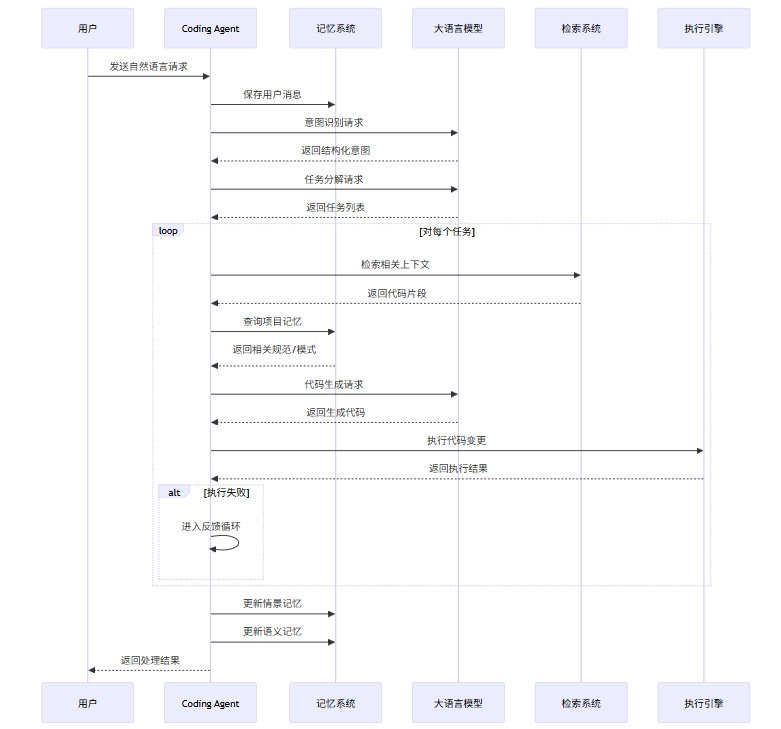
图 9-1:Coding Agent 使用流程时序图
10. 总结与展望
本节核心技术价值
本节为你提供的核心价值是建立对 Coding Agent 未来发展的前瞻认知,理解当前架构的局限性以及可能的演进方向,为读者在 AI IDE 领域的持续探索提供指引。
10.1 架构总结
本文构建的 Coding Agent 核心引擎包含以下核心组件:
组件 | 职责 | 关键实现 |
|---|---|---|
任务理解引擎 | 意图识别、实体提取、任务分解 | 基于 LLM + Few-shot Learning |
混合检索系统 | 多策略检索、结果融合 | BM25 + 语义向量 + RRF 融合 |
代码生成管道 | Prompt 模板、LLM 调用、输出验证 | 多级重试 + 验证机制 |
执行反馈循环 | 语法验证、测试执行、人工确认 | 状态机驱动的反馈处理 |
三层记忆体系 | 工作/情景/语义记忆 | 文件持久化 + 统一访问接口 |
调度编排层 | 状态管理、任务协调、组件调度 | 状态机 + 事件驱动 |
10.2 已知局限
当前实现存在以下局限:
- 检索精度:BM25 检索器使用简单分词,对代码语义理解有限
- 执行安全:缺少沙箱机制,直接修改文件系统存在风险
- 并行化:任务调度器仅支持有限并发,未充分利用资源
- 记忆压缩:三层记忆间的同步和压缩机制尚未实现
10.3 未来演进方向
方向 | 描述 | 预期收益 |
|---|---|---|
多 Agent 协作 | 引入专门的规划 Agent、执行 Agent、审查 Agent | 复杂任务处理能力提升 |
持续学习 | 从用户反馈中自动更新检索和生成模型 | 个性化体验持续优化 |
代码血缘追踪 | 完整的依赖分析和变更影响评估 | 变更安全性提升 |
多模态交互 | 支持语音、图表等非文本交互方式 | 用户体验改善 |
分布式架构 | 支持多实例协同,支持云端部署 | 可扩展性和可用性提升 |
10.4 参考架构对比
架构 | 代表系统 | 特点 | 与本文对比 |
|---|---|---|---|
单 Agent | GitHub Copilot | 实时补全、低延迟 | 本文采用,更适合复杂任务 |
多 Agent | AutoGPT、LangChain Agent | 任务分解、自主规划 | 本文的编排层支持扩展 |
知识增强 | RAG + Agent | 结合外部知识库 | 本文的三层记忆提供类似能力 |
参考链接
- 主要来源:Microsoft Copilot - AI-powered coding assistant - 微软 AI 编程助手的架构参考
- 主要来源:LangChain Agent Framework - Agent 框架设计参考
- 主要来源:OpenAI Function Calling - 结构化输出规范
- 主要来源:BM25 Retrieval Algorithm - BM25 算法原理
附录(Appendix):
附录 A:核心数据模型完整代码
详见第 2 节完整代码,实现的所有 Pydantic 模型定义。
附录 B:意图识别器完整代码
详见第 3 节完整代码,实现的 IntentRecognizer 和 TaskDecomposer 类。
附录 C:检索系统完整代码
详见第 4 节完整代码,实现的 BaseRetriever、SemanticRetriever、KeywordRetriever、HybridRetriever 和 ContextBuilder 类。
附录 D:代码生成管道完整代码
详见第 5 节完整代码,实现的 CodeGenerator 和 GenerationResult 类。
附录 E:执行引擎完整代码
详见第 6 节完整代码,实现的 ExecutionEngine 和 FeedbackLoop 类。
附录 F:三层记忆完整代码
详见第 7 节完整代码,实现的 BaseMemoryStore、WorkingMemoryManager、EpisodicMemoryManager、SemanticMemoryManager 和 UnifiedMemoryManager 类。
附录 G:调度编排层完整代码
详见第 8 节完整代码,实现的 AgentState、AgentContext、AgentOrchestrator 和 TaskScheduler 类。
附录 H:完整 Agent 集成代码
详见第 9 节完整代码,实现的 create_coding_agent 工厂函数和 main 演示函数。
关键词: Coding Agent、AI IDE、大语言模型、意图识别、混合检索、BM25、语义向量、Prompt 工程、代码生成、执行引擎、反馈循环、三层记忆体系、工作记忆、情景记忆、语义记忆、状态机、任务调度、Agent 架构、RAG、LLM、GPT-4
本文参与 腾讯云自媒体同步曝光计划,分享自作者个人站点/博客。
原始发表:2026-05-26,如有侵权请联系 cloudcommunity@tencent.com 删除
评论
登录后参与评论
推荐阅读
目录
腾讯云开发者

Copyright © 2013 - 2026 Tencent Cloud. All Rights Reserved. 腾讯云 版权所有
深圳市腾讯计算机系统有限公司 ICP备案/许可证号:粤B2-20090059  粤公网安备44030502008569号
腾讯云计算(北京)有限责任公司 京ICP证150476号 | 京ICP备11018762号