postgres_fdw优化案例--GUC控制join pushdown

postgres_fdw优化案例--GUC控制join pushdown

NickYoung
发布于 2026-07-09 16:25:27
发布于 2026-07-09 16:25:27
前阵子同事小帅找到老杨,说一个跨库访问的sql运行很慢,慢得就像找女朋友的节奏一样。经过诊断发现是joinclause没有按预期pushdown到remote,导致性能差。
本篇我们透过现象看本质,从案例出发,深入剖析postgres_fdw中join及clause pushdown的原理。并且老杨对这里进行了优化,当join pushdown性能糟糕时,我们能够直接禁用join pushdown。
顺便提一下,分析fdw sql性能问题,就看执行计划, 使用explain verbose确认remote sql是否符合预期。
本文依然很长,还是希望感兴趣的老铁能耐心看完。
有朋友“吐槽”公众号的文章比较长,基本不想看。 这里解释下,老杨之前就讲过做公众号的目的:一是给自己做案例记录,二是给大家分享技术原理。因此我得“记得清楚”,“讲得明白”。原理加实验确实篇幅就过长了,可能也是老杨目前的“抽象”能力不够,还望大家多多担待。
一、 问题现象
两个外表关联查询203490ms。
postgres=> explain (analyze,verbose) select distinct a.sid,a.ip,a.port,a.type from tbl a join inf b on a.sid::text=b.id::text where a.ext=1;
                                                                QUERY PLAN
-------------------------------------------------------------------------------------------------------------------------------------------
 Unique  (cost=452.77..452.86 rows=1 width=328) (actual time=203472.078..203472.100 rows=28 loops=1)
   Output: a.sid, a.ip, a.port, a.type
   ->  Sort  (cost=452.77..452.79 rows=7 width=328) (actual time=203472.076..203472.080 rows=28 loops=1)
         Output: a.sid, a.ip, a.port, a.type
         Sort Key: a.sid, a.ip, a.port, a.type
         Sort Method: quicksort  Memory: 26kB
         ->  Foreign Scan  (cost=100.00..452.68 rows=7 width=328) (actual time=25657.993..203471.879 rows=28 loops=1)
               Output: a.sid, a.ip, a.port, a.type
               Filter: ((a.sid)::text = (b.id)::text)
               Rows Removed by Filter: 50474621
               Relations: (public.tbl a) INNER JOIN (public.inf b)
               Remote SQL: SELECT r1.sid, r1.ip, r1.port, r1.type, r2.id FROM (public.tbl r1 INNERJOIN public.inf r2 ON (((r1.ext = 1))))
 Planning Time: 0.256 ms
 Execution Time: 203489.909 ms
(14rows)

postgres=>
这两个外表映射对应的实际表在同一remote,在remote库本地执行sql仅17ms。
testdb=> explain analyze select distinct a.sid,a.ip,a.port,a.type from tbl a join inf b on a.sid::text=b.id::text where a.ext=1;
                                                                   QUERY PLAN
-------------------------------------------------------------------------------------------------------------------------------------------------
 Unique  (cost=24036.30..24198.05 rows=1294 width=34) (actual time=16.465..17.169 rows=28 loops=1)
   ->  Gather Merge  (cost=24036.30..24185.11rows=1294 width=34) (actual time=16.464..17.152rows=28 loops=1)
         Workers Planned: 1
         Workers Launched: 1
         ->  Sort  (cost=23036.29..23039.52rows=1294 width=34) (actual time=13.913..13.917rows=14 loops=2)
               SortKey: a.sid, a.ip, a.port, a.type
               Sort Method: quicksort  Memory: 25kB
               Worker 0:  Sort Method: quicksort  Memory: 25kB
               ->  HashAggregate  (cost=22956.46..22969.40rows=1294 width=34) (actual time=13.835..13.853rows=14 loops=2)
                     GroupKey: a.sid, a.ip, a.port, a.type
                     Batches: 1MemoryUsage: 73kB
                     Worker 0:  Batches: 1MemoryUsage: 73kB
                     ->  HashJoin  (cost=94.34..21471.91rows=148455 width=34) (actual time=5.451..13.809rows=14 loops=2)
                           Hash Cond: ((b.id)::text = (a.sid)::text)
                           ->  Parallel Seq Scanon inf b  (cost=0.00..1260.92rows=17292 width=4) (actual time=0.007..2.763rows=14698 loops=2)
                           ->  Hash  (cost=72.88..72.88rows=1717 width=34) (actual time=2.448..2.448rows=1717 loops=2)
                                 Buckets: 2048  Batches: 1MemoryUsage: 133kB
                                 ->  Seq Scanon tbl a  (cost=0.00..72.88rows=1717 width=34) (actual time=0.016..1.169rows=1717 loops=2)
                                       Filter: (ext = 1)
                                       Rows Removed by Filter: 1633
 Planning Time: 0.242 ms
 Execution Time: 17.311 ms
(22rows)
跨库访问和本地执行性能相差10000倍,网络问题?
莫慌,从执行计划来看有所不同。重点关注fdw跨库访问的执行计划,我使用了explain verbose打印出了remote sql。 发现两表inner join是直接pushdown到了remote,但是joinclause不符合预期,a.sid::text=b.id::text没有pushdown,而变为了local filter,原本whereclause(r1.ext = 1)变为了joinclause。
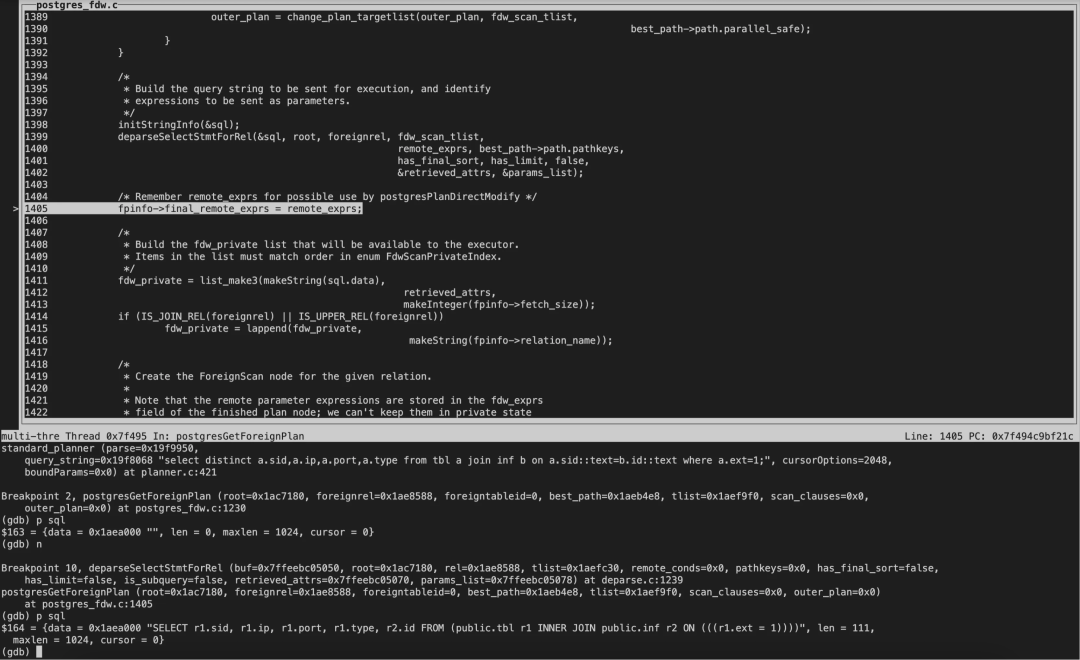
remote sql: SELECT r1.sid, r1.ip, r1.port, r1.type, r2.id FROM (public.tbl r1 INNER JOIN public.inf r2 ON (((r1.ext = 1))))
joinclause都变了,join执行操作的结果集和过程肯定有差别了。从执行计划也能看出来,扫描了更多数据所以这个remote sql执行的慢。因为a.sid::text=b.id::text作为了本地过滤条件,所以最终结果是相同的。
为什么原本的joinclause没有pushdown?
二、原理分析
简述下postgres_fdw的原理:
在local实例中,创建好postgres_fdw和foreign table,以及user mapping。执行query查询foreign table访问remote端,这里并不是简单粗暴地将sql下推到remote执行。
1、local stmt要经过fdw的deparse处理,主要是判断joinclause和whereclause,limit ,sort等是否可以pushdown到remote;
2、根据deparse的结果,生成Foreign scan的路径,结合本地计划节点,生成整体的执行计划;
3、执行器,按照Foreign scan在remote执行,fetch结果返回给local,local端继续执行剩余计划节点,返回最终结果。
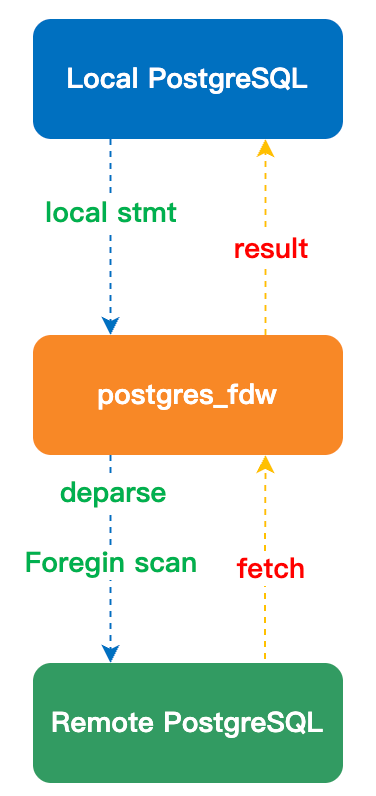
再回到这个case,joinclause a.sid::text=b.id::text为什么没有pushdown到remote?
whereclause a.ext=1为什么被pushdown到remote作为了joinclause?
1、首先我们看下join pushdown的原理
并不是任意join都可以pushdown到remote,当不能pushdown到remote时,一般是每个外表生成一个Foreign scan,获取数据到本地再做join。
什么情况下join可以pushdown到remote?主要是foreign_join_ok[1]函数的逻辑控制,当函数return false时不可pushdown。
可pushdown:
1)支持的类型有INNER, LEFT, RIGHT, FULL OUTER and SEMI joins
2)对于semi join在reltarget安全的情况下才可下推
3)并且inner和outer都要是标记为safe的情况下
4)并且inner和outer的local_conds为NUll
5)并且joinclause经过is_foreign_expr函数验证is_remote_clause为true时可作为remote_conds;
对于outer join,rinfo->is_push_down为true且rinfo->required_relids是joinrel->relids的子集,并且is_remote_clause为true,则可下推。
6)对于PlaceHolder,如果phinfo->ph_eval_at不是relids的子集,且relids的set不大于phinfo->ph_eval_at,也就是两者相同时则可下推。
static bool
foreign_join_ok(PlannerInfo *root, RelOptInfo *joinrel, JoinType jointype,
    RelOptInfo *outerrel, RelOptInfo *innerrel,
    JoinPathExtraData *extra)
{
 PgFdwRelationInfo *fpinfo;
 PgFdwRelationInfo *fpinfo_o;
 PgFdwRelationInfo *fpinfo_i;
 ListCell   *lc;
 List    *joinclauses;

/* 1)
  * We support pushing down INNER, LEFT, RIGHT, FULL OUTER and SEMI joins.
  * Constructing queries representing ANTI joins is hard, hence not
  * considered right now.
  */
if (jointype != JOIN_INNER && jointype != JOIN_LEFT &&
  jointype != JOIN_RIGHT && jointype != JOIN_FULL &&
  jointype != JOIN_SEMI)
return false;

/* 2)
  * We can't push down semi-join if its reltarget is not safe
  */
if ((jointype == JOIN_SEMI) && !semijoin_target_ok(root, joinrel, outerrel, innerrel))
return false;

/* 3)
  * If either of the joining relations is marked as unsafe to pushdown, the
  * join can not be pushed down.
  */
 fpinfo = (PgFdwRelationInfo *) joinrel->fdw_private;
 fpinfo_o = (PgFdwRelationInfo *) outerrel->fdw_private;
 fpinfo_i = (PgFdwRelationInfo *) innerrel->fdw_private;
if (!fpinfo_o || !fpinfo_o->pushdown_safe ||
  !fpinfo_i || !fpinfo_i->pushdown_safe)
return false;

/* 4)
  * If joining relations have local conditions, those conditions are
  * required to be applied before joining the relations. Hence the join can
  * not be pushed down.
  */
if (fpinfo_o->local_conds || fpinfo_i->local_conds)
return false;

/*省略*/
/* 5) */
 joinclauses = NIL;
 foreach(lc, extra->restrictlist)
 {
  RestrictInfo *rinfo = lfirst_node(RestrictInfo, lc);
bool  is_remote_clause = is_foreign_expr(root, joinrel,
                rinfo->clause);

if (IS_OUTER_JOIN(jointype) &&
   !RINFO_IS_PUSHED_DOWN(rinfo, joinrel->relids))
  {
   if (!is_remote_clause)
    return false;
   joinclauses = lappend(joinclauses, rinfo);
  }
else
  {
   if (is_remote_clause)
    fpinfo->remote_conds = lappend(fpinfo->remote_conds, rinfo);
   else
    fpinfo->local_conds = lappend(fpinfo->local_conds, rinfo);
  }
 }
 /* 6) */
 /*
  * deparseExplicitTargetList() isn't smart enough to handle anything other
  * than a Var.  In particular, if there's some PlaceHolderVar that would
  * need to be evaluated within this join tree (because there's an upper
  * reference to a quantity that may go to NULL as a result of an outer
  * join), then we can't try to push the join down because we'll fail when
  * we get to deparseExplicitTargetList().  However, a PlaceHolderVar that
  * needs to be evaluated *at the top* of this join tree is OK, because we
  * can do that locally after fetching the results from the remote side.
  */
 foreach(lc, root->placeholder_list)
 {
  PlaceHolderInfo *phinfo = lfirst(lc);
  Relids  relids;

/* PlaceHolderInfo refers to parent relids, not child relids. */
  relids = IS_OTHER_REL(joinrel) ?
   joinrel->top_parent_relids : joinrel->relids;

if (bms_is_subset(phinfo->ph_eval_at, relids) &&
   bms_nonempty_difference(relids, phinfo->ph_eval_at))
   return false;
 }

/* 省略 */
}
以上是join可pushdown的一些客观条件。但最终执行计划,一定会将join pushdown到remote吗?
当然不是,为什么呢?其实很简单,我们都知道优化器选择计划的顶层逻辑就是“最小代价”预估。最优代价不一定是join pushdown对应的计划,所以实际是否使用pushdown的路径还是要看cost。
从add_paths_to_joinrel[2]函数来看首先是生成Nestloop、Mergejoin、Hashjoin等,当然这里是对每个外表的Foreign scan做local join。等这里路径生成后,最后再进入hook,调用fdw函数fdwroutine->GetForeignJoinPaths,看join是否可以下推。在add_path时会进行cost比较,决定着ForeignJoinPath是否保留,set_cheapest确定最优计划。
void
add_paths_to_joinrel(PlannerInfo *root,
      RelOptInfo *joinrel,
      RelOptInfo *outerrel,
      RelOptInfo *innerrel,
      JoinType jointype,
      SpecialJoinInfo *sjinfo,
      List *restrictlist)
{
 JoinPathExtraData extra;
bool  mergejoin_allowed = true;
 ListCell   *lc;
 Relids  joinrelids;

 /* 省略 */
 /*
  * Find potential mergejoin clauses.  We can skip this if we are not
  * interested in doing a mergejoin.  However, mergejoin may be our only
  * way of implementing a full outer join, so override enable_mergejoin if
  * it's a full join.
  */
if (enable_mergejoin || jointype == JOIN_FULL)
  extra.mergeclause_list = select_mergejoin_clauses(root,
                joinrel,
                outerrel,
                innerrel,
                restrictlist,
                jointype,
                &mergejoin_allowed);

 /*
  * If it's SEMI, ANTI, or inner_unique join, compute correction factors
  * for cost estimation.  These will be the same for all paths.
  */
if (jointype == JOIN_SEMI || jointype == JOIN_ANTI || extra.inner_unique)
  compute_semi_anti_join_factors(root, joinrel, outerrel, innerrel,
            jointype, sjinfo, restrictlist,
            &extra.semifactors);
/* 省略 */

 /*
  * 1. Consider mergejoin paths where both relations must be explicitly
  * sorted.  Skip this if we can't mergejoin.
  */
if (mergejoin_allowed)
  sort_inner_and_outer(root, joinrel, outerrel, innerrel,
        jointype, &extra);

 /*
  * 2. Consider paths where the outer relation need not be explicitly
  * sorted. This includes both nestloops and mergejoins where the outer
  * path is already ordered.  Again, skip this if we can't mergejoin.
  * (That's okay because we know that nestloop can't handle
  * right/right-anti/full joins at all, so it wouldn't work in the
  * prohibited cases either.)
  */
if (mergejoin_allowed)
  match_unsorted_outer(root, joinrel, outerrel, innerrel,
        jointype, &extra);
/* 省略 */
#ifdef NOT_USED

 /*
  * 3. Consider paths where the inner relation need not be explicitly
  * sorted.  This includes mergejoins only (nestloops were already built in
  * match_unsorted_outer).
  *
  * Diked out as redundant 2/13/2000 -- tgl.  There isn't any really
  * significant difference between the inner and outer side of a mergejoin,
  * so match_unsorted_inner creates no paths that aren't equivalent to
  * those made by match_unsorted_outer when add_paths_to_joinrel() is
  * invoked with the two rels given in the other order.
  */
if (mergejoin_allowed)
  match_unsorted_inner(root, joinrel, outerrel, innerrel,
        jointype, &extra);
#endif

 /*
  * 4. Consider paths where both outer and inner relations must be hashed
  * before being joined.  As above, disregard enable_hashjoin for full
  * joins, because there may be no other alternative.
  */
if (enable_hashjoin || jointype == JOIN_FULL)
  hash_inner_and_outer(root, joinrel, outerrel, innerrel,
        jointype, &extra);

 /*
  * 5. If inner and outer relations are foreign tables (or joins) belonging
  * to the same server and assigned to the same user to check access
  * permissions as, give the FDW a chance to push down joins.
  */
if (joinrel->fdwroutine &&
  joinrel->fdwroutine->GetForeignJoinPaths)
  joinrel->fdwroutine->GetForeignJoinPaths(root, joinrel,
             outerrel, innerrel,
             jointype, &extra);

 /*
  * 6. Finally, give extensions a chance to manipulate the path list.  They
  * could add new paths (such as CustomPaths) by calling add_path(), or
  * add_partial_path() if parallel aware.  They could also delete or modify
  * paths added by the core code.
  */
if (set_join_pathlist_hook)
  set_join_pathlist_hook(root, joinrel, outerrel, innerrel,
          jointype, &extra);
}
2、我们接着看原本的joinclause为什么没有pushdown
在之前join pushdown条件的第5)点,我们提到了joinclause经过is_foreign_expr函数验证is_remote_clause为true时可作为remote_conds那么关键就在于is_foreign_expr[3]函数。
1)foreign_expr_walker[4]函数check当前joinclause为不安全的expr时,返回false,不可下推;这里的场景相对比较复杂,对于不同的expr type有不同的安全判断逻辑。
对于我们这个case来说,由于expr nodetag为T_CoerceViaIO,这是一种类型转换机制,当PostgreSQL需要在两种数据类型之间进行转换,但没有直接的转换函数时,会使用这种转换方式。
而foreign_expr_walker对T_CoerceViaIO直接走default分支,返回false,不可下推。 我们这里的a.sid::text=b.id::text是numeric强转text。
2)如果expr具有有效的排序规则,且该排序规则不是来自外部变量,则不可下推;
3)如果expr包含可变函数则不可下推,比如now()函数,发送到远程端可能会因时钟偏移而造成混淆。
bool
is_foreign_expr(PlannerInfo *root,
    RelOptInfo *baserel,
    Expr *expr)
{
 foreign_glob_cxt glob_cxt;
 foreign_loc_cxt loc_cxt;
 PgFdwRelationInfo *fpinfo = (PgFdwRelationInfo *) (baserel->fdw_private);

 /*
  * Check that the expression consists of nodes that are safe to execute
  * remotely.
  */
 glob_cxt.root = root;
 glob_cxt.foreignrel = baserel;

 /*
  * For an upper relation, use relids from its underneath scan relation,
  * because the upperrel's own relids currently aren't set to anything
  * meaningful by the core code.  For other relation, use their own relids.
  */
if (IS_UPPER_REL(baserel))
  glob_cxt.relids = fpinfo->outerrel->relids;
else
  glob_cxt.relids = baserel->relids;
 loc_cxt.collation = InvalidOid;
 loc_cxt.state = FDW_COLLATE_NONE;
/* 1) */
if (!foreign_expr_walker((Node *) expr, &glob_cxt, &loc_cxt, NULL))
return false;

 /*
  * If the expression has a valid collation that does not arise from a
  * foreign var, the expression can not be sent over.
  */
 /* 2) */
if (loc_cxt.state == FDW_COLLATE_UNSAFE)
return false;

 /*
  * An expression which includes any mutable functions can't be sent over
  * because its result is not stable.  For example, sending now() remote
  * side could cause confusion from clock offsets.  Future versions might
  * be able to make this choice with more granularity.  (We check this last
  * because it requires a lot of expensive catalog lookups.)
  */
/* 3) */
if (contain_mutable_functions((Node *) expr))
return false;

/* OK to evaluate on the remote server */
return true;
}
3、为什么whereclause会被作为新的joinclause pushdown到remote
这里foreign_join_ok[5]函数中做了介绍。
为了避免在每个连接步骤中构建子查询, 尽可能将参与join表中的其他远程条件添加到rel的joinclause或其他远程子句(remote_conds)中。
对于内连接,所有限制都可以同等处理。将下推的条件视为连接条件,可以解析顶层全外连接,而无需子查询。
所以本应该a.sid::text = b.id::text和a.ext=1都有机会一起作为joinclause pushdown到remote,但是只有a.ext=1可下推,因此就只保留了a.ext=1。
static bool
foreign_join_ok(PlannerInfo *root, RelOptInfo *joinrel, JoinType jointype,
    RelOptInfo *outerrel, RelOptInfo *innerrel,
    JoinPathExtraData *extra)
{
/* 省略 */
/*
  * Pull the other remote conditions from the joining relations into join
  * clauses or other remote clauses (remote_conds) of this relation
  * wherever possible. This avoids building subqueries at every join step.
  *
  * For an inner join, clauses from both the relations are added to the
  * other remote clauses. For LEFT and RIGHT OUTER join, the clauses from
  * the outer side are added to remote_conds since those can be evaluated
  * after the join is evaluated. The clauses from inner side are added to
  * the joinclauses, since they need to be evaluated while constructing the
  * join.
  *
  * For SEMI-JOIN clauses from inner relation can not be added to
  * remote_conds, but should be treated as join clauses (as they are
  * deparsed to EXISTS subquery, where inner relation can be referred). A
  * list of relation ids, which can't be referred to from higher levels, is
  * preserved as a hidden_subquery_rels list.
  *
  * For a FULL OUTER JOIN, the other clauses from either relation can not
  * be added to the joinclauses or remote_conds, since each relation acts
  * as an outer relation for the other.
  *
  * The joining sides can not have local conditions, thus no need to test
  * shippability of the clauses being pulled up.
  */
      switch (jointype)
      {
          case JOIN_INNER:
              fpinfo->remote_conds = list_concat(fpinfo->remote_conds,
                                                 fpinfo_i->remote_conds);
              fpinfo->remote_conds = list_concat(fpinfo->remote_conds,
                                                 fpinfo_o->remote_conds);
              break;

          case JOIN_LEFT:

              /*
               * When semi-join is involved in the inner or outer part of the
               * left join, it's deparsed as a subquery, and we can't refer to
               * its vars on the upper level.
               */
              if (bms_is_empty(fpinfo_i->hidden_subquery_rels))
                  fpinfo->joinclauses = list_concat(fpinfo->joinclauses,
                                                    fpinfo_i->remote_conds);
              if (bms_is_empty(fpinfo_o->hidden_subquery_rels))
                  fpinfo->remote_conds = list_concat(fpinfo->remote_conds,
                                                     fpinfo_o->remote_conds);
              break;

          case JOIN_RIGHT:

              /*
               * When semi-join is involved in the inner or outer part of the
               * right join, it's deparsed as a subquery, and we can't refer to
               * its vars on the upper level.
               */
              if (bms_is_empty(fpinfo_o->hidden_subquery_rels))
                  fpinfo->joinclauses = list_concat(fpinfo->joinclauses,
                                                    fpinfo_o->remote_conds);
              if (bms_is_empty(fpinfo_i->hidden_subquery_rels))
                  fpinfo->remote_conds = list_concat(fpinfo->remote_conds,
                                                     fpinfo_i->remote_conds);
              break;

          case JOIN_SEMI:
              fpinfo->joinclauses = list_concat(fpinfo->joinclauses,
                                                fpinfo_i->remote_conds);
              fpinfo->joinclauses = list_concat(fpinfo->joinclauses,
                                                fpinfo->remote_conds);
              fpinfo->remote_conds = list_copy(fpinfo_o->remote_conds);
              fpinfo->hidden_subquery_rels = bms_union(fpinfo->hidden_subquery_rels,
                                                       innerrel->relids);
              break;

          case JOIN_FULL:

              /*
               * In this case, if any of the input relations has conditions, we
               * need to deparse that relation as a subquery so that the
               * conditions can be evaluated before the join.  Remember it in
               * the fpinfo of this relation so that the deparser can take
               * appropriate action.  Also, save the relids of base relations
               * covered by that relation for later use by the deparser.
               */
              if (fpinfo_o->remote_conds)
              {
                  fpinfo->make_outerrel_subquery = true;
                  fpinfo->lower_subquery_rels =
                      bms_add_members(fpinfo->lower_subquery_rels,
                                      outerrel->relids);
              }
              if (fpinfo_i->remote_conds)
              {
                  fpinfo->make_innerrel_subquery = true;
                  fpinfo->lower_subquery_rels =
                      bms_add_members(fpinfo->lower_subquery_rels,
                                      innerrel->relids);
              }
              break;

          default:
              /* Should not happen, we have just checked this above */
              elog(ERROR, "unsupported join type %d", jointype);
      }

      /*
       * For an inner join, all restrictions can be treated alike. Treating the
       * pushed down conditions as join conditions allows a top level full outer
       * join to be deparsed without requiring subqueries.
       */
      if (jointype == JOIN_INNER)
      {
          Assert(!fpinfo->joinclauses);
          fpinfo->joinclauses = fpinfo->remote_conds;
          fpinfo->remote_conds = NIL;
      }
   /* 省略 */
   /*
  * Set the string describing this join relation to be used in EXPLAIN
  * output of corresponding ForeignScan.  Note that the decoration we add
  * to the base relation names mustn't include any digits, or it'll confuse
  * postgresExplainForeignScan.
  */
 fpinfo->relation_name = psprintf("(%s) %s JOIN (%s)",
          fpinfo_o->relation_name,
          get_jointype_name(fpinfo->jointype),
          fpinfo_i->relation_name);

 /*
  * Set the relation index.  This is defined as the position of this
  * joinrel in the join_rel_list list plus the length of the rtable list.
  * Note that since this joinrel is at the end of the join_rel_list list
  * when we are called, we can get the position by list_length.
  */
 Assert(fpinfo->relation_index == 0); /* shouldn't be set yet */
 fpinfo->relation_index =
  list_length(root->parse->rtable) + list_length(root->join_rel_list);

return true;
/* 省略 */
}
到这里,join和clause pushdown的原理就清楚了。
问题也清晰了,由于join条件的类型转换,导致inner join时原本join条件没有pushdown,其他的clause被下推为joinclause,检索了更多数据,导致性能差。
为什么会搞类型转换?业务之前有套PG业务用mysql_fdw去拉mysql数据进行分析,mysql表中有个timestamp字段default值为"0000-00-00 00:00:00",这个值在PG中是非法的,不转换类型查询外表就报错,所以干脆搞外表时这个字段建成text类型了。所以他们后来就经常搞类型转换。
三、老杨视角
问题比较清晰了,再简单回顾下join pushdown的原理。 postgres_fdw对于inner join,所有限制都可以同等处理。将下推的所有条件视为连接条件,可以解析顶层全外连接,而无需子查询。
看似是为了优化,但实际上如果原本joinclause没有下推,而将其他条件下推为joinclause,检索了更多数据,就会导致性能劣化。
所以当join pushdown到remote性能比较糟糕时,我们只能动业务?改sql,改外表?
不要轻易say yes,要大胆say no!!!
如下框图描述: 当foreign_join_ok返回true时,才会调用create_foreign_join_path生成ForeignJoinPath。然后和MergePath,NestPath,HashPath进行cost比较,确定最优计划。
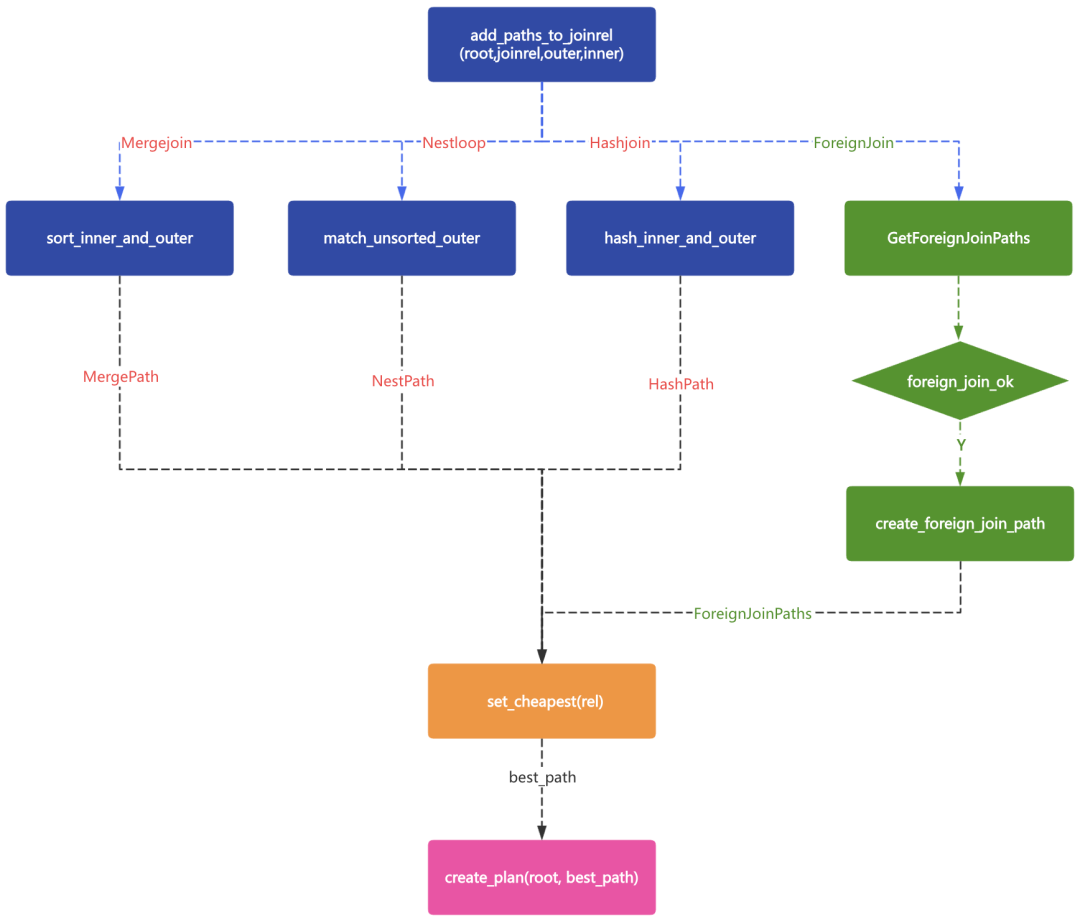
那么当join pushdown到remote性能比较糟糕时,我们不让生成ForeignJoinPath不就行了吗,也就是禁用join pushdown。
方案来了:给postgres_fdw新增GUC “postgres_fdw.is_join_pushdown”,默认为true,当为false时foreign_join_ok直接返回false,这样就不会生成ForeignJoinPath了。
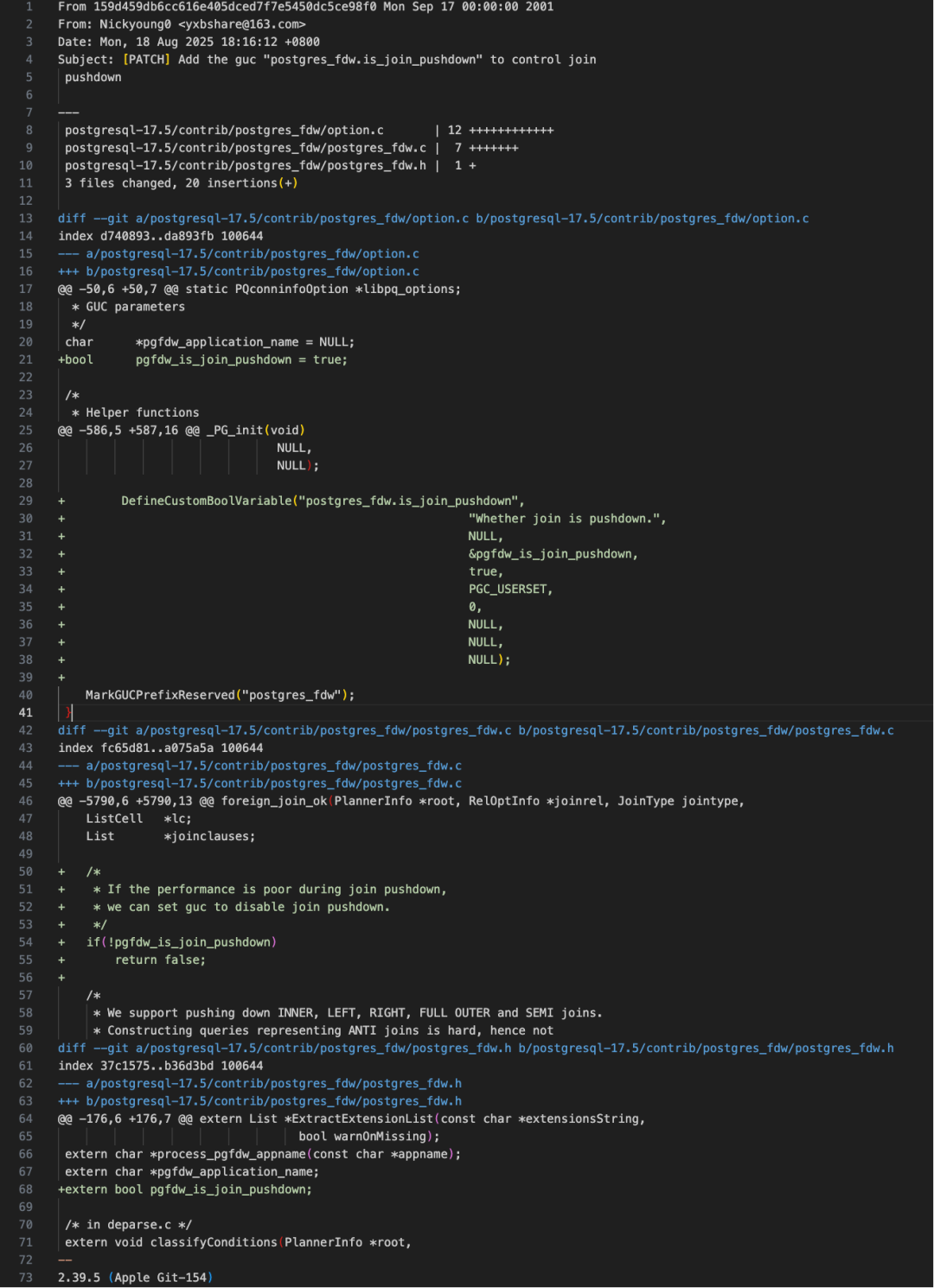
四、测试验证
1、先来看问题复现过程
add_paths_to_joinrel函数中依次生成MergePath、NestPath、HashPath后调用GetForeignJoinPaths准备生成ForeignJoinPaths。
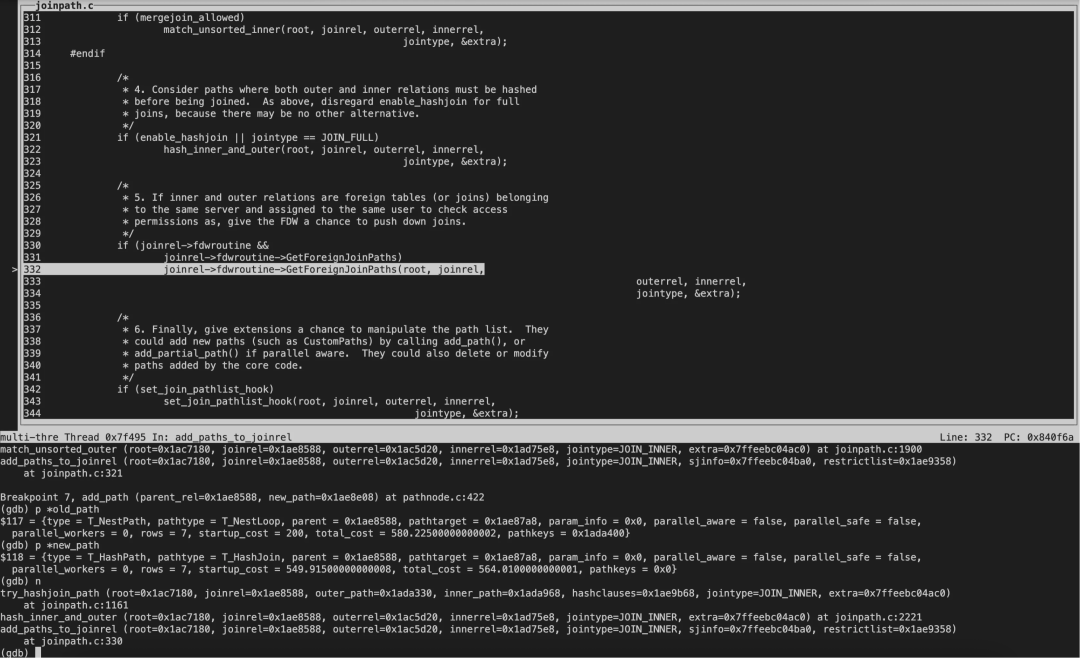
由于joinclause的expr nodetag为T_CoerceViaIO,强制类型转换,命中is_foreign_expr函数default分支,返回false。
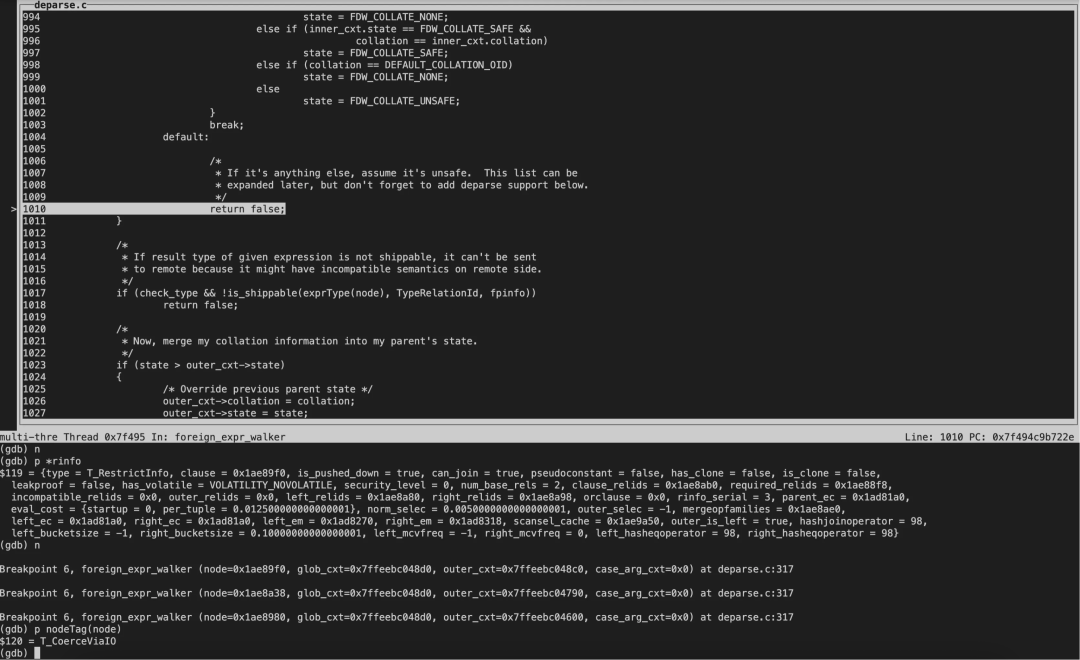
因此is_remote_clause为false。打印当前的clause信息,tree结构看起来不太直观,可以看到对应的opno为98
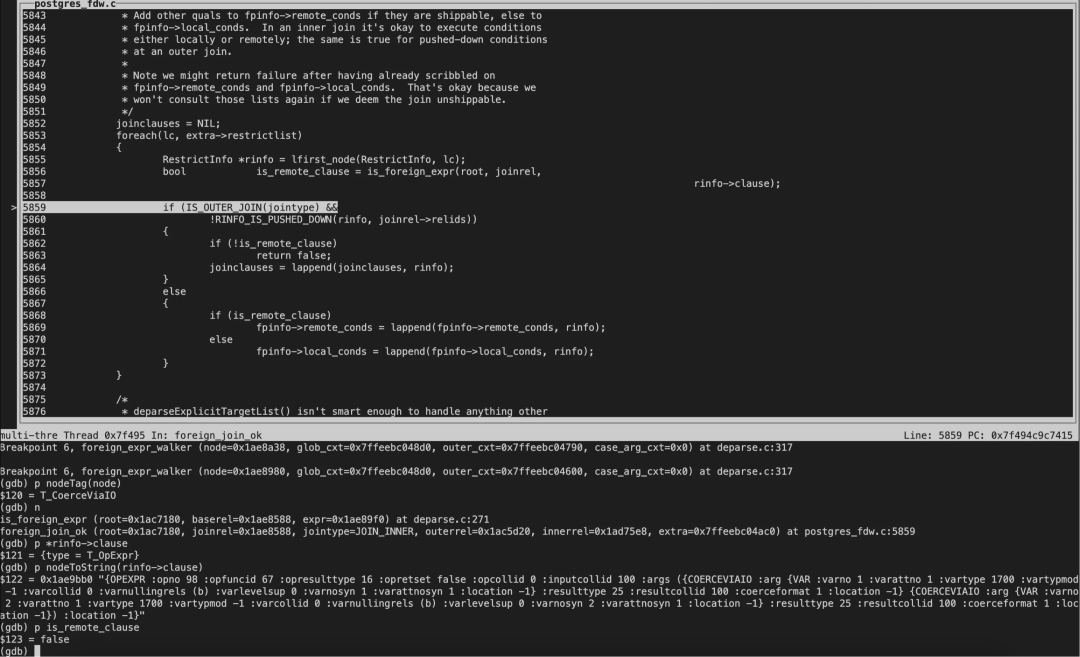
从pg_operator可以得知对应就是left和right做text类型转换后进行等值比较。
postgres=> SELECT oprname, oprcode,oprleft::regtype, oprright::regtype FROM pg_operator WHERE oid =98;
 oprname | oprcode | oprleft | oprright
---------+---------+---------+----------
 =       | texteq  | text    | text
(1 row)

postgres=>
inner的remote_conds为NULL,将outer的remote_conds传递给fpinfo->remote_conds,可以看到opno为96。
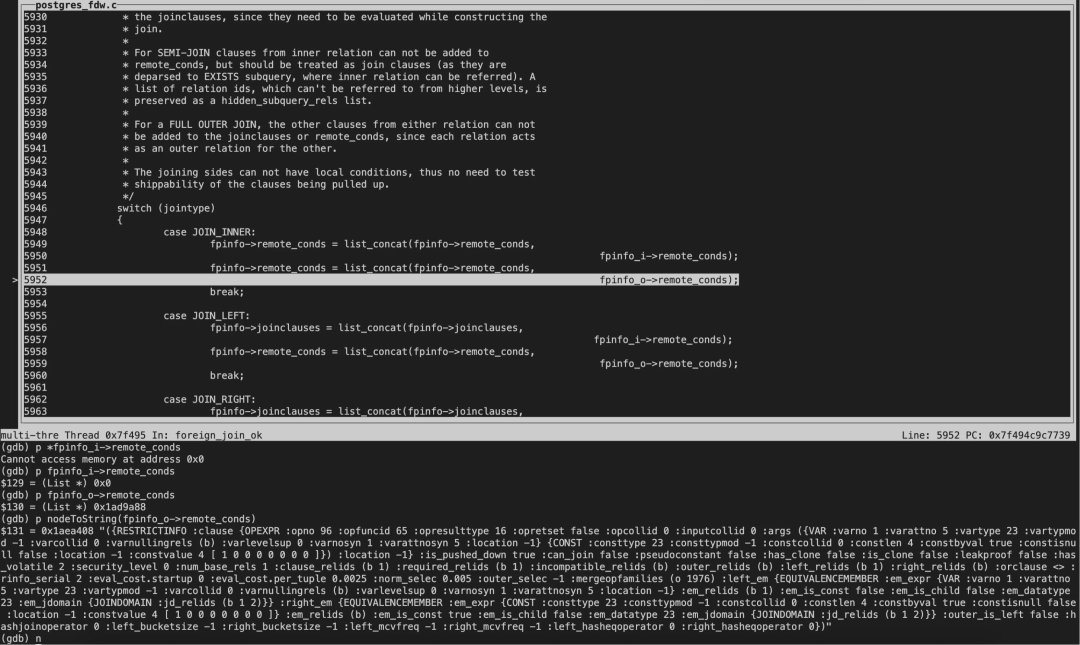
对应是integer类型的等值匹配。即a.ext=1
postgres=> SELECT oprname, oprcode,oprleft::regtype, oprright::regtype FROM pg_operator WHERE oid = 96;
 oprname | oprcode | oprleft | oprright
---------+---------+---------+----------
 =       | int4eq  | integer | integer
(1 row)

postgres=>
这里是inner join,所以将fpinfo->remote_conds传递给fpinfo->joinclauses
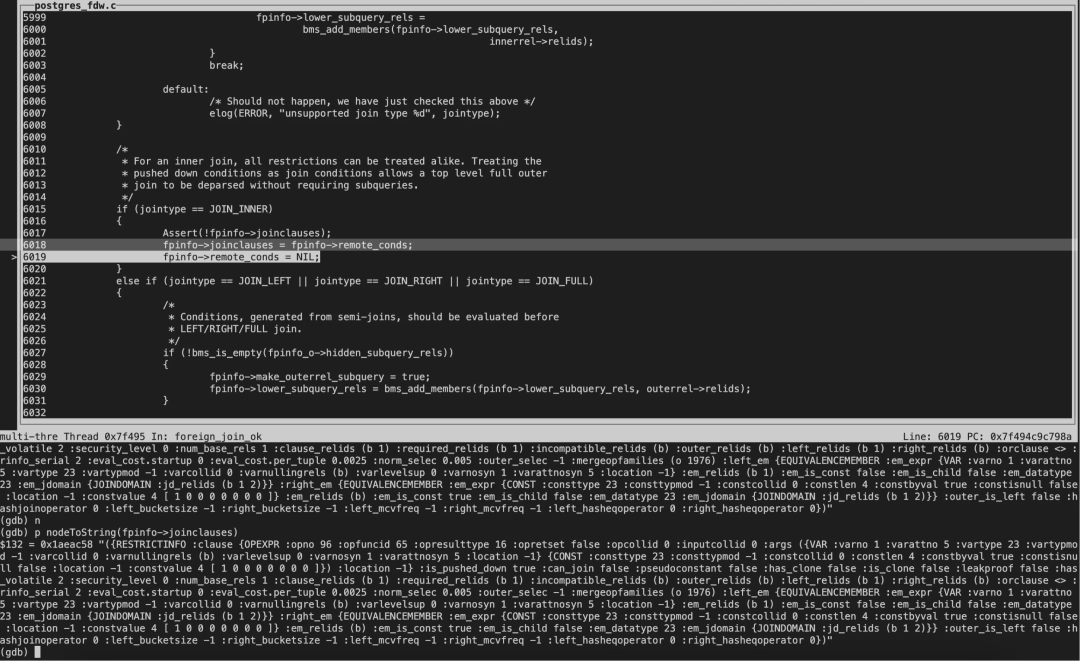
create_foreign_join_path函数创建foreign joinpath。
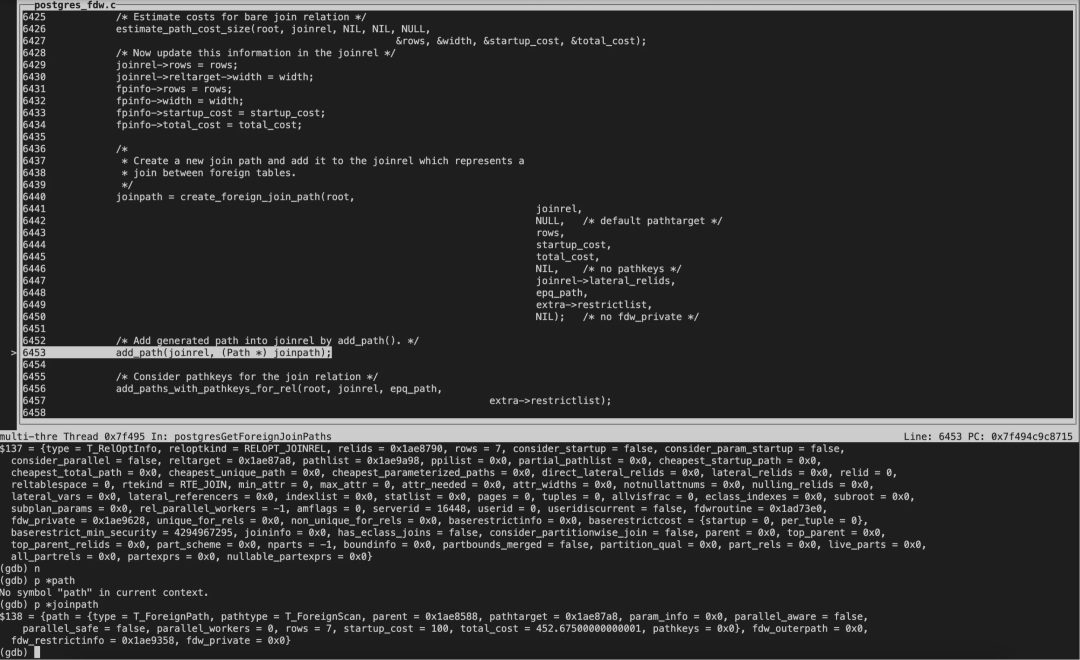
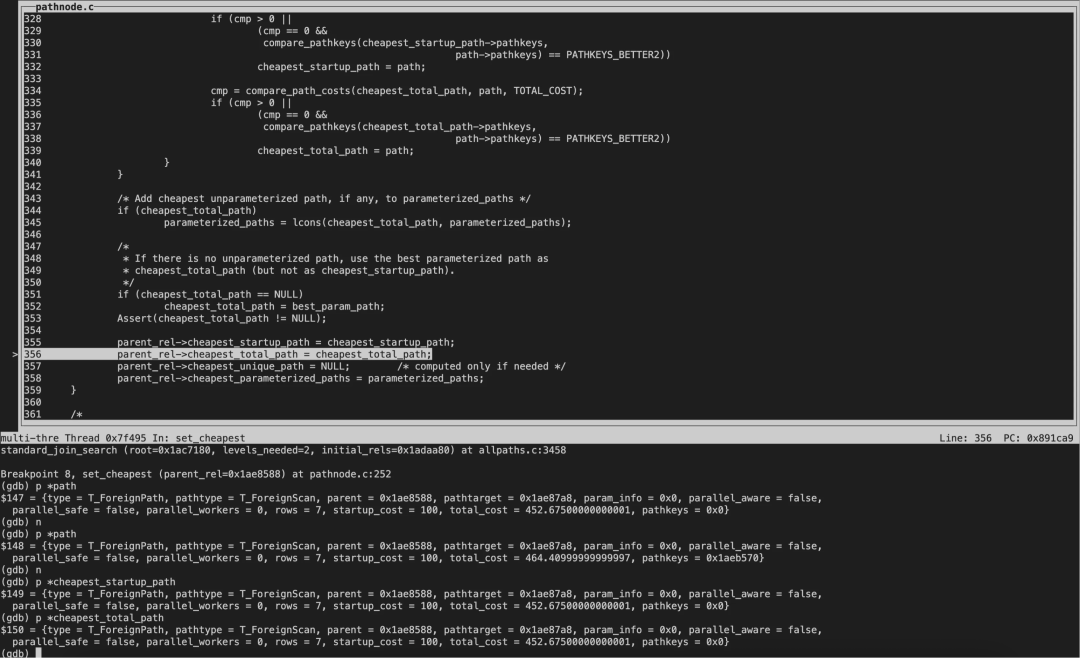
set_cheapest函数经过cost比较,确认join最优路径为foreign joinpath。
可以看到最终的Remote SQL为:SELECT r1.sid, r1.ip, r1.port, r1.type, r2.id FROM (public.tbl r1 INNER JOIN public.inf r2 ON (((r1.ext = 1))))
2、测试下禁用join pushdown效果
postgres_fdw.is_join_pushdown默认为on。复现场景,join成功pushdown,原joinclause转为local filter,whereclause下推为joinclause导致执行过程扫描数据多,耗时222760ms。
postgres=> show postgres_fdw.is_join_pushdown;
 postgres_fdw.is_join_pushdown
-------------------------------
 on
(1 row)

postgres=> explain (verbose,analyze) select distinct a.sid,a.ip,a.port,a.type from tbl a join inf b on a.sid::text = b.id::text where a.ext=1;
                                                                QUERY PLAN
-------------------------------------------------------------------------------------------------------------------------------------------
 Unique  (cost=452.77..452.86 rows=1 width=328) (actual time=222742.200..222742.228 rows=28.00 loops=1)
   Output: a.sid, a.ip, a.port, a.type
   Buffers: shared hit=9
   ->  Sort  (cost=452.77..452.79 rows=7 width=328) (actual time=222742.197..222742.202 rows=28.00 loops=1)
         Output: a.sid, a.ip, a.port, a.type
         Sort Key: a.sid, a.ip, a.port, a.type
         Sort Method: quicksort  Memory: 26kB
         Buffers: shared hit=9
         ->  Foreign Scan  (cost=100.00..452.68 rows=7 width=328) (actual time=27949.156..222741.929 rows=28.00 loops=1)
               Output: a.sid, a.ip, a.port, a.type
               Filter: ((a.sid)::text = (b.id)::text)
               Rows Removed by Filter: 50474621
               Relations: (public.tbl a) INNER JOIN (public.inf b)
               Remote SQL: SELECT r1.sid, r1.ip, r1.port, r1.type, r2.id FROM (public.tbl r1 INNERJOIN public.inf r2 ON (((r1.ext = 1))))
 Planning Time: 0.241 ms
 Execution Time: 222760.342 ms
(16rows)

postgres=>
设置参数,关闭join pushdown,两个Foreign scan扫描remote两个表,最后在local进行inner join,耗时79ms,提升近3000倍。
postgres=> set postgres_fdw.is_join_pushdown to off;
SET
postgres=> explain (verbose,analyze) select distinct a.sid,a.ip,a.port,a.type from tbl a join inf b on a.sid::text = b.id::text where a.ext=1;
                                                                  QUERY PLAN
----------------------------------------------------------------------------------------------------------------------------------------------
 Unique  (cost=557.72..557.81 rows=1 width=328) (actual time=79.539..79.566 rows=28.00 loops=1)
   Output: a.sid, a.ip, a.port, a.type
   ->  Sort  (cost=557.72..557.74 rows=7 width=328) (actual time=79.537..79.544 rows=28.00 loops=1)
         Output: a.sid, a.ip, a.port, a.type
         Sort Key: a.sid, a.ip, a.port, a.type
         Sort Method: quicksort  Memory: 26kB
         ->  Hash Join  (cost=213.12..557.62 rows=7 width=328) (actual time=17.859..79.490 rows=28.00 loops=1)
               Output: a.sid, a.ip, a.port, a.type
               Hash Cond: ((b.id)::text = (a.sid)::text)
               ->  Foreign Scan on public.inf b  (cost=100.00..431.64 rows=1462 width=32) (actual time=0.465..54.815 rows=29397.00 loops=1)
                     Output: b.id
                     Remote SQL: SELECTidFROM public.inf
               ->  Hash  (cost=113.11..113.11rows=1 width=328) (actual time=8.201..8.202rows=1717.00 loops=1)
                     Output: a.sid, a.ip, a.port, a.type
                     Buckets: 2048 (originally 1024)  Batches: 1 (originally 1)  MemoryUsage: 133kB
                     ->  ForeignScanon public.tbl a  (cost=100.00..113.11rows=1 width=328) (actual time=0.575..6.676rows=1717.00 loops=1)
                           Output: a.sid, a.ip, a.port, a.type
                           Remote SQL: SELECTsid, ip, port, typeFROM public.tbl WHERE ((ext = 1))
 Planning Time: 0.236 ms
 Execution Time: 79.839 ms
(20rows)

postgres=>
五、总结
join的pushdown有很多客观条件,但是最终是否采用ForeignJoinPath还是取决于cost是否最优;
对于inner Join所有限制都可以同等处理,将下推的所有条件视为连接条件。如果原本joinclause没有下推,而将其他条件下推为joinclause,检索了更多数据,就会导致性能劣化。
当Join pushdown后性能不理想时,可以考虑通过GUC参数来关闭join pushdown。
Reference
[1]
https://github.com/postgres/postgres/blob/REL_17_5/contrib/postgres_fdw/postgres_fdw.c#L5783
[2]
https://github.com/postgres/postgres/blob/REL_17_5/src/backend/optimizer/path/joinpath.c#L124
[3]
https://github.com/postgres/postgres/blob/REL_17_5/contrib/postgres_fdw/deparse.c#L244
[4]
https://github.com/postgres/postgres/blob/REL_17_5/contrib/postgres_fdw/deparse.c#L312
[5]
https://github.com/postgres/postgres/blob/REL_17_5/contrib/postgres_fdw/postgres_fdw.c#L5922
本文参与 腾讯云自媒体同步曝光计划,分享自微信公众号。
原始发表:2025-08-19,如有侵权请联系 cloudcommunity@tencent.com 删除
目录
腾讯云开发者

Copyright © 2013 - 2026 Tencent Cloud. All Rights Reserved. 腾讯云 版权所有
深圳市腾讯计算机系统有限公司 ICP备案/许可证号:粤B2-20090059  粤公网安备44030502008569号
腾讯云计算(北京)有限责任公司 京ICP证150476号 | 京ICP备11018762号